Connect with us

HTML Image

i

Fiji News

CRC recommends 41 seat Parliament and 19 seat Senate, and guarantees religious freedom

Published

on

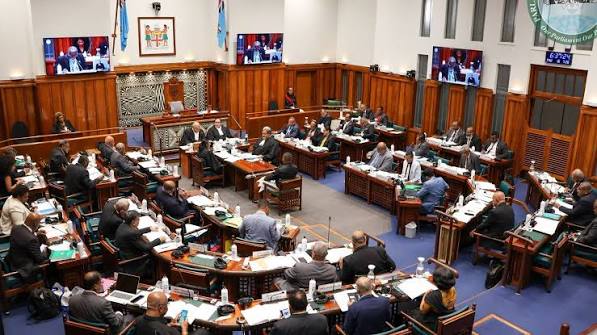
The Constitution Review Commission has recommended a 41 seat House of Representatives or Parliament with 26 constituencies.
According to the Draft Constitution Bill, 26 MPs are to be elected under the first past the post system and 15 through the proportional representation system.
The Commission confirms that it has not recommended any reserved seats for women or ethnic groups.
All will be Open seats.
The Review Commission is recommending a 19 seat Senate.
The Commission is also recommending through the Draft Constitution that the election of the country’s President be done by a 6 member Presidential Appointment Committee.
The nominees for the President can be made by the Boselevu Vakaturaga, the Prime Minister, the Leader of Opposition, the Council of Churches and the inter-faith group.
Religious freedom is also guaranteed in the Draft Constitution.
The Commission has also recommended that FICAC should be an investigative body and the prosecution of the cases to be handled by the Office of the Director of Public Prosecutions.
Some of the recommendations arising from the 2013 Constitution review are the reinstatement of the Boselevu Vakaturaga; the reinstatement of the Senate as the Upper House of Parliament; the reinstatement of the Public Service Commission to oversee the Public Service and personal matters of public servants; the continued use of “Fijian” as the national identity with a caveat that a consultative process is to be utilised so that people of Fiji can decide what their common or national identity should be, among other things.
This was highlighted by the Chairman of the Constitution Review Commission, Sevuloni Valenitabua as the commission handed over it’s report and the Draft Constitution Bill to President Ratu Naiqama Lalabalavu.
Valenitabua says from the recommendations, the Commissioners wrote a Draft Constitution.
He says the Draft Constitution, which is an amendment, is a recommended Constitution to take Fiji forward.
The Chairman says the draft is forward-looking, recognises our nation’s multiracialism; it aspires to streamline State services; and it aspires to encourage peaceful living of all ethnic groups within Fiji, among other things.
The original Commissioners were: Professor Dr. Unaisi Nabobo-Baba (Vice Chancellor, Fiji National University [FNU]), Professor Dr. Neelesh Gounder (Economist, Lecturer at the University of the South Pacific), Dr. John Fatiaki (Private Medical Practitioner, Suva), Conway Beg (Architect, Suva), Merewalesi Nailatikau (Consultant, Suva), Ami Kholi (Barrister and Solicitor, Private Practitioner, Labasa) and Sevuloni Valenitabua (Barrister and Solicitor, Private Practitioner, Nausori) as Chairperson.
Commissioner Professor Dr. Unaiasi Nabobo-Baba, who was initially one of the seven Commissioners, resigned on 5th May 2026 due to her busy work commitments as the Vice Chancellor of the FNU.
Dr. Salanieta Bakalevu was appointed to replace Professor Dr.Nabobo-Baba as the seventh Commissioner.
The Commission was assisted by three professionals and experts from Australia and New Zealand.
They were Professor Anthony Regan (a Constitutional Lawyer from the Australian National University), Dr. Kathrene Le Roy (the Deputy Head of the Queensland Legislative Drafting Office – Legal Drafter) and  Fiona Leonard (former Head of the New Zealand Drafting Office in Wellington – Legal Drafter).
1,220 submissions were received, through oral, virtual and online means.
These submissions were from Government Ministries, statutory bodies, non-government organisations, individuals, Villages, Tikina and Yasana; comprising 832 individual and 388 joint submissions.
The CRC’s face-to-face consultative sessions were attended by 3,873 people.
Cabinet will now look at the report and the Draft Constitution Bill.
The report and Bill have not been made public and the media was not invited to cover the handing over of the documents to the President at State House.
We have requested for the report and Bill.
Prime Minister, Sitiveni Rabuka and Acting Attorney General, Siromi Turaga are yet to respond.
fiji village

Continue Reading
Click to comment

Leave a Reply

Your email address will not be published. Required fields are marked *

Fiji News

4 girls allegedly trafficked in two separate domestic trafficking cases

Published

on

Four girls are alleged to have been trafficked in two separate domestic human trafficking cases, with the case files now with the Office of the Director of Public Prosecutions.

Police say in the first case, two suspects are alleged to have subjected a young girl to domestic trafficking in Labasa.

Police say the investigation has been completed and the file was forwarded to the Office of the Director of Public Prosecutions on 6th June 2026 for an independent legal review.

The second case was reported at the Lautoka Police Station and involves one of the two suspects from the Labasa case.

The suspect is alleged to have subjected three girls to domestic trafficking in the Western Division.

Police say two police officers were also questioned in relation to the case.

The investigation has been completed and the file was forwarded to the ODPP on 31st August.

Police say as part of their broader investigative approach, the Anti-Money Laundering Unit is now looking into possible financial crime offences involving proceeds that may have arisen from the alleged domestic trafficking.


fiji village

Continue Reading

Fiji News

Fiji PM Rabuka to appeal COI ruling, says he’ll resign if appeals fail

Published

on

Fijian Prime Minister Sitiveni Rabuka says he will appeal against a High Court decision quashing the report of a Commission of Inquiry (COI) into the appointment of a former head of the country’s anti-corruption agency.

The months-long inquiry, which cost the taxpayer around FJ$2 million (NZ$1.5m), has become a major political issue for Rabuka’s coalition government.

The COI, headed by Australian judge Justice David Ashton-Lewis, began on 31 October 2024 and was originally due to conclude on 31 January 2025, but continued until 1 May 2025.

Acting on the inquiry’s recommendations, Rabuka advised the country’s president that the then-commissioner of the Fiji Independent Commission Against Corruption (FICAC), Barbara Malimali, should be sacked.

Malimali strongly challenged her suspension and subsequent sacking and launched a judicial review against Rabuka and President Ratu Naiqama Lalabalavu.

Fiji’s High Court ruled in February that Malimali’s dismissal was unlawful, a decision immediately appealed by Rabuka.

Then, in June, the High Court rejected Rabuka’s attempt to stall its ruling that Malimali was illegally sacked.

Nearly two years after the inquiry was established, Rabuka faced another legal setback when the High Court ruled last Friday that the inquiry report, in its entirety, was null and void.

The High Court found that the inquiry’s work after 31 January 2025 was unlawful because its term had not been validly extended, and the president lacked the power to extend its term.

“[The] commission’s work from 1 February 2025, and the COI Report dated 1 May 2025, is ultra vires,” the judgement stated.

Ultra vires is a legal term meaning beyond lawful authority.

The ruling comes as political parties prepare for Fiji’s next general election, which is due later this year.

Following the court’s decision, Rabuka told local media he would appeal the decision and would resign if he failed in the Court of Appeal, or if necessary, the Supreme Court.

“I’m appealing the part that implies my activities and touch on my name [regarding] what I had done,” he said.

“I’m not the author of the COI. I made the recommendations and it’s up to the Attorney-General when he advised me and Solicitor-General. And my personal side, my legal counsel is doing.”

Asked if he would reisgn if the appeal failed, Rabuka replied: “Correct.”

“This is only the High Court. We [will] go to the Court of Appeal, and if [I’m not happy] with the Court of Appeal [decision], then we [will] go to the Supreme Court, and that’s the end.”

RNZ

Continue Reading

Fiji News

Four months on, still no charges in death of man in Fiji military custody

Published

on

The Fiji Police Force has yet to charge any suspects four months after the alleged murder of the reportedly infamous Jone Vakarisi while he was in military custody.

Vakarisi, 37, who was widely known for being on the wrong side of the law and reportedly linked to criminal networks, died on 17 April after being taken for questioning by soldiers to the Republic of Fiji Military Forces (RFMF) headquarters in Suva.

His death was initially attributed to pre-existing conditions by the RFMF commander Ro Jone Kalouniwai, who was later forced to issue a “correction” when police classified Vakarisi’s death as murder after a copy of Vakarisi’s death certificate was leaked online, exposing massive blunt force trauma to his head and chest.

Vakarisi’s sister Melehola Tagaga told Pacific Waves at the time that he begged for his life at the military barracks in Suva before allegedly being “bruatlised to death”.

Several weeks later in May, Kalouniwai admitted that the RFMF was “at fault” for Vakarisi’s death, describing it as an “unintentional” and “regrettable” incident.

However, more than 120 days after Vakarisi’s death, an active murder investigation remains open, while no one has been charged or presented in court.

In late July, the Fiji Sun reported that the case file on Vakarisi’s death was expected to be forwarded to the Office of the Director of Public Prosecutions.

“Police Commissioner Rusiate Tudravu confirmed yesterday that investigators were completing interviews with those involved before finalising the file,” the newspaper reported on 21 July.

“I can state that people need to trust the process that we are following. Investigation has been done,” Tudravu was quoted as saying.

Earlier this month, the police commissioner told local reporters that investigators continue to carry out house-to-house inquiries, collect witness statements, and examine forensic evidence as the probe intensifies.

He also called for “patience, understanding, and continued public support” for the joint police and military taskforce.

Local and international human rights groups condemned Vakarisi’s death in military custody, saying it reflected a “culture of impunity” within Fiji’s military forces.

Amnesty International’s Pacific researcher Kate Schuetze said the RFMF’s shifting excuses regarding Vakarisi’s death raised “more questions than answers”.

RNZ

Continue Reading

Trending

Copyright © 2026 The Buzz: Powered by Apna Network Limited - Concept by Digital Hub NZ