

Breaking News
Petrol prices jump past $3 a litre at the pump

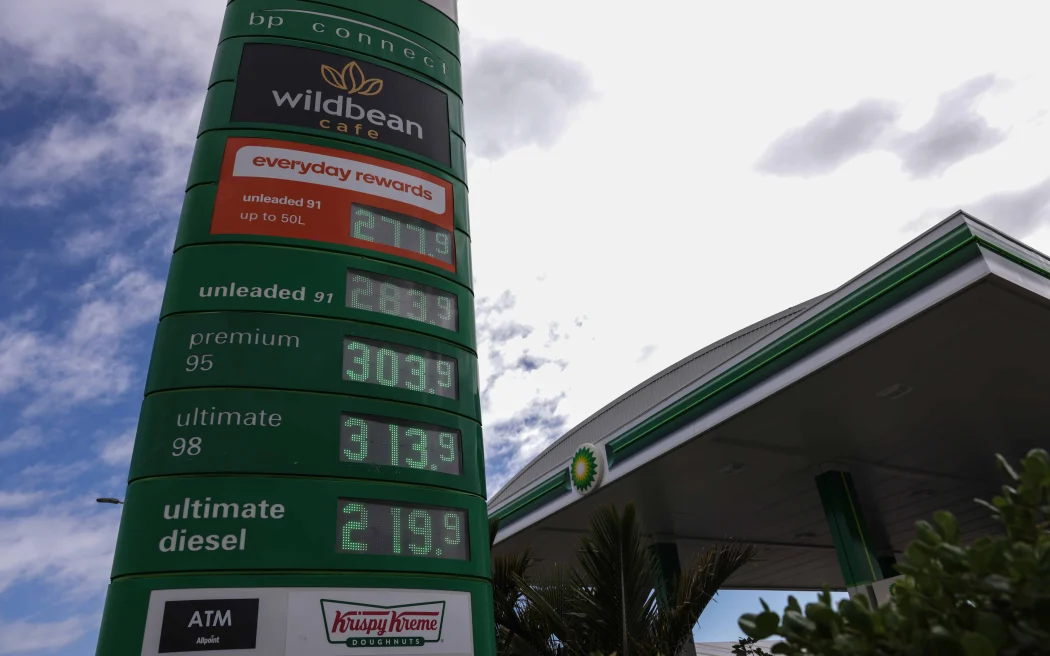
The price of 95 petrol has hit $3 in some parts of the country as conflict in the Middle East pushes up oil prices.
Motorists contacted RNZ upset at being asked to pay more than $3 in Kapiti outlets.
On Friday morning, Z Kapiti Road was recording $3.019 for 95 and g.a.s Waikanae $3.059 for 95, according to the fuel price monitoring app Gaspy.
An Otaki grandmother told RNZ she was encouraging others to be strategic in how they filled their cars.
“I gassed up yesterday and I gassed it up again now, before it shoots up in price. It’s only a matter of time.”
Kapiti Coast resident Bill Turner said the price of 91 was up 12c at his local station in the last week.
He said it made staying within his household budget almost impossible.
“I’m lucky I’ve got a business. I should be retired but I’m still working to pay for this.”

Bill Turner. Photo: RNZ / Samuel Rillstone
Mike Newton, spokesperson for Gaspy, said other more isolated parts of the country were also at or near that level.
NPD Fox Glacier was $3.089 for 95. Greymouth stations were also around the $3 level.

Are the big Aussie banks treating us like mugs?
“We’re definitely seeing more and more stations getting closer to that mark,” Newton said.
“I think while there’s so much uncertainty we’re just going to keep seeing prices rise.
“If you compare this to when Russia first invaded Ukraine, we saw huge price increases after that. There’s probably a lot more uncertainty here because of the fact that Iran wasn’t actually allowed to export oil to the world.
“There’s a lot of uncertainty about where it’s going to go, how long it’s going to last … there’s definitely a feeling that prices are going to rise.”

Photo: RNZ / Samuel Rillstone
After the Russian invasion of Ukraine, the price of 91 increased past $3, the government responded by temporarily halving the fuel excise tax.
Newton said the national average for 91 was now $2.66 a litre.
“It’ll be interesting to see how rapidly prices ramp up. The oil companies are pricing in expected increases, they’re not buying oil at the more expensive rates yet but they expect they will be.”
He said Kapiti stations had recorded increases of between 8c and 15c in the past week, above the national and regional average.
The Wellington region was up 4c over the same period.
“A lot of that could be driven by the discount retailers. I noticed that Paraparaumu has a NPD station which has only gone up 6c so the discount retailers are maybe not moving as quickly and in some places everybody else follows the lead of the discount retailers but in Paraparaumu that doesn’t appear to be the case.”
He said Nelson had experienced an increase of 6c on average, whereas 3c to 4c was the norm for most other regions.

Fuel prices at a Z in Paraparaumu. Photo: RNZ / Samuel Rillstone
‘Can’t see it getting cheaper in March’
AA policy adviser Terry Collins said he had been able to fill up in Wellington on Tuesday at $2.34 a litre for 91, which he said still seemed good value. “Today, $2.48, $2.50 is looking like a good deal.”
He said, for 91, about $2.70 was the top end in the Wellington region. Gaspy noted Mobil Karori at $2.79 and Z Taranaki St at $2.85.
Collins said oil futures for April had reached US$85 a barrel, about 12c more than a week ago.
“I said at the beginning of the week we will be at US$80 by the end of the week, we’re at US$85. The longer the fighting continues the more the upward trajectory in price.”
In previous times of disruption, the price of a barrel had hit US$120.
Photo: RNZ / Samuel Rillstone
“US$100 wouldn’t surprise me. These geopolitical events take time to readjust the supply chains.
“All I know is I’m confident I bought some fuel on Monday knowing that I wasn’t going to get it cheaper for a little while. I can’t see it getting cheaper in March, I think it’s on an upward trajectory.”
Infometrics chief executive Brad Olsen said 95 reaching the $3 benchmark was a sign of the wider trend.
“The latest MBIE reporting for the week of February 27 had average 91 prices at something like $2.53. We estimated that given where oil prices were yesterday, we could se something like a 30c-plus per litre increase over the next week or so.”
He said if oil prices reached US$100 a barrel, it could push 95 up to $3.20 or $3.30.
“The hit is starting to come through and we feel the risk of it going further is high.”

Photo: RNZ / Samuel Rillstone
Olsen said fuel already in New Zealand was helping to moderate prices.
“The challenge is that you see fuel prices go up quicker than they come down the other side. Part of that is because you often see people that buy fuel during times of challenge at the moment because you’re not sure when you can get the next big shipment of fuel in.
“So you buy it at the higher price and you have to sell it at the higher price because you don’t know when the conflict’s going to end. Towards the end of the conflict it may well be that oil prices start to come down but you’ve already ordered another shipment’s worth at the higher price and need to sell it.”
He said it was also worth noting that diesel prices would also rise, which would affect the commercial sector and put pressure on inflation.
“If you’ve got transport costs the board that have gone up, if businesses start to pass on those higher operating costs on their prices, that’s where there would be some worry.
“Even at the moment, the whole aim to get inflation back within the band and then driving down towards 2 percent … that goal will likely have to be pushed out because of this increase in oil prices.”
~ RNZ


The Trump administration denounced CNN on Thursday (local time) for airing a portion of the new Iranian supreme leader’s public statement, the second time in three days the network has been targeted for reporting on how the regime is responding to the American attacks.
The attack illustrated the care news outlets must take in reporting during wartime, and the responsibilities of American journalists to report the perspective of countries its government views as enemies. It also exposed inconsistencies.
The message of Supreme Leader Ayatollah Mojtaba Khamenei during his first public statement since he succeeded his father, who was killed in an Israeli airstrike, was widely available elsewhere.
The White House said on social media that “fake news CNN just aired four straight minutes of uninterrupted Iranian state TV, run by the same psychotic and murderous regime that prided itself on brutally slaughtering Americans for 47 years”.
Earlier CNN interview criticised by Trump’s communications leader
Two days earlier, White House communications director Steven Cheung took issue with CNN anchor Erin Burnett’s interview with Hossein Mousavian, a former Iranian nuclear negotiator. Burnett asked Mousavian what he had been hearing about the Iranian government’s interest in having talks with the United States. There wasn’t much, he said.
“Ever notice how CNN just regurgitates quotes and unverified information from Iranian terrorists?” Cheung wrote on X.
“Total disgrace. They have become the murderous Iranian Regime’s version of Pravda,” he said, referring to the official newspaper of the former Soviet Union.
CNN did not address Cheung’s statement but did respond to the White House attack on Thursday. It noted that CNN, Sky News and Al Jazeera also showed portions of the ayatollah’s statement live.
“The world is watching with anticipation which direction this war will take,” CNN said. “Purported remarks from Iran’s new supreme leader are a critical component in helping audiences understand where this conflict is heading and were aired for their obvious news value.”
Other news outlets, including The Associated Press, sent out alerts on what Khamenei said. His vow to keep up attacks on other Arab countries in the region and plans to choke off the world’s oil supply were headlines.

The New York Times led its website with a story on the speech in its immediate aftermath, later writing that the speech “was an early indication of how the new supreme leader would approach the war, as well as how he would lead the country”.
CNN has long been a favoured target of President Donald Trump, dating back to his first term. It’s a particularly vulnerable time for the network with Paramount Global’s agreement to purchase CNN’s parent company, Warner Bros Discovery, raising questions about its future editorial independence.
CNN showed a news anchor reading a portion of Khameini’s remarks in Farsi, with an English translation. It did not air them in full. After the speech, correspondent Nick Paton Walsh gave a debrief to anchor Kate Bolduan, noting how the non-appearance of the leader — reportedly injured in an air attack — was as important as what he said.
“We were waiting to see the face of the man to have proof of his health and survival,” Walsh said, “and they’ve not met that moment. Instead, a handwritten message, it seems, that mostly reiterates things we kind of already knew.”
A social media message board for Iran’s point of view
The Tech Transparency Project has reported that several Iranian leaders and institutions maintain verified accounts on X, formerly Twitter, owned by Trump ally Elon Musk. CNBC said Thursday that Khamenei has one of them, and an X account with his portrait posted the text of his remarks, available in Farsi and in an English translation.
Even though Khamenei’s father is dead, an account with his portrait was active on Thursday, mainly reposting messages from his son. “The revenge we have in mind is not just because of the martyrdom of the illustrious Leader of the Revolution,” read one message posted Thursday. “Every member of the nation martyred by the enemy is a separate case that demands we seek revenge.”
X is officially blocked in Iran, although many use a virtual private network to bypass restrictions. A message sent to the platform on Thursday was not immediately returned.
There’s a long history of journalists seeking interviews with world leaders, even when they are regarded as enemies of the United States. Most notable was 60 Minutes correspondent Mike Wallace’s interview with Iran’s Ayatollah Ruhollah Khomeini in 1979, when that country was holding Americans hostage.
Thursday’s remarks by Iran’s new supreme leader were absolutely newsworthy and legitimate for CNN to air them, said Jane Ferguson, a veteran international correspondent and founder of the journalism platform Noosphere. It’s not the job of government leaders to pick apart what CNN is reporting, she said.
“We’ve always faced this,” she said, about when reporters interview leaders or other figures hostile to American interests. “This has been a bit of low-hanging fruit for a while.”
Historian Douglas Brinkley of Rice University said that it’s unfair for CNN to be singled out in this instance. He, too, believes it is newsworthy to learn what leaders of an adversary are thinking, but it’s important to make sure that journalists are careful.
“You have to be leery of being used as a propaganda tool by the Iranian regime,” he said. “On the other hand, knowing what the enemy is saying and looking for a sign of a peace offering or a nuance is important … It’s a difficult balance.”


Police say person who fired gun at officers still at large

New Zealand sides named for RLWC finals

Parliamentary Service working on extra chairs and offices for increased number of MPs


-

 Latest News2 months ago
‘Chilling’: Business groups speak out against National’s supermarket break-up plan
-
 NZ News2 months ago
Tom Phillips report: The missed opportunities to find the children
-
 Politics2 months ago
National vows to try to split Pak’nSave and New World
-

 Latest News2 months ago
Cars bearing Chinese police markings stir unease in Auckland
-

 Fiji News2 months ago
Plans to have new Constitution by Dec 24th 2026
-
 Latest News2 months ago
NRL finals schedule: Who plays who in week 2 and how the Warriors can make the Grand Final
-
 NZ News2 months ago
Cop who stole $68,000 can now be named as champion Muay Thai fighter Haimona Tamati-Te Paki
-

 Politics2 months ago
MBIE confirms botched biometric projects costs blown out to $50.7 million