Connect with us

HTML Image

i

Fiji News

Fiji PM Rabuka to appeal COI ruling, says he’ll resign if appeals fail

Published

on

Fijian Prime Minister Sitiveni Rabuka says he will appeal against a High Court decision quashing the report of a Commission of Inquiry (COI) into the appointment of a former head of the country’s anti-corruption agency.

The months-long inquiry, which cost the taxpayer around FJ$2 million (NZ$1.5m), has become a major political issue for Rabuka’s coalition government.

The COI, headed by Australian judge Justice David Ashton-Lewis, began on 31 October 2024 and was originally due to conclude on 31 January 2025, but continued until 1 May 2025.

Acting on the inquiry’s recommendations, Rabuka advised the country’s president that the then-commissioner of the Fiji Independent Commission Against Corruption (FICAC), Barbara Malimali, should be sacked.

Malimali strongly challenged her suspension and subsequent sacking and launched a judicial review against Rabuka and President Ratu Naiqama Lalabalavu.

Fiji’s High Court ruled in February that Malimali’s dismissal was unlawful, a decision immediately appealed by Rabuka.

Then, in June, the High Court rejected Rabuka’s attempt to stall its ruling that Malimali was illegally sacked.

Nearly two years after the inquiry was established, Rabuka faced another legal setback when the High Court ruled last Friday that the inquiry report, in its entirety, was null and void.

The High Court found that the inquiry’s work after 31 January 2025 was unlawful because its term had not been validly extended, and the president lacked the power to extend its term.

“[The] commission’s work from 1 February 2025, and the COI Report dated 1 May 2025, is ultra vires,” the judgement stated.

Ultra vires is a legal term meaning beyond lawful authority.

The ruling comes as political parties prepare for Fiji’s next general election, which is due later this year.

Following the court’s decision, Rabuka told local media he would appeal the decision and would resign if he failed in the Court of Appeal, or if necessary, the Supreme Court.

“I’m appealing the part that implies my activities and touch on my name [regarding] what I had done,” he said.

“I’m not the author of the COI. I made the recommendations and it’s up to the Attorney-General when he advised me and Solicitor-General. And my personal side, my legal counsel is doing.”

Asked if he would reisgn if the appeal failed, Rabuka replied: “Correct.”

“This is only the High Court. We [will] go to the Court of Appeal, and if [I’m not happy] with the Court of Appeal [decision], then we [will] go to the Supreme Court, and that’s the end.”

RNZ

Continue Reading
Click to comment

Leave a Reply

Your email address will not be published. Required fields are marked *

Fiji News

How a weak NZ dollar could help and hurt you

Published

on

A weak New Zealand dollar might be hard on anyone shopping from international websites for Christmas presents or putting fuel in their cars but could be helping us in other ways, ASB says.

Over the past 20 years, the average value of the dollar has been about US70c.

On Friday, it was worth US54c.

ASB senior economist Chris Tennent-Brown said the impact would be felt differently across the economy. Households and New Zealanders travelling internationally would feel the pinch, but exporters, tourism operators and investors could benefit.

Tennent-Brown said the dollar was historically low against most major currencies except the Japanese yen. That was because our interest rates have got out of step with most other countries’.

“We’ve got very high inflation, which is something that many western economies are dealing with, but we’re coming at that problem from a very low interest rate setting, and I’d still say our interest rates are quite low on a historical basis.

“If we compare it to across the Tasman, Australia’s official cash rate is a couple of percent higher than ours, and normally New Zealand needs to have a bit of a premium over other countries, so we’re below Aussie, we’re below the US in terms of an official cash rate, that impacts wholesale rates and that does weigh on the New Zealand dollar.”

The focus on interest rates would continue for some time, he said.

“I think interest rates will be important over the next couple of years, and some of that will be the Reserve Bank returning our official cash rate and our interest rates towards more normal levels – or neutral when we put some economic jargon in there about where the official cash rate should be – and likewise some of the countries that have been pretty aggressive on tightening over the past year, Australia is a good example, will perhaps be easing interest rates next year whilst we’re still trying to get them back to more normal levels, so that will all impact the exchange rate over the year ahead.”

How the dollar moved had different effects on various parts of the economy.

“For households buying imported goods, or Kiwis spending money overseas, it can mean higher prices and less bang for buck. But for exporters earning offshore, tourism businesses and some investors with international exposure there can be meaningful upside,” he said.

Oil and refined products like diesel, petrol and aviation fuel are priced globally in US dollars, meaning a weaker NZ dollar compounds already high international fuel costs. The impact is ultimately felt at the petrol pump, in airline ticket prices, and in the cost of transporting people and goods.

But it made New Zealand a more appealing tourism destination and could also encourage New Zealanders to holiday at home, too.

“That could provide a double boost for parts of the tourism and hospitality sector over summer, with more international visitors coming and more Kiwi choosing to spend their holiday dollars at home. Some of us may even remember the 1980s tourism campaign – ‘don’t leave town until you’ve seen the country’. It’s true, and it worked,” Tennent-Brown said.

The weak dollar also boosted key exports such as dairy and meat.

“It’s painful every time we buy something that has an international price, and petrol’s the obvious one, but it is supporting the rural recovery with things like the Fonterra milk price update … reflecting how the weak New Zealand dollar flows through to improved incomes at the farm gate, but it has some impacts on the rest of the economy.

“The rural income story is definitely a beneficiary of the weak New Zealand dollar … it’s a twin-edged sword though, because things like fertilizer prices, investing in plant and machinery is clearly going up, just as the New Zealand dollar goes down.”

He said there could also be a silver lining for those with money invested offshore, including through KiwiSaver. A weaker NZ dollar can provide a currency tailwind for international investors.

“Every investment manager will have an approach to FX management. ASB maintains a deliberate mix of hedged and unhedged international assets. Keeping a portion of global equities unhedged provides a natural buffer during global market downturns, as the NZD historically tends to fall during periods of economic stress, lifting the value of overseas shares.”

RNZ

Continue Reading

Fiji News

Fiji ‘worse off today’, former PM warns, as Rabuka’s constitution overhaul faces backlash

Published

on

Mahendra Chaudhry, Fiji’s first and only prime minister of Indian descent, has warned that the island nation is “worse off today than we were at independence” and that its political leadership must focus on solving social and economic issues rather than “making multiple constitutions”.

Chaudhry made the comments over the weekend while making a submission to a special parliamentary committee – led by Prime Minister Sitiveni Rabuka – on the country’s constitutional reform process in Vanua Levu, Fiji’s second main island.

“Are we doing enough to alleviate the problems that we face as a nation that our people face, problems of poverty, hunger, unemployment, poor health services, education problems, crumbling infrastructure, the invasion by drug traffickers, HIV, NCDs (non-communicable diseases)?

“Is the economy delivering to the people? Are we giving sufficient attention to the economic problems that the nation faces? Because you can do nothing on the back of a failing economy.

“These are areas where our attention should be focused,” the former prime minister, whose government was held hostage at gunpoint for 56 days during the 2000 ethno-nationalist coup, said.
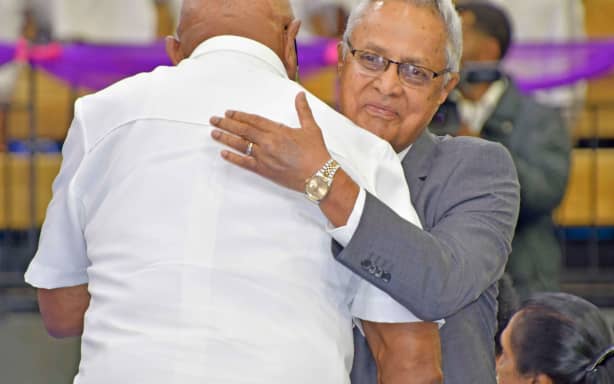
Sitiveni Rabuka and Mahnedra Chaudhry embrace at the reconciliation church service on 14 May 2023.
Mahendra Chaudhry, right, embraces Sitiveni Rabuka during a reconciliation church service on 14 May 2023.

Fiji Government

Rabuka’s coalition has made it its mission to replace the 2013 Constitution – widely criticised as being imposed by the previous Bainimarama administration – ahead of a looming election.

His government is currently conducting nationwide public consultations on its Constitution (Amendment) Bill 2026, which passed its second reading earlier this month and is set to be brought back to parliament for its third reading next week.

If the bill passes its third reading, Fiji is set to hold its first national referendum in December, where the people will vote on whether they want Rabuka’s constitution. In its current form, the bill – presented to parliament in September – has been criticised as a downgrade from what the Constitution Review Commission had proposed.
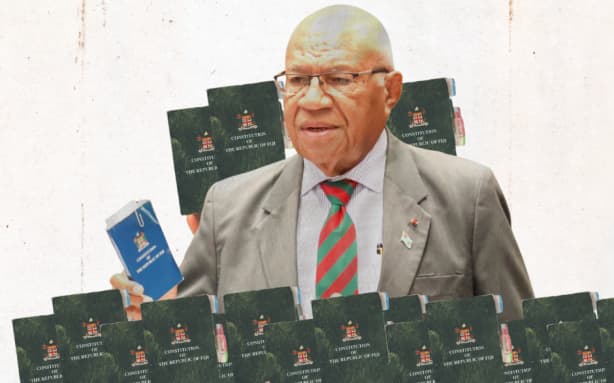
Fijian Prime Minister Sitiveni Rabuka
Prime Minister Sitiveni Rabuka

RNZ Pacific / Fiji Parliament

Rabuka and his inner circle are backing the removal of the current constitution despite widespread opposition from local community leaders, non-governmental organisations as well as his own coalition partners who say that the process is being “rushed”.

Rabuka, 78, said he had a responsibility that he would review and amend the 2013 Constitution and “that’s what we’re going for”.

“You voted for us – some in government and some in opposition – so we have the collective vote of the people of Fiji,” he said at one of the public consulations last week.

“And you have entrusted us of doing the amendment in accordance with the rules of the country.”

The move has also given rise to online conspiracies and misinformation that Rabuka is deliberately trying to delay the election, forcing him to provide assurances that the general election will proceed as planned.

More than 723,000 eligible voters are expected to head to the polls no later than 6 February 2027.

Rabuka has so far kept the date of the general election close to his chest, stating previously that the election date will be announced after the constitutional reform process was completed.

“This is the fifth constitution that we will be looking at. Have the four previous constitutions served our purpose? Has it helped the people?” Chaudhry asked.

“Why do we rush this process of a new constitution? It can wait,” he said.

Chaudhry said Fiji could have an election under the 2013 Constitution and the incoming government could deal with the constitutional reform process.

“We have got to listen to the people. In this process, what I have noticed is that everybody has complained,” he said.

“If anything that has come through very clearly and loud in this consultation meeting, it is the people saying, ‘No, look, give us more time’.”

While the government’s constitution bill maintains the common national identity ‘Fijian’ for all its citizens, it proposes a new parliamentary system, brings back an unelected senate, changes the current electoral system, and provides “excessive concentration of constitutional power in the Executive”, according to Fiji’s Centre for Democracy and Dialogue.

It also includes Christianity as a founding value.

Chaudhry said the country should be looking at the proposed constitution that was presented by the Constitution Review Commission and not the government’s version of the document.

“Having had a look at the constitution presented as Bill 32 of 2026, I find it divisive, undemocratic, and discriminatory in many of its provisions,” he said.

“I have no problems with Christian values. I think they are good values, but I believe that religion and state must be kept apart because this is one aspect which can cause serious division [in a] multiracial country like Fiji between communities.

“I am a Hindu. My wife is a Christian. We have no problems. She practices her religion. I do mine. So where is the problem? Why do we have to put in something which is causing controversy? Is it necessary? It is not.”

RNZ

Continue Reading

Fiji News

PM confirms the next general elections will be held under the current electoral system and by Feb 6th 2027
Published

on

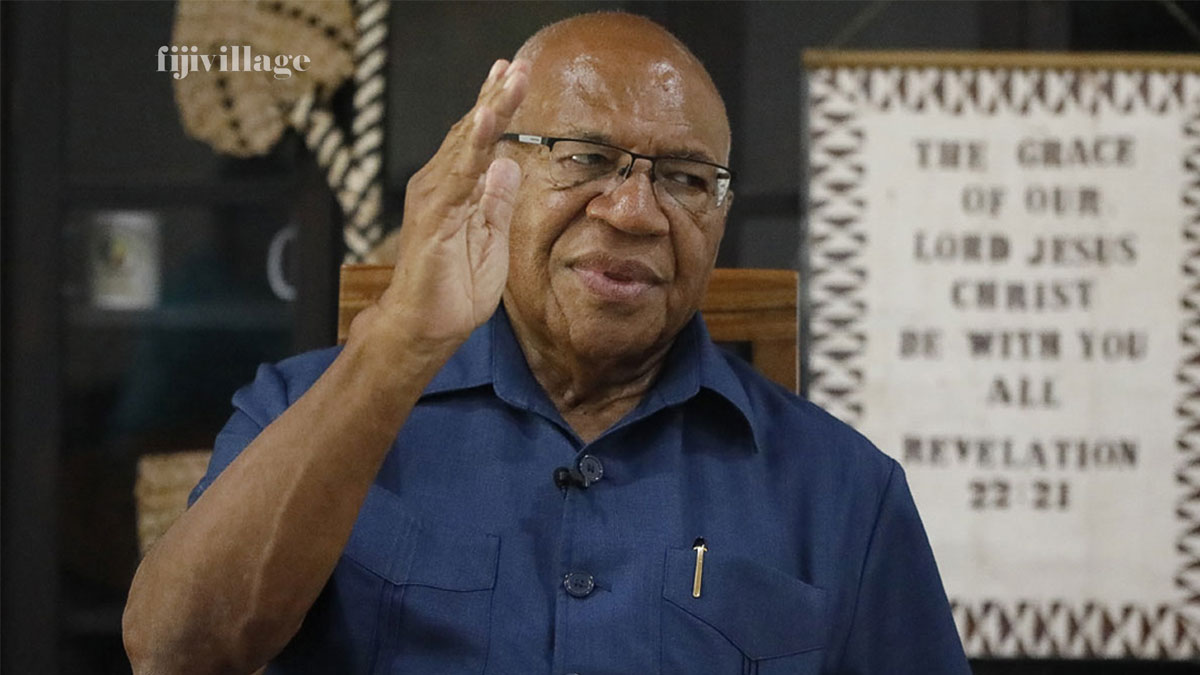
With some creating confusion by saying that the general elections will not be held during the required legal timeline under the 2013 Constitution, and uncertainties surrounding drastic changes to the electoral system that could affect the Fijian Elections Office’s preparations with only about 8 weeks to go for the Writ of Elections to be issued, Prime Minister, Sitiveni Rabuka has today made it clear that logically, the next general elections will be held under the current electoral system.

Rabuka made this clear in an exclusive interview when fijivillage News asked him on whether he can confirm to the people if the next general elections which has to be held by February 6th 2027, will be held under the current electoral system.

We also asked Rabuka whether any electoral changes, including those in the Constitution Amendment Bill on the drawing up of electoral boundaries if a multi constituency electoral system is approved, will be used in the elections after the 2027 elections as we need the boundaries drawn up, and population figures based on the census, which is scheduled to be held next year.

In his response, the Prime Minister says the constituency boundaries have to be drawn up and the census will take place next year.

Rabuka says the census data will provide the essential information for the Electoral Commission to do their work in time for any elections eventually the next government will face.

In a recent interview, Supervisor of Elections, Ana Mataiciwa had said that the Fijian Elections Office is ready to deliver the general elections under the current system based on the legal timeline where the last day for the Writ of Elections to be issued by the President on the advice of the Prime Minister is December 24th this year and the last date for the general elections is February 6th 2027.

She had said it would be impossible to deliver the general elections operationally within this timeframe if drastic changes are made to the electoral system including a multi constituency system.

The transitional provision of the Constitution Amendment Bill states that on the commencement of the law, the current parliament continues until it is dissolved or ends its term in accordance with section 58 of the 2013 Constitution.

This means the next general elections will be held under the legal timetable specified in the 2013 Constitution – the last day for the Writ of Elections to be issued is 24th December this year and the last day for the general elections is February 6th next year.

It is also stated that the 2026 Constitution Amendment Bill, if passed, will come into force on 31st March 2028.

However the President may, by Proclamation published in the Gazette, fix a date earlier than 31st March 2028.

Despite the commencement, section 58 of the 2013 Constitution continues to apply to the current parliament, and the maximum term of the current parliament remains 4 years from the date of the first meeting of the first Parliament.

The Constitution Amendment Bill also proposes the retention of a 55 member Parliament however a system is proposed where 33 constituency members or such number as Parliament may by written law

prescribe, which includes 5 maritime constituencies chosen directly by the registered voters of those constituencies in a first-past-the-post election; and 22 party list members or such number as Parliament may by written law prescribe, allocated to political parties in proportion to the total number of votes for the candidates of that party in the constituency seats.

Parliament or the House of Representatives is to be composed in a manner that reflects, as closely as practicable, the proportion of votes cast for political parties.

A political party is entitled to proportional representation if it secures not less than

5 percent of the party vote.

Constituency seats won are deducted from each party’s proportional entitlement, with the balance filled from party lists.

The Party list seats must be allocated in accordance with a written law prescribing an appropriate mathematical rounding method, which rounds fractions to whole numbers to determine seat allocations.

Candidates unaffiliated with a political party may contest constituency seats, and if elected, serve as independent members without affecting proportional allocation.

A candidate of a party can stand for election in a constituency seat and be included in the party’s list for a party list seat.

The Bill says Parliament may provide, by written law, for temporary special measures relating to the way in which party lists must be constituted, for example measures to ensure, as far as possible, equal numbers of male and female candidates; or measures to otherwise facilitate diverse representation on party lists.

The maritime constituencies are Rotuma, Yasawa, Kadavu, Lomaiviti and Lau.

A candidate for election to the House of Representatives must be either nominated by a registered political party or nominated as an independent candidate in accordance with the laws governing elections.

A person may be a candidate for election to the House of Representatives only if the person is a citizen of Fiji; is qualified to be registered as a voter and is registered on the Register of

Voters; is ordinarily resident in Fiji for at least 2 years immediately before being nominated; is not an undischarged bankrupt; is not a member of the Electoral Commission and has not been a member of that Commission at any time during the 4 years immediately before being nominated; is not subject to a sentence of imprisonment when nominated; has not, at any time during the 8 years immediately before being nominated, been convicted of an offence under any law for which the maximum penalty is a term of imprisonment of 12 months or more; and has not, in the 5 years immediately before being nominated, been found guilty of any offence under a law relating to elections, registration of political parties or registration of voters.

The total number of candidates that a political party may nominate for any general election must not be more than the total number of seats in the House of Representatives, and the total number of candidates that a political party may nominate for any by-election must not be more than the total number of vacant seats in the House of Representatives for which the by-election is held.

If a seat in the House of Representatives becomes vacant, the vacancy must be filled in the case of a constituency seat, by a by-election; and in the case of a party list seat, by the next candidate on the party list; or if there is no next candidate on the party list, by a by-election.

The Bill also proposes the House of Representatives continues for 5 years from the date of its first meeting after a general election of the members of the House of Representatives, unless sooner dissolved in accordance with the Constitution.


fiji village

Continue Reading

Trending

Copyright © 2026 The Buzz: Powered by Apna Network Limited - Concept by Digital Hub NZ