Connect with us

HTML Image

i

Latest News

An extra Port Waikato seat in Parliament: What you need to know

Published

on

Opinion – We should begin by properly acknowledging loss. The death of the Act Party’s Port Waikato candidate, Neil Christensen, is a tragedy for his family and friends. Me tangi, kāpā ko te mate i te marama.

However, Christensen died while a candidate for election, so this personal loss also has very public consequences. In particular, the Electoral Act 1993, s 153A is quite clear about what happens when an electorate candidate dies during the campaign.

The election of an MP for that electorate is cancelled (although voters still may cast party votes and these get counted). Then, under the Electoral Act 1993, s 153E, instructions for a by-election in that electorate must then be issued “without delay”.

Which means that Port Waikato voters still need to go to the polls by the end of Saturday to cast their party vote, then sometime after the general election process is completed, but before the end of the year, go back to the polls again to elect a local electorate MP.

Professor Andrew GeddisAndrew Geddis Photo: RNZ / Cole Eastham-Farrelly
In the meantime, of course, all the country’s other MPs will have been declared elected. So, how does the required by-election in Port Waikato link with that process?

The law governing the allocation of seats in parliament after the general election is set out in the Electoral Act 1993, ss 191-193. In essence, it requires the Electoral Commission to allocate 120 seats amongst the various parties that cross the representation threshold of either 5 percent of the party vote, or winning an electorate.

The Commission can only allocate less than 120 seats if some independent candidate wins an electorate (something that has not happened in New Zealand under MMP).

Therefore, in early November after all the votes are officially counted, there will be at least (more on this in a minute) 120 MPs with the right to sit in Parliament. One of these MPs will be National’s candidate for Port Waikato, Andrew Bayly, who is at 15 on the National Party list. Given current polling, this guarantees him a list seat in Parliament even with the Port Waikato electorate vote being cancelled.

Then, at some point before the end of the year, Port Waikato voters will elect their local electorate MP.

This MP will be “extra” to the 120 seats already allocated by the Electoral Commission after the general election. And one of the candidates at the by-election will be Andrew Bayly, standing for the National Party.

Andrew BaylyAndrew Bayly Photo: RNZ / Samuel Rillstone
Smarter people than I, such as the NZ Herald’s Claire Trevett, say that he will be a lock to win that by-election. At which point he will resign his list seat for National, re-enter Parliament as Port Waikato’s electorate MP, while the National Party gets allocated another list seat to make up for the one that it “lost” when he resigned.

In short, the legally required by-election process means National basically is guaranteed getting another seat in Parliament quite shortly after the final results of the general election are announced.

Meaning that the magic number of seats it and Act now need to get between them from the general election in order to avoid having to deal with New Zealand First is 60, rather than 61.

Which, given how tight everyone says the polls are, could literally change who will be our next government.

All of which raises the question, how much sense does this make?

Well, parliaments with more than 120 MPs in them and parties getting more seats than they are “entitled” to can happen in other ways.

If at a general election a party wins more electorate seats than its share of the party vote would give it, they get to keep these “overhang” seats and parliament just gets that much bigger. We’ve already seen this happen after three elections under MMP. Depending on what happens in the Māori seats – how many of these Te Pāti Māori win relative to their share of the party vote – it might happen this year, too.

However, the underlying rule that when any candidate in an electorate dies the election of an electorate MP must be re-run really is a throwback to pre-MMP days.

Under the old First Past the Post system, winning an electorate was the only route into parliament. And it was the total electorates won by each party that then determined the overall government. So, having a candidate – especially one of the National or Labour candidates – die during the campaign could literally change the nationwide outcome.

Under MMP that just isn’t the case.

Let’s imagine – and apologies if this sounds ghoulish – that it were Andrew Bayly who passed on and not Neil Christensen, but the election of an electorate MP for Port Waikato carried on anyway. That would mean one less electorate seat for National, and one more electorate seat for some other party. However, when the list seats are allocated by the Electoral Commission, National would receive one more, while the other party would receive one less. The voters of Port Waikato may not get their preferred local MP – assuming they want that to be a National one – but the overall distribution of seats in parliament would remain the same.

As such, it might be time to rethink the rule at play here. Not for this election – it must play out as the law requires. But whether this ought to happen again in future elections really is questionable,

*Andrew Geddis is a professor of law at the University of Otago.

*This story was first published by Pundit


VIA RNZ

Continue Reading
Click to comment

Leave a Reply

Your email address will not be published. Required fields are marked *

Latest News

Police say person who fired gun at officers still at large

Published

on

Police say a person who fired a gun at officers in Napier is still at large.

Eastern District Commander Superintendent Joel Lamb said Police tried to stop a vehicle in the Pirimai Area at about 10pm on Tuesday.

He said someone in the back seat pointed what was presumed to be a firearm at officers pursuing the vehicle.

“Staff have then heard two distinct gunshots as the firearm was discharged.

“Fortunately, neither of our officers were injured, and the patrol vehicle did not sustain any damage.”

He said hours later, the vehicle was seen travelling north on the Waikato Expressway towards Auckland.

Police seized the vehicle at an address in Manurewa, but they had not found the alleged offender.

Lamb said people who lived at the Manurewa address were engaging with Police.

He said Eastern District and Counties Manukau Police were making enquiries.

“Presenting a firearm at a Police officer is a serious escalation that puts our staff and the wider community at risk. This behaviour is entirely unacceptable.

“We are taking this incident extremely seriously and will be pursuing all lines of enquiry to locate the offender and hold them accountable.”

Police asked anyone who witnessed the incident to contact Police on 105 or online using the reference number 261111/3764.

Information could also be provided anonymously via Crime Stoppers on 0800 555 111.

rnz

Continue Reading

Latest News

New Zealand sides named for RLWC finals

Published

on

The players tasked with ending Australia’s Rugby League World Cup dominance have been named.

The Kiwis and Kiwi Ferns have announced their squads for this Sunday’s World Cup finals in Brisbane.

Both sides are chasing their first titles since 2008, and both are looking to end their opponents run of three crowns in a row.

“Our Kiwi Ferns have been so dominant in years gone by, and we want to bring dominance back to this jersey, so I think it will be a case of who wants it more,” said co-captain Georgia Hale of the impending clash.

The Kiwis get a major boost for the final as they welcome back Ronaldo Mulitalo after he served a one-match ban for a high tackle against Fiji Bati.

Mulitalo replaces Charnze Nicoll-Klokstad, who moves to the six-man bench, which again includes utility Te Maire Martin, middle forwards Naufahu Whyte, Erin Clark and Xavier Willison plus fullback Keano Kini.

Loose forward Joseph Tapine will make his 30th Test appearance in a familiar pack again, including second-rowers Isaiah Papali’i and Briton Nikora, and props James Fisher-Harris and Moses Leota.

Winger Jamayne Isaako is on the cusp of claiming the New Zealand record for most Test points.

His five goals against Tonga lifted his career points tally to 225 – level with Shaun Johnson – while centre Casey McLean goes into the final with 16 tries in just eight Tests.

Fisher-Harris will again captain the team.

Fullback Ponga said the goal of the group was clear.

“We have high expectations around what we want to achieve, and obviously winning a world Cup is one of them.”

Meanwhile, Ricky Henry has selected a settled side to take on the Jillaroos, led by their lethal centre combination of Stacey Waaka and Mele Hufanga.

Veteran Apii Nicholls takes the number one jersey, Leianne Tufuga and Mackenzie Wiki on the wings.

Henry has stuck with his halves pairing of Chantay Kiria-Ratu and Raecene McGregor with Alexis Tauaneai, Georgia Hale and Otesa Pule up front.

Rounding out the starting pack is Shaniece Monschau, Kaiyah Atai, and Angelina Teakaraanga-Katoa.

“We have been building well throughout the tournament; we understand the Jillaroos side, and will give it our all to make New Zealand proud this weekend,” said Henry.

RLWC Finals:

Kiwi Ferns vs Jillaroos- 6.10pm

Kiwis vs Kangaroos – 9.35pm

Sunday November 15

Suncorp Stadium, Brisbane

Live blog updates on RNZ

Kiwi Ferns:

1. Apii Nicholls 2. Leianne Tufuga 3. Mele Hufanga 4. Stacey Waaka 5. Mackenzie Wiki 6. Chantay Kiria-Ratu 7. Raecene McGregor 8. Alexis Tauaneai 9. Georgia Hale 10. Otesa Pule 11. Shaniece Monschau 12. Kaiyah Atai 13. Angelina Teakaraanga-Katoa.

Interchange: 14. Ashleigh Quinlan 15. Annessa Biddle 16. Shannon Mato 17. Ivana Lauitiiti.

Reserves: 18. Brooke Anderson 19. Zahara Temara 20. Brianna Clark 21. Abigail Roache 22. Tenika Willison.

Kiwis:

1. Kalyn Ponga, 2. Jamayne Isaako, 3. Dane Gagai, 4. Casey McLean, 5. Ronaldo Mulitalo, 6. Kodi Nikorima, 7. Jahrome Hughes, 8. James Fisher-Harris (c), 9. Jeremy Marshall-King, 10. Moses Leota, 11. Isaiah Papali’i, 12. Briton Nikora, 13. Joseph Tapine (v/c).

Interchange: 14. Te Maire Martin, 15. Naufahu Whyte, 16. Erin Clark, 17. Xavier Willison.

Reserves: 18. Keano Kini, 19. Phoenix Crossland, 20. Charnze Nicoll-Klokstad, 21. Scott Sorensen, 22. Leo Thompson.

rnz

Continue Reading

Latest News

Parliamentary Service working on extra chairs and offices for increased number of MPs

Published

on

The chief executive of the Parliamentary Service is confident there will be enough room to accommodate the increased number of MPs and their staff coming into Parliament.

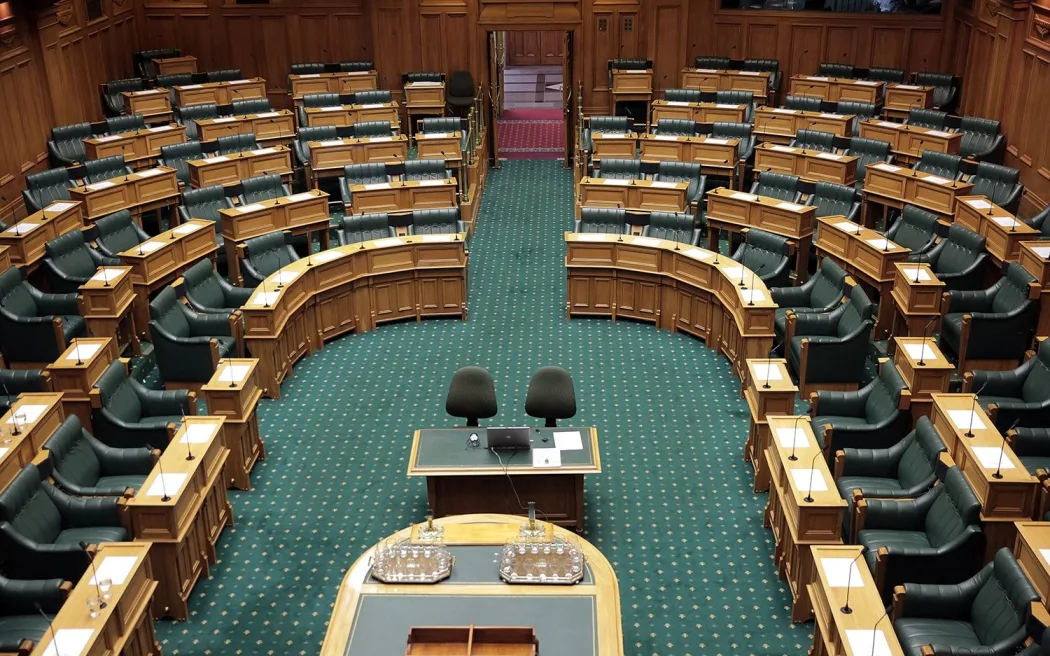
On current numbers, up to 131 MPs could be sitting in the Chamber following the election, brought on by a record overhang result.

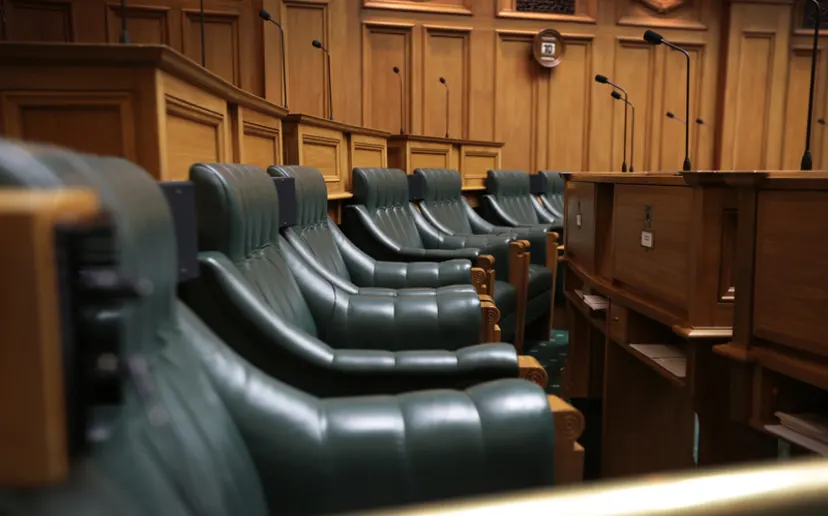
Clerk of the House of Representatives Dr David Wilson told the Spinoff that currently the debating chamber had enough chairs to seat 124 MPs – including the Speaker of the House – and work was being done to accommodate more by altering the seating arrangement.

In a statement, Parliamentary Service chief executive Rafael Gonzalez-Montero said planning for a larger Parliament had been going for “some time”.

“Now that the election results have confirmed an increase to the number of members we are looking at several options.

“We are confident we will be able to accommodate all members within the Chamber.”
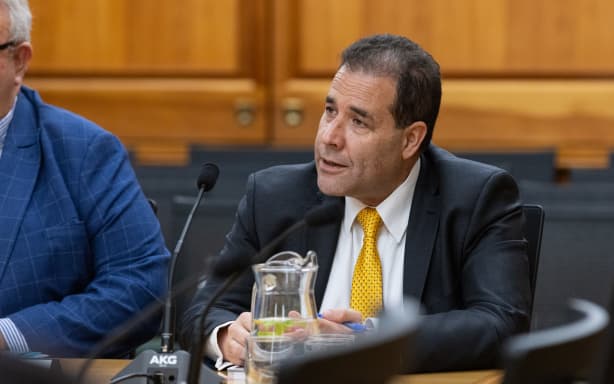
Chief Executive of the Parliamentary Service Rafael Gonzalez-Montero appears before select committee.
Parliamentary Service chief executive Rafael Gonzalez-Montero.

VNP / Phil Smith

Gonzalez-Montero said office accommodation for members and their staff would be “stretched” for a short time, but the new Members’ Building was only a few months away from “practical completion”.

That building – located behind Parliament – was due to be ready to occupy in April next year and had capacity to accommodate around 30 backbench MPs.

“All members should be in fit-for-purpose accommodation from that point,” Gonzalez-Montero said.

Following the 2023 election, 123 MPs sat in the Chamber – a record number at the time. That decreased to 122 following the resignation of National MP Judith Collins.

Collins held the seat of Papakura and stepped down in May and Parliament voted against holding a by-election because it was too close to the election.

The election result also meant high-ranking National Party MPs like Chris Bishop, Paul Goldsmith, Nicola Willis and Gerry Brownlee – Speaker of the House and an MP for 30 years – would likely not make it back into Parliament.

Only resigning or retiring MPs were permitted to give a valedictory speech meaning none of them would get the chance to give a valedictory statement.

Asked if their would be special allowances for valedictories, Wilson said in a statement that normally only MPs were allowed to speak in the House but the House could suspend its own rules or temporarily alter them.

“It could do so to allow former members to address the House.”

Wilson said no such arrangements could be made until the next Parliament opened and members sworn in.

rnz

Continue Reading

Trending

Copyright © 2026 The Buzz: Powered by Apna Network Limited - Concept by Digital Hub NZ