Opposition parties have been accused of trying to whip up racism over a tool which prioritises surgery waitlists based partly on ethnicity.
Green Party co-leader Marama Davidson was asked to apologise after making the accusation in Parliament today.
The ‘Equity Adjuster’ tool was introduced to some hospitals in Auckland and Northland in February, and uses an algorithm to rank people who have been waiting for surgery for more than two years.
It uses five criteria including clinical priority; time already spent on waitlist; rural isolation; deprivation level; and ethnicity – namely, prioritising Māori and Pasifika over others.
It is that ethnicity measure which has riled opposition parties, with National’s Shane Reti on Monday calling it offensive and wrong, and urging the use of the tool to be halted immediately.
National rollout delayed, awaiting further evidence
Prime Minister Chris Hipkins later confirmed he had asked Health Minister Ayesha Verrall to look into whether the tool was working as it should, and “that we’re not replacing one form of discrimination with another”.
Prime Minister Chris Hipkins talks to journalists.Prime Minister Chris Hipkins. Photo: VNP / Phil Smith
“Those who are arguing that we should do absolutely nothing need to explain to New Zealanders why they think that Māori, Pacific, rural, and low-income people should have to wait longer with the same clinical need for healthcare as other New Zealanders,” he said.
“I don’t think that form of discrimination has a place in our health system. I think it’s right that Te Whatu Ora are grappling with how best to address the fact that that has been the case up until now.”
On Tuesday, he told reporters at Parliament the national rollout of the tool would be put on hold until Verrall’s review of it was complete.
“She’s given me an assurance that’s not going to be rolled out any further while that’s happening,” he said. “We don’t want anyone waiting on a wait list for two years, but in getting through the backlog we want to make sure we’re doing that equitably.”
‘It should be about need’ – National
Under questioning from Reti in Parliament on Tuesday, Verrall confirmed the severity of a patient’s health condition was the most influential factor in the algorithm.
“For a clinically high-priority procedure, the other variables will have almost no weight in the algorithm and, therefore, would not influence a person’s wait time. The second most influential factor is the number of days the patient has already been waiting,” she said.
She said she had already met with the multi-disciplinary group who designed the algorithm, and the evidence she had seen so far suggested it was effective for closing gaps between different ethnic groups.
“It brings everyone to equal. We need to continue to track that in the place that it’s been used, which is just two hospitals.
“There are markers we can track along the way including making sure that different groups are waiting an equal time to get their surgery and no group is disadvantaged. That’s what I’ve seen so far.”
National leader Christopher Luxon argued waitlists should only be prioritised based on health need.
“We want everything to be based on a need base only, we will deliver to communities through community health based organisations,” he said.
National Party leader Christopher LuxonPhoto: RNZ / Angus Dreaver
“It should be about need. Everything’s about need. The people at the top of the waiting list are those in the most need. These are scarce resources, they’re allocated to people on the basis of their needs, [regardless of] whether they’re Māori, whether they’re non-Māori.”
Reti said clinical severity was only one aspect to consider, and he could see the logic in considering other things like deprivation or time already waited.
“I think some of the other parts – like how long you’ve been on the waiting lists, that kind of makes sense … I think deprivation makes sense as well, so no, it is the ethnicity part that mostly worries me. I can see some logic with some of the other parts.”
He acknowledged there was a disparity in care for Māori and Pacific people, but suggested the other four criteria already covered off some of the causes of that.
Shane RetiDr Shane Reti. Photo: RNZ / Samuel Rillstone
“There’s no doubt there’s inequities, I’ve talked about it for decades, even published on it actually, but I don’t believe this is the mechanism to do that, to resolve that.
“The solutions to that are to have better cultural competency across the whole health sector, so that when we train at medical schools and nursing schools we’re trained in cultural competency.”
Luxon later clarified his own stance, saying he and Reti were in agreement – those other factors were part of what he was calling “health need”.
“We’re in the same camp. Essentially what we’re saying is the overarching and only principle we should be considering in health is health need. Obviously health need is shaped by clinical state, it’s shaped by time on waiting list, it’s shaped by deprivation.
“Those things are all adding up to an assessment of individual health need – and so you don’t need to have ethnicity in there on its own because actually you’ll pick up Māori, Pasifika, non-Māori, across that, if you come at it from the lens of health need.”
Luxon said it was clear that surgeons were not comfortable with the tool.
“The reality is it’s a government-imposed criteria that’s been put on clinicians and that’s what they’re reacting to and saying ‘it’s unfair’, it’s not the way that they want to look at things,” he said.
When it was put to him that the tool had been designed by clinicians, he said “I don’t care. There is no room for health services to be based on ethnicity rather than need”.
It was also put to him that the Royal Australasian College of Surgeons supported the tool, but he dismissed that too.
“Pretty simple, team. I’m sorry, but we just might have a difference of opinion on it, but with respect to health there’s only one lens to come through and that’s about people’s needs – whether it’s medical, surgical – and the support that they need to be able to deliver that, rather than ethnicity.”
Verrall suggested using a different label such as life expectancy would be tricky to calculate without taking ethnicity into account.
“The fact is, we know that life expectancy is hugely influenced in New Zealand by ethnicity, so any effort to incorporate life expectancy would default to one based on ethnicity. It’s so important we address these inequities in the health system.
“We know there is decades of evidence that Māori and Pasifika wait too long for care. This tool, what I’ve seen, is that it closes those gaps and therefore it’s important we continue to evaluate it.”
Green co-leader ejected after racism claim
ACT’s David Seymour was also critical of the ethnicity measure.
“Everything should be nationwide, but this particular policy of putting some people up the list and some people down with the same need but different races we just oppose. We think it’s wrong. We think people should be treated according to their circumstances, and their clinical need, their location and their deprivation – not their ethnicity.
ACT Party leader David Seymour.Photo: RNZ / Samuel Rillstone
“It is true that Māori and Pacific people have worse health outcomes but so do all people who have bad housing regardless of race. Maybe that should be an issue. We need to get the public service focused on the actual data.”
He and his MPs Nicole McKee, Karen Chhour and James McDowall targeted the matter in Question Time this afternoon.
Green Party co-leader Marama Davidson questioned whether this went against a previous speaker’s ruling which called on MPs to take care about the wider consequences of their statements and questions in Parliament.
“The nature of these questions are absolutely intended to raise racist opinions amongst the New Zealand public,” she said.
She was pulled up on this by Speaker Adrian Rurawhe however.
“It’s a discussion that perhaps this House should have one day, but you cannot make that accusation in this House,” he said. He asked her to apologise, but removed her after she phrased her apology incorrectly.
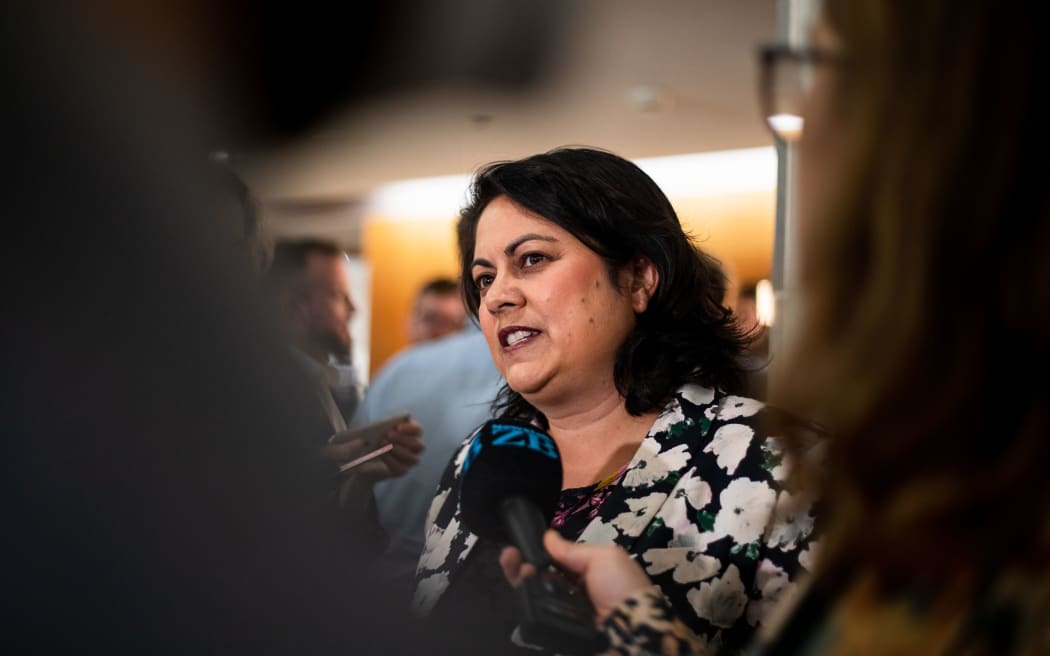
After leaving the chamber, she told reporters she would abide by the speaker’s rulings but it was important to stand up to racism.
“The speaker will make the decisions as he sees fit. What’s most important to me is we should be taking leadership. The health access has not been good for everyone and that’s got to change,” she said.
Green Party co-leaders Marama DavidsonGreen Party co-leader Marama Davidson. Photo: RNZ/ Angus Dreaver
“I’m upset about the line of questioning that the ACT party is using, they actually don’t care about equity, they are weaponising fear and division of people for votes. That to me seems quite horrific, actually.
“It is because of ethnicity that the inequity exists in the first place. I’m open to making sure we address the equities in the right way but we have to remember it is because of ethnicity that those inequities exist in the first place.”
Te Pāti Māori co-leader Debbie Ngarewa-Packer backed that view.
“What we have is an election period that’s been completely run by a bunch of racists, and this isn’t new to us. It’s disappointing but not new,” she said.
“We think the tone of questionings is going to continue to create disorder, I know that it has for us. And sadly that’s what we’ve seen the opposition parties get relegated to is this low level – race baiting.
“I don’t think we should be shy to say that tangata whenua are suffering some of the worst consequences, and through the fault of systems that haven’t been designed with them in mind.
Debbie Ngarewa-PackerDebbie Ngarewa-Packer Photo: RNZ / Samuel Rillstone
“I don’t know what is a pretty way to state the obvious, and I think we should be less uncomfortable with that but more uncomfortable with being shamed or blamed because you have suffered those consequences of oppression and systemic racism for a very long time.”
Seymour rejected the party was stirring up racism.
“The point of some of the questions that they asked is ‘How is it possible that my husband and I live under the same roof, but are somehow going to be treated differently based on our different ethnic backgrounds’,” he told RNZ.
“There certainly are inequities between Māori as a group, and non-Māori as a group … but if your lens is an ethnic lens then of course it’s not surprising that you find ethnic differences. That lens averages people out, it misses people who are doing very well thank you very much but are seen as needy because of their ethnicity. It also misses people who have greater needs but the ‘wrong’, so-to-speak, ethnicity.
“It seems their objection is a policy debate, and they should enter into that policy debate without throwing around these epithets of racism. That doesn’t help.”
It was wrong to say their approach was aimed only at getting votes, he said.
“It’s a difficult charge to answer, because of course every political party including them are trying to get people to vote for them – that’s how democracy works … but the idea that’s the only reason we raise these issues is patently untrue.”
VIA RNZ







 Latest News2 months ago

 NZ News2 months ago

 Latest News2 months ago

 Politics2 months ago

 Fiji News2 months ago

 Politics2 months ago

 NZ News2 months ago

 Latest News2 months ago