

Fiji News
Fiji govt minister apologises to media for abuse and harassment

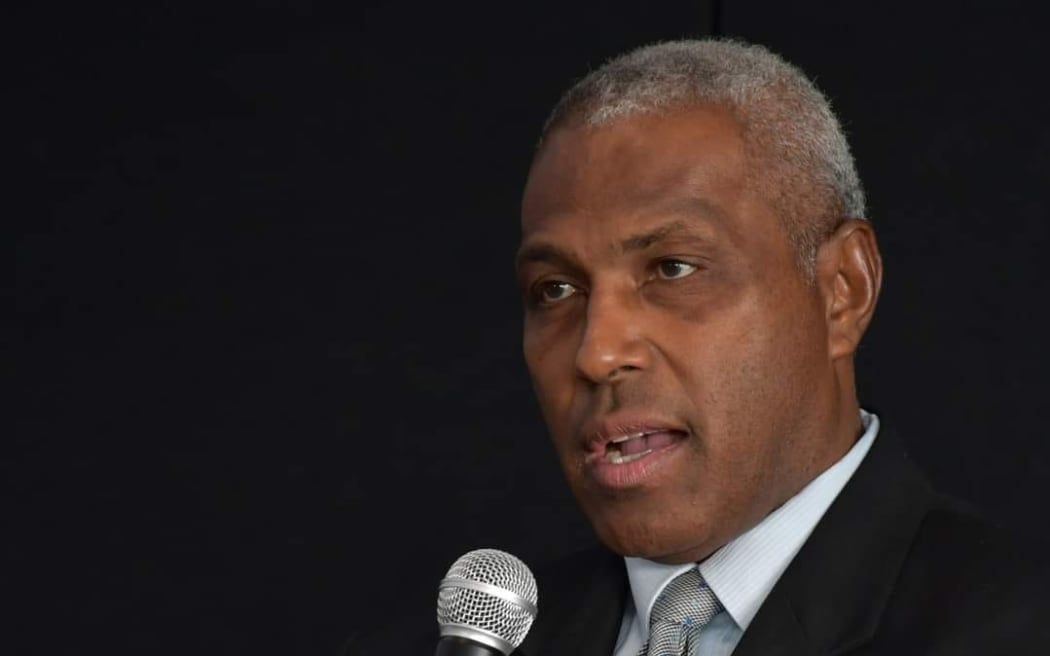
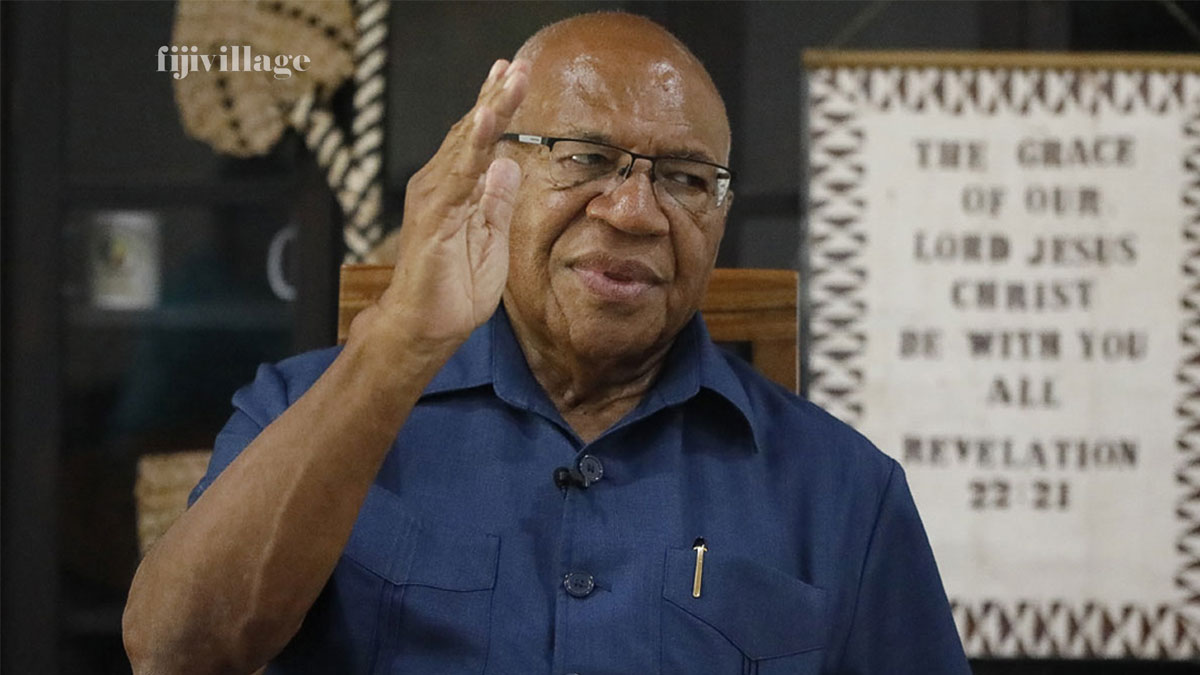
Fiji’s Attorney-General Siromi Turaga has publicly apologised to journalists for the harassment and abuse they endured during the Bainimarama government’s reign.
He was one of the panellists invited to speak following the launch of a report titled Fiji Media Industry Development Act 2010: An Analysis organised by Dialogue Fiji.
The Pacific News agency reported Turaga and other guests heard accounts of abuse suffered by senior journalists at The Fiji Times during editor-in-chief Fred Wesley’s address.
Wesley, who was one of the four people implicated in sedition charges in 2018, spoke of his experience being charged and having the threat of going to prison hanging over him until he and his team were ultimately acquitted by the High Court in Suva.
He also shared an account of the newspaper’s chief of staff Margaret Wise and deputy chief of staff Felix Chaudhary, who both were intimidated and harassed by the military.
Wise was threatened by soldiers at The Fiji Times Lautoka office in 2010, where she was the bureau chief at the time. The soldiers were after her mobile phone, which she refused to hand over.
Wesley said following discussions with their legal counsel, she was ultimately advised to hand over the phone. In fear of further repercussions, Wesley said Wise and her family had to be relocated for their safety.
In the case of Chaudhary, he was taken in for questioning by military personnel while he was covering an event in 2011.
Chaudhary was also locked up in a police cell after “orders were given from above”, Wesley said.
Upon hearing the stories, Turaga said he and Prime Minister Sitiveni Rabuka also had stories to tell.
“In my capacity as Attorney-General, I publicly apologise for the actions taken by the previous administrators in terms of media freedom,” he said.
“A lot of people were victimised.”.
Turaga also said he truly sympathised with what the journalists had gone through. There were also suggestions from those at the report launch for journalists to document such experiences so they may never be erased from history.
The Media Industry Development Act (MIDA) 2010 and its implementation meant that Fiji was ranked 102 out of 180 countries by Reporters without Borders in 2022.
The Act, which was constructed after a mere two-hour meeting with industry representatives, contains exorbitant penalties and jail time for journalists, editors and media companies for any breach.
The coalition government has begun taking steps to keeping its campaign promise of a free press by either repealing, replacing or amending the existing Act.
Turaga, who is also Minister for Justice, said the government held media freedom in the highest regard.
“The government recognises the pivotal role the media plays in Fiji in ensuring the circulation and responsible reporting of information as was evidenced in the Covid-19 pandemic and during the 2022 General Election,” he said.
“That being said, the government reaffirms its support of a free and independent and responsible media.”
Fred Wesley and Communications Fiji Ltd news director Vijay Narayan represented the media at the report launch and voiced their concerns in relation to the Act.
They called for an even playing field for all media organisations in the country and to look into the prospect of increasing shares for foreign ownership to allow companies to grow.
The report also listed a number of recommendations, including clarification of the content regulation clause, revisiting media ownership reforms, and removal of hefty fines.
Government committed to media freedom
On Monday, the prime minister said he was “totally committed” to press freedom.
In his opening statement for the 2023 parlimentary sitting, Prime Minister Sitiveni Rabuka said the country could have proper democracy without a free media landscape.
He said without a free media, people “cannot fulfill their democratic obligations to give their views and participate in governance.”
Rabuka said his government would “carefully study the substantial amount of public funds” collected by one national newspaper for more than a decade – and served as a “propaganda paper” of the previous administration.
“The coalition has given an assurance that we will end that era of media oppression. We’re discussing new legislation that reflects more democratic values.
“There is also discussion about establishing a system of self regulation underpinned by a code of conduct with a media council to adjudicate complaints by the public about the media coverage as was the case before 2006.”

A newspaper stand selling the Fiji Times in Fiji Photo: RNZ/Sally Round

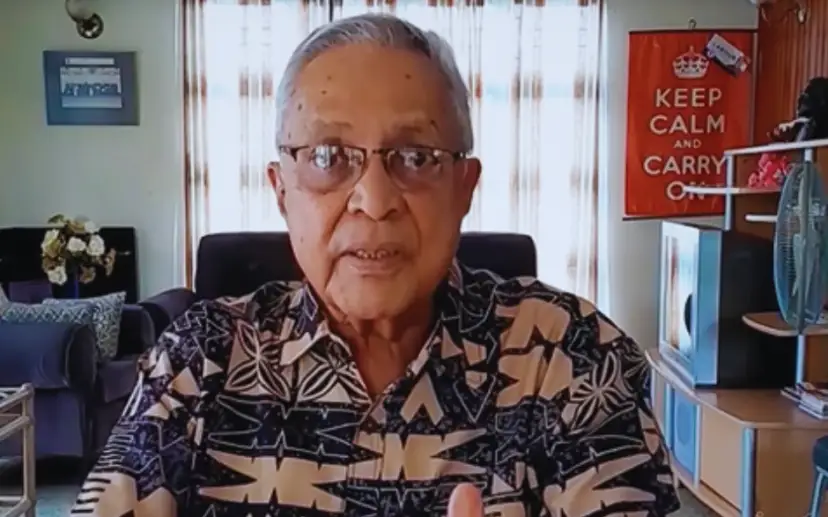
Mahendra Chaudhry, Fiji’s first and only prime minister of Indian descent, has warned that the island nation is “worse off today than we were at independence” and that its political leadership must focus on solving social and economic issues rather than “making multiple constitutions”.
Chaudhry made the comments over the weekend while making a submission to a special parliamentary committee – led by Prime Minister Sitiveni Rabuka – on the country’s constitutional reform process in Vanua Levu, Fiji’s second main island.
“Are we doing enough to alleviate the problems that we face as a nation that our people face, problems of poverty, hunger, unemployment, poor health services, education problems, crumbling infrastructure, the invasion by drug traffickers, HIV, NCDs (non-communicable diseases)?
“Is the economy delivering to the people? Are we giving sufficient attention to the economic problems that the nation faces? Because you can do nothing on the back of a failing economy.
“These are areas where our attention should be focused,” the former prime minister, whose government was held hostage at gunpoint for 56 days during the 2000 ethno-nationalist coup, said.
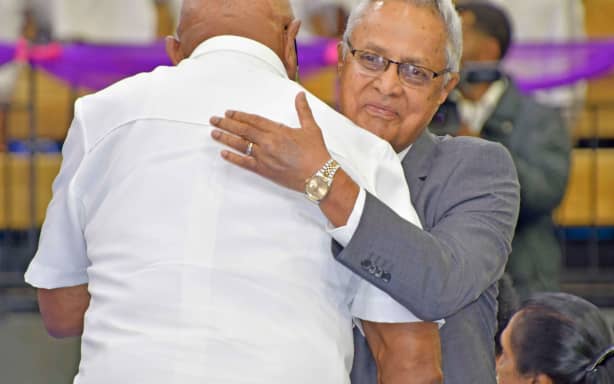
Fiji Government
Rabuka’s coalition has made it its mission to replace the 2013 Constitution – widely criticised as being imposed by the previous Bainimarama administration – ahead of a looming election.
His government is currently conducting nationwide public consultations on its Constitution (Amendment) Bill 2026, which passed its second reading earlier this month and is set to be brought back to parliament for its third reading next week.
If the bill passes its third reading, Fiji is set to hold its first national referendum in December, where the people will vote on whether they want Rabuka’s constitution. In its current form, the bill – presented to parliament in September – has been criticised as a downgrade from what the Constitution Review Commission had proposed.
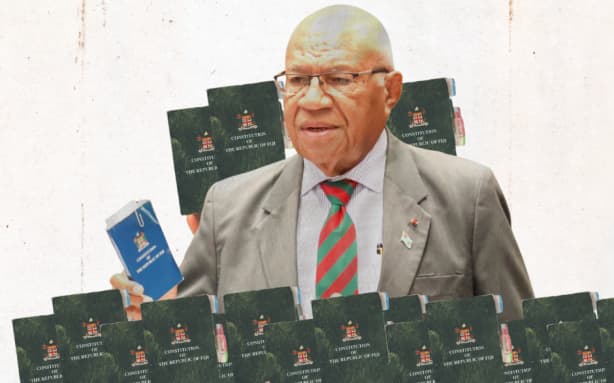
RNZ Pacific / Fiji Parliament
Rabuka and his inner circle are backing the removal of the current constitution despite widespread opposition from local community leaders, non-governmental organisations as well as his own coalition partners who say that the process is being “rushed”.
Rabuka, 78, said he had a responsibility that he would review and amend the 2013 Constitution and “that’s what we’re going for”.
“You voted for us – some in government and some in opposition – so we have the collective vote of the people of Fiji,” he said at one of the public consulations last week.
“And you have entrusted us of doing the amendment in accordance with the rules of the country.”
The move has also given rise to online conspiracies and misinformation that Rabuka is deliberately trying to delay the election, forcing him to provide assurances that the general election will proceed as planned.
More than 723,000 eligible voters are expected to head to the polls no later than 6 February 2027.
Rabuka has so far kept the date of the general election close to his chest, stating previously that the election date will be announced after the constitutional reform process was completed.
“This is the fifth constitution that we will be looking at. Have the four previous constitutions served our purpose? Has it helped the people?” Chaudhry asked.
“Why do we rush this process of a new constitution? It can wait,” he said.
Chaudhry said Fiji could have an election under the 2013 Constitution and the incoming government could deal with the constitutional reform process.
“We have got to listen to the people. In this process, what I have noticed is that everybody has complained,” he said.
“If anything that has come through very clearly and loud in this consultation meeting, it is the people saying, ‘No, look, give us more time’.”
While the government’s constitution bill maintains the common national identity ‘Fijian’ for all its citizens, it proposes a new parliamentary system, brings back an unelected senate, changes the current electoral system, and provides “excessive concentration of constitutional power in the Executive”, according to Fiji’s Centre for Democracy and Dialogue.
It also includes Christianity as a founding value.
Chaudhry said the country should be looking at the proposed constitution that was presented by the Constitution Review Commission and not the government’s version of the document.
“Having had a look at the constitution presented as Bill 32 of 2026, I find it divisive, undemocratic, and discriminatory in many of its provisions,” he said.
“I have no problems with Christian values. I think they are good values, but I believe that religion and state must be kept apart because this is one aspect which can cause serious division [in a] multiracial country like Fiji between communities.
“I am a Hindu. My wife is a Christian. We have no problems. She practices her religion. I do mine. So where is the problem? Why do we have to put in something which is causing controversy? Is it necessary? It is not.”
RNZ
Fiji News
PM confirms the next general elections will be held under the current electoral system and by Feb 6th 2027
Fiji News
‘Respect the people’: Fiji coalition clash over Rabuka’s fast-tracked constitutional referendum

Cracks are starting to show within Sitiveni Rabuka’s coalition government ahead of a looming general election and a potential national referendum, as the country prepares to mark its 56th anniversary on Saturday.
This follows the National Federation Party (NFP) and the Social Democratic Liberal Party (Sodelpa), both the minor partners that helped Rabuka return to power, publicly calling out the prime minister for fast-tracking a constitutional reform process.
NFP leader Biman Prasad, who said earlier that his party fully supported the joint parliamentary process to review Fiji’s proposed Constitution (Amendment) Bill to change the 2013 Constitution, shifted his stance after Rabuka pre-emptively announced a referendum date.
“We (NFP) have said all along very clearly that the new constitution, once and if it is passed and approved, the implementation of that constitution should not be rushed,” Prasad, who was one of three Fiji deputy prime ministers, said on Monday.
However, in a statement on Tuesday, he declared that the NFP “outrightly rejects” Rabuka’s attempt to fast-track the process, comparing the approach to the previous Bainimarama administration’s unilateral implementation of the 2013 Constitution.
He said Rabuka’s announcement was inconsistent with Section 160(3) of the 2013 Constitution on holding a referendum.
“This is not how to formulate a genuine, meaningful, and fair constitution for all our people,” Prasad said.
“It is now clear that [Rabuka] is pre-empting the outcome even before the bipartisan special parliamentary committee, which was unanimously agreed to by parliament last week, has met and started scrutiny and consultation with the people on the draft constitution bill.”
“The prime minister must reconsider his position and respect the people.”

RNZ Pacific / Kelvin Anthony
The election and referendum timelines
Fiji is expected to hold elections by 6 February at the latest as the Rabuka administration’s term legally comes to an end on 24 December. Rabuka has delayed announcing an election date, previously telling RNZ Pacific that it depends on the constitutional reform process.
The prime minister prematurely announced the referendum date for 9 December after the government’s Constitution (Amendment) Bill passed its second reading last Friday. He also announced that he would write to the Electoral Commission to suspend all election-related campaigning until after the referendum.
During the crucial second reading, the government secured 38 votes (out of 53) in favour of the bill to meet the required two-thirds majority of 36 MPs needed to progress the legislation to the next stage.
The Electoral Commission has stated that it would “give the matter serious consideration” before making any decision.
“We will deliberate and consider the extent of the discretion provided under section 15(2) of the National Referendum Act 2026 that provides guidance when the discretion is activated, and whether it should be exercised, including the reasons for and against doing so and the potential impacts of either approach,” it said in a statement.
Demand for ‘constitutional order’
Sodelpa is calling on Rabuka to “immediately respect constitutional boundaries” regarding the national referendum process.
“The rule of law and constitutional order in Fiji cannot be subordinated to executive convenience or political scheduling,” Sodelpa leader Aseri Radrodro, who is also Rabuka’s education minister, said in a statement.
The party said no one was above the law and that all parliamentarians must make decisions that prioritised the Fijian people.
Some of Fiji’s leading civil society organisations have warned that the Electoral Commission cannot lawfully suspend general election campaigning at this stage.
Fiji’s opposition condemned the announcement, saying that Rabuka was “putting the cart before the horse”.
Justice Minister Siromi Turaga has defended the process, stating on Monday that the government would systematically inform the Fijian people about the bill.
But Prasad said parliamentarians cannot do a deal on the constitution behind closed doors.
He said the government must first go back to the people to ask them what they think about the constitution bill.
“That will take time,” he said.
“All our citizens must understand what the draft constitution says and what it means for them. We could never do this in 30 days.
“If this process must be finished after the next election, so be it.”
Prasad said announcing a referendum was not Rabuka’s decision, as under the law, only the president can do that.
“And only after the bill has been passed by parliament. How does the Prime Minister then expect the people to vote for a constitution they have barely seen?”
“This announcement [of a] referendum and the process is wrong. The whole point of a new constitution is to bring our people together. It is not to divide us further.”
More than 723,000 eligible Fijian voters have registered to cast their vote at the general election.
RNZ


Police say person who fired gun at officers still at large

New Zealand sides named for RLWC finals

Parliamentary Service working on extra chairs and offices for increased number of MPs


-

 Latest News2 months ago
‘Chilling’: Business groups speak out against National’s supermarket break-up plan
-

 Latest News2 months ago
Cars bearing Chinese police markings stir unease in Auckland
-

 Fiji News2 months ago
Plans to have new Constitution by Dec 24th 2026
-

 Latest News2 months ago
Five Karangahape Road venues lose their liquor licences after police intervention
-

 NZ News2 months ago
Cop who stole $68,000 can now be named as champion Muay Thai fighter Haimona Tamati-Te Paki
-

 Politics2 months ago
MBIE confirms botched biometric projects costs blown out to $50.7 million
-

 NZ News2 months ago
Nearly 1000 stalking warnings, 140 charges since law came into effect
-

 NZ News2 months ago
Kaikohe man jailed nine years for rape, bat attack and family violence