Analysis – It was a year in which Labour’s support seeped away and its grip on power loosened until, in December, polls consistently showed National and ACT could form a government with a comfortable majority.
It didn’t happen suddenly, and it didn’t all happen in 2022.
During a private session at Labour’s annual conference in November, the party’s pollster Talbot Mills presented a graph which started at the 2020 election and which charted Labour’s support since the 2020 election.
The Herald obtained it, reported it and likened it to a Halloween horror movie for the party faithful.
It showed that Labour maintained majority in the polls until July 2021.
For six months after that it could have governed with just the Greens.
Then in March 2022 it lost that advantage, and over the winter it would have needed both the Greens and Te Māori Pati to govern.
Then it lost that too. From September National and ACT held a majority.
The graph also showed that the cost of living was currently considered by voters to be the biggest issue – it didn’t feature at all in 2020.
Labour had also lost voters’ confidence in running the economy – twice as many, 47 percent to 24 percent – believed National was better at it.
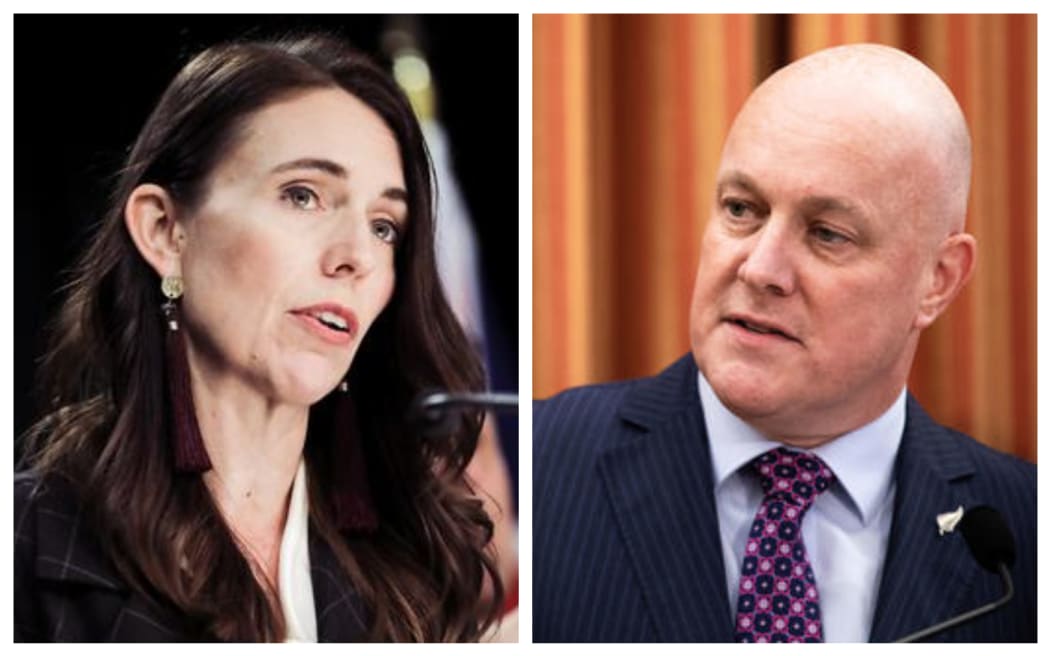
Throughout this period Jacinda Ardern was, and still is, the most preferred prime minister, so what changed to bring Labour down from an unprecedented single-party majority government to trailing the opposition?
Covid, the cost of living and Christopher Luxon.
Labour won the “red tide” election in 2020 because Ardern and her government had kept voters safer than nearly anywhere else as the pandemic raged around the world, and National was in disarray after chaotic leadership changes.
The elimination strategy had been tough but it had worked. The public were behind it. Ardern’s team of five million were playing the game.
In 2021 it all began to change.
A Ministry of Health review, published in June this year, said the first case of the Delta variant was detected on 17 August 2021. Until then, there hadn’t been any community transmission for 100 days.
Central Auckland on Wednesday 25 August 2021 on the eighth today of a Covid-19 lockdown.Auckland during lockdown. Photo: RNZ / John Edens
It was much more transmissible, harder to contain, and caused more serious illness.
At the time, only 18 percent of the population was fully vaccinated.
The government continued with its elimination strategy and ordered an immediate nationwide lockdown.
But Delta couldn’t be beaten. Cases continued to rise and the health system was straining to meet the needs of infected people, MIQ and quarantine.
“It quickly became apparent that we needed a new model for managing Delta,” MoH said in its review.
Gradually, and often confusingly, elimination morphed into managing the outbreak. Vaccination mandates were introduced, which were to become one of the government’s most controversial pandemic problems.
Lockdowns continued sporadically, with Auckland suffering the most, and the government knew that much of the public support that existed through the elimination period was no longer there.
The first Omicron case, also highly transmissible, appeared in January this year soon after alert levels had been replaced by the traffic light system.
Through February, March and April there were numerous changes to the rules amid increasing frustration.
The team of five million had played the game, and they were over it.
By September the government knew people had been through enough, and on 12 September the traffic lights were switched off.
By then the vaccination rate had reached around 95 percent. Vaccination didn’t stop people catching Covid but they were much less likely to become seriously ill.
Weekly instead of daily case numbers were released and the last regular health briefing was on 21 September.
Vast amounts of money had been spent to support the economy through the pandemic and the Reserve Bank had lowered interest rates to help keep it going.
With the country back to nearly normal and learning to live with Covid, a price had to be paid.
Inflation was taking hold around the world, it became known as the Covid hangover. New Zealanders started feeling it in 2021.
Russia invaded Ukraine in February 2022, which helped pushed up fuel prices, and it began to really hurt.
The government blamed international events and handed out a $350 cost of living payment for eligible income earners.
It cut petrol tax by 25 cents a litre and brought in half-price public transport fares. It tried to help poor families by tweaking benefits.
Inflation reached 7.3 percent and stayed there, which the government insisted was lower than a lot of other developed countries but that didn’t do anything to placate struggling families.
It knew, by December, that it couldn’t sustain that sort of spending and announced fuel tax would return to normal at the end of March next year, when half-price fares would also end.
Reserve Bank governor Adrian Orr. Photo:
The Reserve Bank, under a mandate to control inflation, began raising interest rates which fed through to mortgages.
In November governor Adrian Orr said the bank was deliberately engineering a recession which was necessary to deal with the “horrible environment” of embedded inflation.
A perfect storm was brewing, and it was going to happen in an election year.
Labour will remember 2022 as a terrible year, and it started badly with the occupation of Parliament.
A paving stone is thrown at police on the Bowen/Lambton cornerThe protest ended with a riot. Photo: VNP / Phil Smith
What began as a protest against vaccine mandates swelled to include conspiracy theorists, bigots of various kinds and, it seemed, anyone with a grievance about anything.
For 23 days in February and March Parliament’s beautiful grounds were trashed and vandalised, roads were choked with illegally parked vehicles and Wellingtonians often voiced their fury about police inaction.
It should have been shut down at the start, it got totally out of hand, and when the police did move in on 2 March there was a riot.
The occupation eclipsed all other political events and reporting, and while the government wasn’t directly blamed it didn’t come out of it well.
Ardern, in one of her year-end interviews, described it as “one of the most challenging parts of the year” and thought it had been very hard for New Zealanders to see it happening.
When Parliament got back to a normal existence the government got on with an agenda which included the huge projects of transforming the health system, getting Three Waters legislation through Parliament and replacing the Resource Management Act.
It also began changing the rules around the supermarket sector to curb excessive profits and bring down prices, but while there was a lot of talk about “helping Kiwis at the checkout” there were no short-term gains for families struggling with inflation.
And it made some serious blunders. Stuff gave Revenue Minister David Parker its Mistake of the Year award for the KiwiSaver tax debacle.
Labour MP Nanaia MahutaLocal Government Minister Nanaia Mahuta. Photo: RNZ / Angus Dreaver
Local Government Minister Nanaia Mahuta was at the centre of the entrenchment fiasco, which did nothing to ease the path of the highly controversial Three Waters project.
The legislation was passed just before Parliament adjourned.
In October the government announced farmers would start paying for agricultural emissions from 2025 through a scheme three years in the making, which caused rural rage and doomsday predictions for the future of New Zealand’s backbone industry.
Although the government would argue that it did many good things to help lower and middle income families during 2022, and it did, it was the big, transformative initiatives that made the headlines and, with the possible exception of the supermarket rule changes, they were vote losers.
Ardern’s last words before Parliament adjourned was an announcement that ministers had been told to take a hard look at their legislative agenda over the break because there was going to be some trimming down and a total focus on the economy.
Difficult and unpopular projects are likely to be dropped or put on hold – the RNZ/TVNZ merger being one of them.
Ardern suggested the government had taken on too much, and perhaps that was because it had its own majority and it could do what it liked.
In the process it might have forgotten what voters liked.
Throughout 2022, Labour’s loss was National’s gain.
Christopher Luxon was elected party leader in December 2021 and stabilised the caucus.
He was good at it, although he was helped by the party’s MPs having realised that unless they got their act together the party had no chance of presenting itself as an alternative government.
Under Luxon National steadily gained support, rising to the high 30s in the polls. By the end of the year it was well ahead of Labour.
The tactic was to keep up intense pressure on the government, particularly over the cost of living, with Luxon and his deputy and shadow finance minister Nicola Willis leading the charge.
They blamed the government for nearly everything that was going wrong, including the health system which was struggling with chronic staff shortages.
Luxon persisted with his claim the government was “addicted to spending” which he said was fuelling inflation.
National promised to be a prudent, responsible government but there was very little hard policy and no detail on what would be cut – something the government continually highlighted.
Luxon, early on in his reign, did promise tax cuts including abolishing the top tax rate but took that plan off the table when the Reserve Bank issued its recession warning.
He promised “full fiscals” would be presented well before the election, with costed policies. They will be eagerly awaited.
Luxon crept up on Ardern in the preferred prime minister stakes during the year but didn’t look like overtaking her.
That caused commentators to suggest voters weren’t sure about him – although polls showed a majority wanted a change of government, they hadn’t made up their minds about whether he was the right man to lead it.
Luxon will be working on that next year. He’s been gaffe-prone and his inexperience – he had been an MP for just a year when he became leader – has showed.
When those TV election debates come round, he’ll be tested by a very experienced opponent.
David SeymourACT Party leader David Seymour. Photo: RNZ / Samuel Rillstone
ACT’s irrepressible leader David Seymour also had a good year, keeping his party’s support at around 10 percent despite National’s rise.
In Parliament he was better than Luxon at needling Ardern, and the prime minister’s “arrogant prick” comment proved it.
ACT, advantaged by National’s meltdown, won 10 seats in 2020 and nine of its MPs were rookies. There were predictions that at least one of them would be a loose cannon but that didn’t happen.
Caucus discipline was admirable and Seymour was able to maintain the party’s support level.
The Hamilton West by-election in December was described by RNZ as a litmus test for next year’s general election.
National easily took the Labour-held seat, and if the results really do play out nationwide the government is going to be in serious trouble.
Tama Potaka up on stage with his whanau after preliminary votes show he has won the Hamilton West seat by a comfortable margin.National’s Tama Potaka won the Hamilton by-election. Photo: RNZ / Andrew McRae
The Greens, who Labour will most definitely need if it gets a chance at a third term, also held their ratings through the year despite the bizarre refusal to re-appoint co-leader James Shaw at its annual conference in July.
A group of disgruntled members who didn’t think he was doing enough about climate change prevented him from getting enough votes to keep his position.
That forced another vote, which he won. No other candidate came forward.
The Greens appear immune from the sort of swings that can afflict minor parties and the party isn’t much affected by what happens to National or Labour.
Its support seems to be locked in and will probably stay that way through next year, unless it does something catastrophic.
Te Pāti Māori co-leaders Rawiri Waititi and Debbie Ngarewa-Packer speak to RNZ at the end of 2022Te Pati Māori co-leaders Rawiri Waititi and Debbie Ngarewa-Packer. Photo: RNZ / Angus Dreaver
Te Pati Māori, with its two co-leader MPs, made as much noise as it could during the year with its limited presence and was reported to have built up a solid grassroots organisation.
Rawiri Waititi and Debbie Ngarewa-Packer appear to have a firm grip on the leadership and the party, with polls showing the prospect of at least the same representation after the general election and possibly one or two more MPs.
Then there was Winston Peters. New Zealand First, he declared in October, was back and would fight the next election.
In November, very unusually, he ruled out working with Labour in the next Parliament.
Peters had never before said which of the main parties he would join in coalition.
He didn’t say he would join National, but it would be either that or go on the cross benches.
First he has to get NZ First back into Parliament, and he needs 5 percent of the party vote to get there.
By year end polls were giving it between 3 percent and 4 percent – another comeback could be in reach.
The party usually does better than polls show, and Peters is a grievance politician who campaigns well.
He has a lot of grievances to work on this time.
*Peter Wilson is a life member of Parliament’s press gallery, 22 years as NZPA’s political editor and seven as parliamentary bureau chief for NZ Newswire.
Source – RNZ









 Latest News2 months ago

 NZ News2 months ago

 Politics2 months ago

 Latest News2 months ago

 Fiji News2 months ago

 NZ News2 months ago

 Politics2 months ago

 Latest News2 months ago