

Latest News
NZ’s marine heatwave is back – forecasters predict ‘hot, sticky’ January


Kiwi holidaymakers could be looking forward to an unusually hot and sticky January as the country is enveloped by a resurgent marine heatwave.
The balmy ocean temperatures, already up to 3C above average in some regions, will be welcome news for thousands of people fleeing the office and flocking to the beach.
But the elevated conditions may also worsen humidity in many places this summer, adding to uncomfortably hot days and nights.
Authorities are also warning of higher fire danger in many parts of the country, after months of rain and vegetation growth.
Water safety experts are also urging beachgoers to take extra care around the ocean, lakes and rivers, with the summer holidays representing the peak danger period for drownings.
Niwa forecaster Ben Noll said sea surface temperatures (SSTs) jumped in the past two weeks with coastal waters now running between 1C and 3C above average ahead of the busy holiday period.
“We’re looking at a moderate marine heatwave signal at present, with the opportunity to become something more severe in coming weeks.”
For beachgoers, a marine heatwave – defined by SSTs being at the upper bounds of historical observations for at least five days – meant noticeably balmier water.
But the heatwaves have also fuelled scorching days and nights, wildfires, glacier melt and a host of damaging effects for ocean life.
After seas warmed up over a record-hot November, they cooled around the start of this month, bringing a brief respite after two years of relentless marine heatwave conditions in many regions.
Now, Noll said, sea temperatures were soaring once more.
“It’s really warmed up over the past 10 to 14 days with the arrival of warmer air masses,” he said.
“We’re seeing anomalies in the order of 1-3C above average, pretty much right across the country, but the real hotspots are the west coast of the upper South Island, near places like Westport and Greymouth, where SSTs are tracking at 2-3C above average.”
Similar values were being observed around Tasman and Golden Bay, and further up the country near Manawatu and Taranaki.
“But because everywhere is basically elevated by about a degree, if you’re swimming at the beach, you’ll definitely notice that it’s pretty warm.”
While our seas weren’t yet as unusually warm as they were this time last year, Noll said this year’s heatwave looked to be just getting going.
“As we look ahead, there are going to be some really hot temperatures between Boxing Day and New Year, especially in the west of both islands,” Noll said.
“We can expect to get to a place where the feedback mechanism between coastal SSTs and land temperatures really start to work off of one another, which means warmth can get locked in for extended periods.
“It may even be the case that this warm weather we’re about to get locks us in for a hot, sticky January.”
While SSTs typically peaked mid-summer, past years had shown warmer waters could linger through autumn and beyond.
Just how long this heatwave lasted would dictate what extreme impacts it came with: notably melting ice, tropical fish drifting into colder climates and kelp dying.
Scientists would also be watching for damaging knock-on effects for species deeper in the ocean, like crayfish and sponges, that couldn’t so easily escape the heat.
Marine heatwave conditions recently recorded in Fiordland – where sea surface temperatures have soared to 5C above normal – have proven the most impactful seen.
Scientists were alarmed this year to discover millions of sea sponges there had turned from velvet-brown to bone-white – one of the worst bleaching events documented among sponge species anywhere.
Warmer coastal waters could energise low-pressure systems – meaning heavier deluges – but also contribute to heatwaves and fire danger on land.

Scientists will be watching for damaging knock-on effects for species deeper in the ocean, like crayfish, that can’t easily escape the heat. Photo: University of Waikato
With La Nina steering our summer climate once again, Fire and Emergency NZ (Fenz) has predicted fire danger would be higher this season in the north and west of the North Island and the south and west of the South Island, but lower in eastern areas.
“We’ve had warmer than normal conditions, with good rainfall across many areas,” Fenz national wildfire manager Tim Mitchell said.
“It’s great that it’s green but if people don’t stay on top of that growth – and it dries out – it could become a significant fire risk.
“This is particularly dangerous around buildings and homes, as dry grass can help fires spread very quickly.”
But while New Zealand had recently seen a string of record or near record summers, with plenty of moisture in the ground ahead of our warmest weeks of the season, the country wasn’t starting off as dry as last year.
Soil moisture was currently at low levels only in central and coastal Otago, Banks Peninsula and pockets elsewhere in eastern regions.
“The first week of December was cooler than usual, but La Niña temperatures are kicking in, producing above average summer temperatures, overall,” MetService forecaster Georgina Griffiths said this week.
As our planet heats, scientists only predict marine heatwaves to grow longer, stronger and more severe.
Niwa researchers recently warned local average sea temperatures could rise by 1.4C within four decades – and almost 3C by the century’s end.
That would mean that, by mid-century, we could be facing 260 days of marine heatwaves per year – and 350 days by 2100 – compared with the 40-odd days we see now.
Source – RNZ



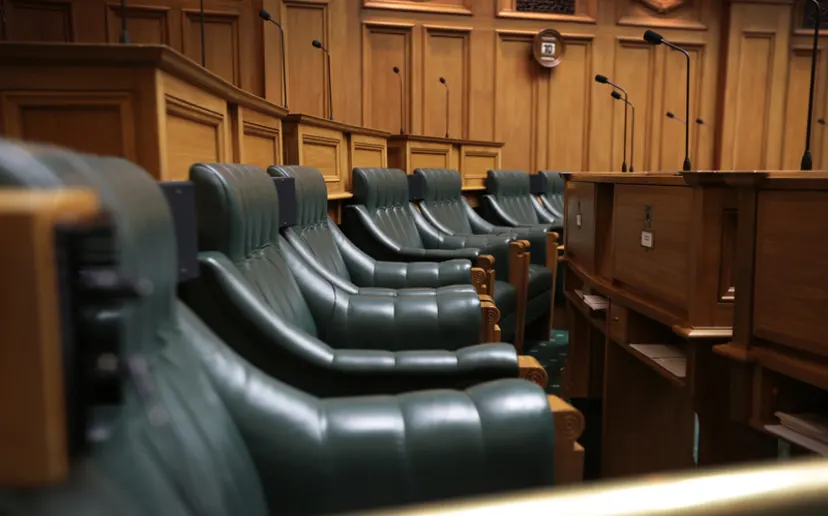
The chief executive of the Parliamentary Service is confident there will be enough room to accommodate the increased number of MPs and their staff coming into Parliament.
On current numbers, up to 131 MPs could be sitting in the Chamber following the election, brought on by a record overhang result.
Clerk of the House of Representatives Dr David Wilson told the Spinoff that currently the debating chamber had enough chairs to seat 124 MPs – including the Speaker of the House – and work was being done to accommodate more by altering the seating arrangement.
In a statement, Parliamentary Service chief executive Rafael Gonzalez-Montero said planning for a larger Parliament had been going for “some time”.
“Now that the election results have confirmed an increase to the number of members we are looking at several options.
“We are confident we will be able to accommodate all members within the Chamber.”
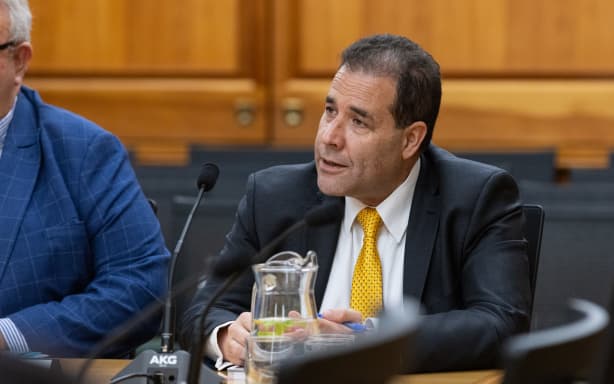
VNP / Phil Smith
Gonzalez-Montero said office accommodation for members and their staff would be “stretched” for a short time, but the new Members’ Building was only a few months away from “practical completion”.
That building – located behind Parliament – was due to be ready to occupy in April next year and had capacity to accommodate around 30 backbench MPs.
“All members should be in fit-for-purpose accommodation from that point,” Gonzalez-Montero said.
Following the 2023 election, 123 MPs sat in the Chamber – a record number at the time. That decreased to 122 following the resignation of National MP Judith Collins.
Collins held the seat of Papakura and stepped down in May and Parliament voted against holding a by-election because it was too close to the election.
The election result also meant high-ranking National Party MPs like Chris Bishop, Paul Goldsmith, Nicola Willis and Gerry Brownlee – Speaker of the House and an MP for 30 years – would likely not make it back into Parliament.
Only resigning or retiring MPs were permitted to give a valedictory speech meaning none of them would get the chance to give a valedictory statement.
Asked if their would be special allowances for valedictories, Wilson said in a statement that normally only MPs were allowed to speak in the House but the House could suspend its own rules or temporarily alter them.
“It could do so to allow former members to address the House.”
Wilson said no such arrangements could be made until the next Parliament opened and members sworn in.
rnz


Police say person who fired gun at officers still at large

New Zealand sides named for RLWC finals

Parliamentary Service working on extra chairs and offices for increased number of MPs


-

 Latest News2 months ago
‘Chilling’: Business groups speak out against National’s supermarket break-up plan
-

 NZ News2 months ago
Tom Phillips report: The missed opportunities to find the children
-

 Politics2 months ago
National vows to try to split Pak’nSave and New World
-

 Latest News2 months ago
Cars bearing Chinese police markings stir unease in Auckland
-

 Fiji News2 months ago
Plans to have new Constitution by Dec 24th 2026
-

 NZ News2 months ago
Cop who stole $68,000 can now be named as champion Muay Thai fighter Haimona Tamati-Te Paki
-

 Politics2 months ago
MBIE confirms botched biometric projects costs blown out to $50.7 million
-

 Latest News2 months ago
Five Karangahape Road venues lose their liquor licences after police intervention