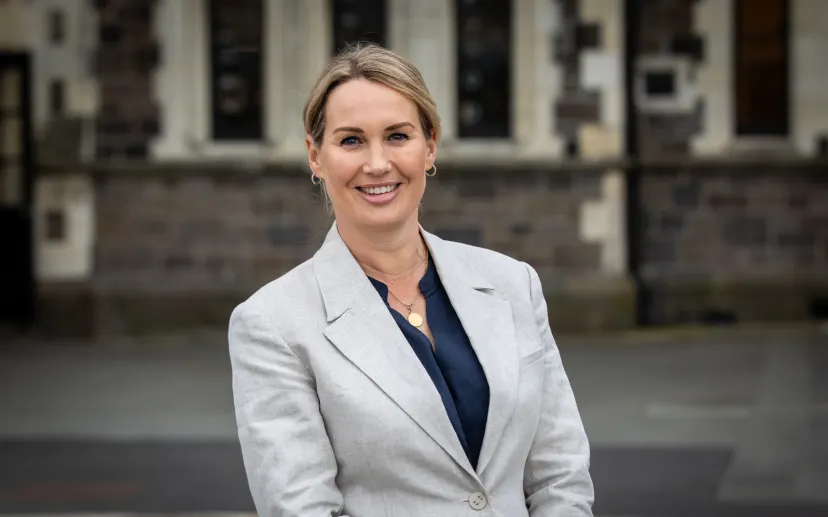
Minister for Women and National MP Nicola Grigg is taking medical leave to deal with a cancer diagnosis, the Prime Minister says.
In a statement, Christopher Luxon said Grigg recently underwent surgery and is scheduled for another in a fortnight, before beginning further treatment.
“Nicola has a positive prognosis and is hopeful of a successful outcome.”
“I want Nicola to take the time she needs for her treatment and recovery. The whole National team backs her as she focuses on getting well.”
Luxon confirmed National MP Penny Simmonds would take over Grigg’s portfolio’s of Minister for the Environment and Women while she was on medical leave.
Grigg went to Parliament in 2020 after winning the safe National seat of Selwyn in the 2020 election. She worked as a journalist before shifting to politics, working for former National leaders Bill English and Simon Bridges.
Luxon said Grigg is a very committed MP.
“She wants to assure Selwyn residents her electorate office is fully operational, and her team will be available to help with their enquiries while she is on leave,” he said.
A weak New Zealand dollar might be hard on anyone shopping from international websites for Christmas presents or putting fuel in their cars but could be helping us in other ways, ASB says.
Over the past 20 years, the average value of the dollar has been about US70c.
ASB senior economist Chris Tennent-Brown said the impact would be felt differently across the economy. Households and New Zealanders travelling internationally would feel the pinch, but exporters, tourism operators and investors could benefit.
Tennent-Brown said the dollar was historically low against most major currencies except the Japanese yen. That was because our interest rates have got out of step with most other countries’.
“We’ve got very high inflation, which is something that many western economies are dealing with, but we’re coming at that problem from a very low interest rate setting, and I’d still say our interest rates are quite low on a historical basis.
“If we compare it to across the Tasman, Australia’s official cash rate is a couple of percent higher than ours, and normally New Zealand needs to have a bit of a premium over other countries, so we’re below Aussie, we’re below the US in terms of an official cash rate, that impacts wholesale rates and that does weigh on the New Zealand dollar.”
The focus on interest rates would continue for some time, he said.
“I think interest rates will be important over the next couple of years, and some of that will be the Reserve Bank returning our official cash rate and our interest rates towards more normal levels – or neutral when we put some economic jargon in there about where the official cash rate should be – and likewise some of the countries that have been pretty aggressive on tightening over the past year, Australia is a good example, will perhaps be easing interest rates next year whilst we’re still trying to get them back to more normal levels, so that will all impact the exchange rate over the year ahead.”
How the dollar moved had different effects on various parts of the economy.
“For households buying imported goods, or Kiwis spending money overseas, it can mean higher prices and less bang for buck. But for exporters earning offshore, tourism businesses and some investors with international exposure there can be meaningful upside,” he said.
Oil and refined products like diesel, petrol and aviation fuel are priced globally in US dollars, meaning a weaker NZ dollar compounds already high international fuel costs. The impact is ultimately felt at the petrol pump, in airline ticket prices, and in the cost of transporting people and goods.
But it made New Zealand a more appealing tourism destination and could also encourage New Zealanders to holiday at home, too.
“That could provide a double boost for parts of the tourism and hospitality sector over summer, with more international visitors coming and more Kiwi choosing to spend their holiday dollars at home. Some of us may even remember the 1980s tourism campaign – ‘don’t leave town until you’ve seen the country’. It’s true, and it worked,” Tennent-Brown said.
The weak dollar also boosted key exports such as dairy and meat.
“It’s painful every time we buy something that has an international price, and petrol’s the obvious one, but it is supporting the rural recovery with things like the Fonterra milk price update … reflecting how the weak New Zealand dollar flows through to improved incomes at the farm gate, but it has some impacts on the rest of the economy.
“The rural income story is definitely a beneficiary of the weak New Zealand dollar … it’s a twin-edged sword though, because things like fertilizer prices, investing in plant and machinery is clearly going up, just as the New Zealand dollar goes down.”
He said there could also be a silver lining for those with money invested offshore, including through KiwiSaver. A weaker NZ dollar can provide a currency tailwind for international investors.
“Every investment manager will have an approach to FX management. ASB maintains a deliberate mix of hedged and unhedged international assets. Keeping a portion of global equities unhedged provides a natural buffer during global market downturns, as the NZD historically tends to fall during periods of economic stress, lifting the value of overseas shares.”
After a horror start to the test series, the Black Caps have fought back on day one against India at the Basin Reserve, grinding their way to 243 for 5.
Sent in to bat on a green pitch, New Zealand lost five wickets for just 70 runs as the Indians ripped through the top order, Jasprit Bumrah taking three scalps including that of skipper Tom Latham for a duck.
Devon Conway, Daryl Mitchell, Rachin Ravindra and Tom Blundell all fell cheaply to leave the Kiwis reeling.
However, Henry Nicholls and Glenn Phillips combined to resurrect the innings, combining for an unbeaten 173 run partnership to bring their side right back into the contest.
Nicholls brought up his 12th test century in the third session, ending the day unbeaten on 113 while at the other end Phillips is just six shy of three figures.
Bumrah was the pick of the Indian bowlers, taking three for 52.
More people are being charged for low-level drug offending than ever in the last decade, despite a 2019 law change telling police not prosecute unless it’s in the public interest.
Authorities had been told to consider a health-centred approach instead, but data collated by the Drug Foundation shows more than 4200 people were charged for unlawful possession or use in 2025 and 2026 period.
Of those cases, 960 had possession or use as the only charge they faced.
In the same year, 15 people were imprisoned for drug possession or use alone.
The maximum penalty for possession or use is three to six months in prison depending on class, or a fine of $500 to $1000.
Dave Burnside is the lived experience leader at Odyssey Trust, an addiction treatment service based in Auckland.
He said the trend was worrying.
“Particularly when most of the world is turning to a health not handcuffs approach and recognising the futility of criminalising drug use particularly and possession,” he said.

Odyssey Trust lived experience leader Dave Burnside.
Supplied / Odyssey Trust
Burnside had his own experience with the system, where minor cannabis charges led him on a downward spiral to other offending and prison time.
“It gave me a criminal record, it affected my opportunities in terms of employment, travel, education and other things,” he said.
“I ended up spending considerable time in jail over my life, and the offending increased.”
It was only when Burnside was able to get treatment later in his life that he was able to break free from that world.
“There are alternatives that exist, and we’re just not using them,” he said.
He said there needed to be investment and provision for treatment options, as well as a shift in perception.
“One of the key things is that criminalising people, charging more people, imprisoning more people does not make communities safer,” Burnside said.
“Those people will come out, they will have lost any sort of employment, any housing, any supports that they’ve had and be expected to rebuild that with very little support.”
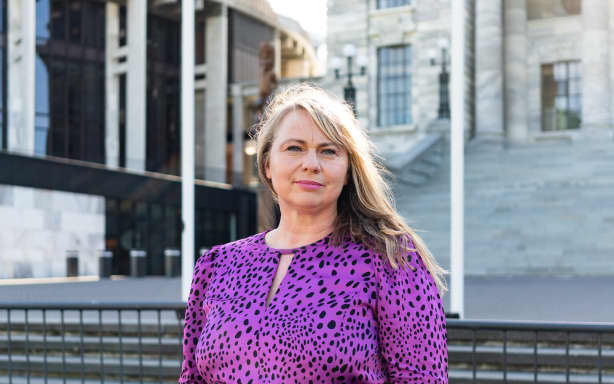
NZ Drug Foundation executive director Sarah Helm
Supplied/ NZ Drug Foundation
Executive director of the Drug Foundation, Sarah Helm, said over the period covered by the report, consumption of meth and cocaine had surged, as did the harm it caused.
“It does pose the question whether or not it is in the public interest to continue prosecuting for drug use and possession,” she said.
The report also highlighted that Māori were charged with drug offences nearly five times more than the rate of non-Māori in the last year.
Helm said that was the tip of the iceberg.
“The disparity grows as you move into convictions and imprisonment, with almost 60 percent of people imprisoned for drug crime are Māori.”
Police’s Greg Williams of the National Organised Crime Group investigates the most serious level of drug and gang offending.

Greg Williams, of Police’s National Organised Crime Group.
RNZ / Angus Dreaver
He said those who were charged with minor drug offences were often also facing more serious crimes.
“What you’re seeing in that charging data is a lot of examples of [possession of a drug utensil] but the reality, even the report accepts this, is that it was associated with other more serious offending,” he said.
“You can talk about people charged, but actually what this report fails to realise is the other resolutions that occur around the back of this.”
Williams said from the start of July 2021 to the end of July 2026 there had been 12,429 people charged with drug offences who went through non-court action, like diversion and warnings.
Police wanted to see more investment in treatment programmes also, but enforcement was still needed against those at the top of the drug trade, he said.
“We believe there’s that need to provide that support to people who have that addiction the opportunity to get off it, because they really want to get away from it.”