

Latest News
Disabled teen loses deportation appeal, ordered to leave New Zealand


A teenager who uses a wheelchair and needs help with daily tasks such as eating, bathing and dressing has been ordered to leave the country or face deportation.
Her resident family will likely have to leave New Zealand with her, after the teen’s appeal against deportation on humanitarian grounds failed.
The teen, who has cerebral palsy, spastic quadriplegia, vision impairment and an intellectual disability, arrived in New Zealand from the Philippines in December 2024, having been granted a special visitor visa after a failed first attempt.
She then overstayed her visa by almost a year, making her liable for deportation.
An appeal lodged on her behalf was declined.
The Immigration and Protection Tribunal found last month that the teen, whose name and identifying details are suppressed, had not established that there were exceptional circumstances of a humanitarian nature.
However, given her dependence on family for daily care, the tribunal allowed the family four months to make arrangements for the teen’s departure and “potentially their own”.
The family also needed time to arrange care for the teen on her return to the Philippines, tribunal member Natalie Small said.
The teen’s father arrived in New Zealand in late 2017 on an essential skills work visa, followed by her mother and two siblings in 2020 on work and student visas.
The high-needs teen remained in the Philippines while the family sought ways for her to join them in New Zealand.
In November 2021, the father lodged an application for a resident visa under the Accredited Employers category and included his wife and all three children.
The application was withdrawn a few months later and replaced with one under the “Special” category.
The application included medical evidence disclosing the teen’s condition.
Small said the father withdrew the teen from the application in August 2022. In March 2023, the parents and two siblings were granted resident visas and became permanent New Zealand residents in 2025.
Special visitor visa granted on second attempt
An application was lodged on the teen’s behalf in January 2024 for a six-month visitor visa but was turned down when Immigration New Zealand found she did not have an acceptable standard of health because she required fulltime care.
The family tried again in May 2024. Four months later, the Minister of Immigration granted her a nine-month special visitor visa.
In evidence presented to the minister, it was noted that the teen’s mother had travelled back to the Philippines in 2023 to take care of her daughter.
The pair then travelled to New Zealand in December 2024.
Small said the teen’s visitor visa expired on September 7, 2025, meaning she had been unlawfully in New Zealand since then while being cared for by her family.

NZ Herald / Supplied
Teen’s case ‘did not meet statutory test’
In making its decision, the tribunal focused on whether exceptional circumstances of a humanitarian nature would arise from deportation.
Small said the teen’s case did not meet the statutory test.
“This is because it has not been demonstrated that the appellant’s health needs, or any inability to provide for those health needs, has arisen out of, or as a consequence of her liability for deportation.”
Small said the teen appeared to have been adequately cared for in the Philippines after her mother and siblings left in 2020, possibly by the parents’ large, extended families who were still there.
“There is nothing exceptional about a person who arrives in New Zealand with a pre-existing medical condition who has had adequate support in their home country,” Small said.
She said it appeared that the teen’s cerebral palsy had been a constant feature in her life and that of her family, and that she would need ongoing assistance.
“That is true whether she is in New Zealand or in the Philippines.”
Small said the evidence suggested the family had been able to make adequate care arrangements for her in both countries.
“In this case, there is no evidence to establish that the appellant cannot access daily support and/or medical support in the Philippines should she require it.”
Small said the teen’s family, as permanent residents, could leave New Zealand and return at any point.
The fact that her parents were faced with difficult choices was a result of their earlier decisions to move to New Zealand and obtain residence status here.
“They have long known that the appellant will not meet the eligibility requirements for residence and so there is nothing unexpected or uncommon in the requirement that the appellant must go home while they have the ability to remain in New Zealand,” Small said.
* This story originally appeared in the New Zealand Herald.
rnz




The chief executive of the Parliamentary Service is confident there will be enough room to accommodate the increased number of MPs and their staff coming into Parliament.
On current numbers, up to 131 MPs could be sitting in the Chamber following the election, brought on by a record overhang result.
Clerk of the House of Representatives Dr David Wilson told the Spinoff that currently the debating chamber had enough chairs to seat 124 MPs – including the Speaker of the House – and work was being done to accommodate more by altering the seating arrangement.
In a statement, Parliamentary Service chief executive Rafael Gonzalez-Montero said planning for a larger Parliament had been going for “some time”.
“Now that the election results have confirmed an increase to the number of members we are looking at several options.
“We are confident we will be able to accommodate all members within the Chamber.”
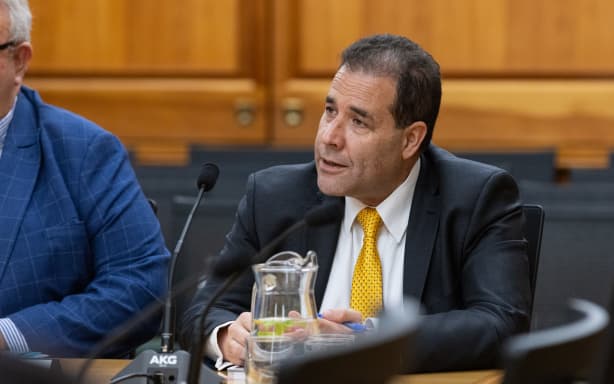
VNP / Phil Smith
Gonzalez-Montero said office accommodation for members and their staff would be “stretched” for a short time, but the new Members’ Building was only a few months away from “practical completion”.
That building – located behind Parliament – was due to be ready to occupy in April next year and had capacity to accommodate around 30 backbench MPs.
“All members should be in fit-for-purpose accommodation from that point,” Gonzalez-Montero said.
Following the 2023 election, 123 MPs sat in the Chamber – a record number at the time. That decreased to 122 following the resignation of National MP Judith Collins.
Collins held the seat of Papakura and stepped down in May and Parliament voted against holding a by-election because it was too close to the election.
The election result also meant high-ranking National Party MPs like Chris Bishop, Paul Goldsmith, Nicola Willis and Gerry Brownlee – Speaker of the House and an MP for 30 years – would likely not make it back into Parliament.
Only resigning or retiring MPs were permitted to give a valedictory speech meaning none of them would get the chance to give a valedictory statement.
Asked if their would be special allowances for valedictories, Wilson said in a statement that normally only MPs were allowed to speak in the House but the House could suspend its own rules or temporarily alter them.
“It could do so to allow former members to address the House.”
Wilson said no such arrangements could be made until the next Parliament opened and members sworn in.
rnz


Police say person who fired gun at officers still at large

New Zealand sides named for RLWC finals

Parliamentary Service working on extra chairs and offices for increased number of MPs


-

 Latest News2 months ago
‘Chilling’: Business groups speak out against National’s supermarket break-up plan
-

 NZ News2 months ago
Tom Phillips report: The missed opportunities to find the children
-

 Latest News2 months ago
Cars bearing Chinese police markings stir unease in Auckland
-

 Politics2 months ago
National vows to try to split Pak’nSave and New World
-

 Fiji News2 months ago
Plans to have new Constitution by Dec 24th 2026
-

 Politics2 months ago
MBIE confirms botched biometric projects costs blown out to $50.7 million
-

 NZ News2 months ago
Cop who stole $68,000 can now be named as champion Muay Thai fighter Haimona Tamati-Te Paki
-

 Latest News2 months ago
Five Karangahape Road venues lose their liquor licences after police intervention