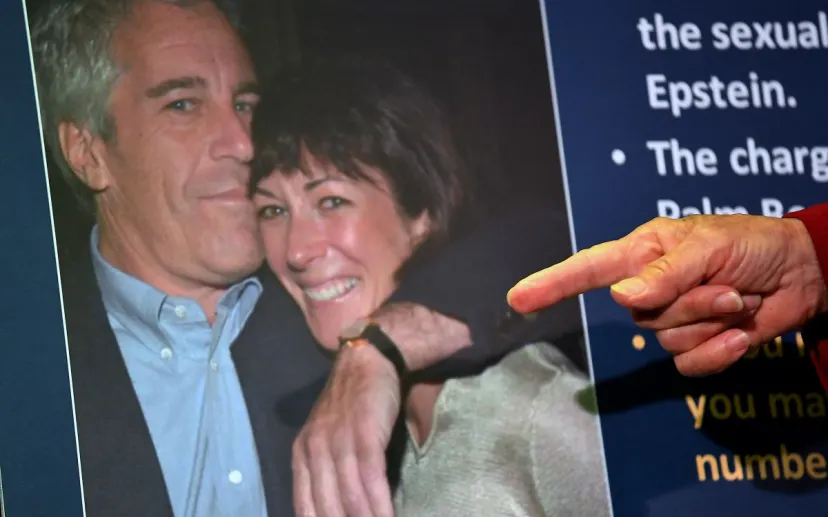
A US federal judge on Tuesday rejected a bid by Ghislaine Maxwell, a key accomplice of notorious sex offender Jeffrey Epstein, to throw out her conviction on sex trafficking charges.
In his ruling, Judge Paul Engelmayer said that Maxwell’s claims that her constitutional rights at trial and sentencing were violated “are all meritless and all or almost all are frivolous.”
Maxwell was convicted in 2021 of supplying underage girls to Epstein, whose ties to powerful business executives, politicians, celebrities and academics have fueled years of scrutiny and conspiracy theories.
Under a new law passed last year, President Donald Trump’s administration has released vast troves of investigative files relating to Epstein — drawing huge public attention to the case.
High-profile figures including Britain’s former prince Andrew have been publicly disgraced for their associations with Epstein.
In February, Maxwell was subpoenaed by the House Oversight Committee to discuss her relations with Epstein but refused to answer any questions. Her lawyer stated she would only speak if Trump granted her clemency.
The US Supreme Court last October declined to hear an appeal by Maxwell of her sex trafficking conviction.
Trump, who also had a years-long relationship with Epstein, initially opposed releasing the so-called Epstein files, prompting accusations of a cover-up that dogged his first year back in office.
The Republican has denied any link to Epstein’s crimes.
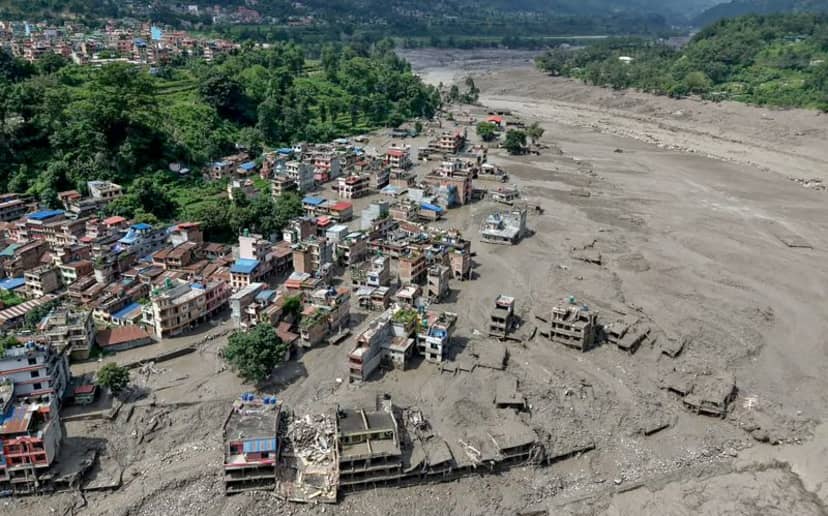
Many of the missing are foreign tourists, officials said of the disaster that wiped out entire villages. The death toll appeared likely to rise.
Are you or is someone you know affected? Email iwitness@rnz.co.nz
One terrifying clip of surveillance video from the Chinese side of the frontier shows a raging wall of mud and debris crashing over a building several stories high on Wednesday morning, engulfing it as dozens of people run for their lives below. The surge sweeps away buses and cars like they are toys.
Chinese state media reported “major casualties” from a mudslide at a Tibet border hub, reporting three dead and another 265 people missing.
Nepali police said they had recovered 157 bodies after “devastating floods”, with officers working to move families in flood-risk areas to safety.
Tibet government officials mobilized nearly 800 emergency workers and 150 vehicles as well as sniffer dogs and speed boats to help the rescue efforts, China’s official Xinhua news agency said.
In the area hit by the disaster, rescuers waded through mud and sludge to look for survivors after floodwaters buried the lower floors of multi-storey buildings.
Some 403 tourists – 341 of them foreigners – were unaccounted for several hours after the disaster struck, according to Nepal’s tourism ministry.
The missing foreigners included 142 Indians, and others from Australia, Britain, Malaysia, the Netherlands, Portugal, South Africa, South Korea and the United States, the tourism board said.
“Entire villages and market areas have been wiped out,” said David Fisher, the Nepal head of the International Federation of Red Cross and Red Crescent Societies (IFRC).
It said it was was dispatching emergency supplies including blankets, first aid kits, stretchers and body bags.
Risk of new flood?
Locals were traumatised, while experts cautioned that a lingering blockage in a river could produce an additional flood.
“I got a call from (my brother-in-law) this morning, and they were crying and said their entire house had been swept away. Three family members were rescued, but his brother is still missing,” said 56-year-old local Raju Bhadel.
The cause of the flooding was not immediately clear.
But Nepal’s Foreign Minister Shishir Khanal said an earthquake likely triggered a landslide, which in turn blocked a river, sending water gushing downstream.
Nepal’s disaster authority said that satellite data indicated that a “snow-rock landslide” on the Nepal-China border may have caused the flood.
Images shared by Nepali police showed floodwater surging through a river, sweeping away houses in its path, while AFP images depicted the top floor of a house sticking out from muddy soil.
The Nepali Army was carrying out flights and had rescued scores of people, while others living near the river in danger zones had been told to relocate.
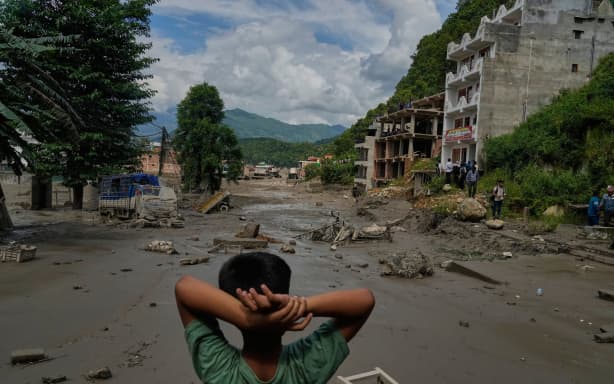
A boy looks at the devastation caused by flash flooding along the Trishuli River in Nepal’s Nuwakot district on Wednesday.
Niranjan Shrestha/AP via CNN Newsource
‘Mudslide disaster’
Sarthak Shrestha, a remote sensing and geo information analyst at the Kathmandu-based International Centre for Integrated Mountain Development (ICIMOD), said a preliminary assessment showed “no anomalies” from China’s side of the border.
“We believe a rock-ice avalanche occurred in Nepal, blocking the Lhende river and causing the cascading flood event,” he told AFP.
Chinese state broadcaster CCTV reported on Wednesday that “a mudslide disaster” on the Nepali side resulted in “major casualties and missing people” at the Gyirong Port in Tibet.
China’s leader Xi Jinping said that “the most urgent task is doing everything possible to search for and rescue the missing people”, according to CCTV.
Traffic authorities in Tibet’s Shigatse said roads in the area were “at risk of mudslides and unsafe for passage”.
Monsoon rains from June to September regularly trigger deadly floods and landslides across South Asia.
Scientists say climate change is increasing the frequency and intensity of extreme weather events in the region.
Qianggong Zhang, head of climate and environmental risks at ICIMOD, warned of the potential for a second flood.
“With a blockage still lodged upstream on the Nepal-China border river, authorities warn a second flood may occur,” he told AFP.
Advice for New Zealanders in Nepal
A spokesperson for the Ministry of Foreign Affairs and Trade said the New Zealand High Commission in New Delhi is in contact with authorities in Nepal to seek information about New Zealanders who may have been affected.
“All New Zealanders in Nepal should follow the advice of local authorities at all times, including any evacuation orders. New Zealanders in Nepal should also let their family and friends know that they are safe when they are able to.”
They said any New Zealanders requiring consular assistance can call the 24/7 consular emergency line on +64 99 20 20 20.
The Israeli military has acknowledged for the first time that it opened fire on the vehicle carrying five-year-old Hind Rajab in Gaza and said it had opened a criminal investigation into the killing.
The Israel Defence Forces (IDF) had previously denied involvement in the January 2024 killing, saying months later that a preliminary investigation found its forces were “not present near the vehicle or within firing range” of the vehicle.
The case is one of two-high profile incidents into which the military has opened criminal investigations. But the military said that it would not probe three other attacks from the early months of the war that killed aid workers.
Rajab was one of seven family members travelling in a vehicle in northern Gaza on when they came under Israeli fire. Rajab survived the initial fire and pleaded on the phone for hours with Palestinian paramedics to come rescue her. Afterwards, an ambulance dispatched to save her also came under fire.
Twelve days later, Rajab’s body was found in a car riddled with bullets.
“The findings of the examination indicate that IDF troops fired at a vehicle that was approaching them,” the IDF said in a statement.
“Following review of the findings an due to apparent failures in the coordination of the movement of the Palestine Red Crescent ambulance, it has been decided to initiate a criminal investigation of the incident by Military Police Criminal Investigation Division.”
The Hind Rajab Foundation said in a statement that investigations by Israeli forces “overwhelmingly end without meaningful examination, prosecution, or punishment. In the small number of cases in which soldiers have been convicted of crimes, the punishments imposed have often been exceptionally lenient or administrative in nature.”
Recordings of Rajab’s call with paramedics gained international attention, driving calls for accountability for her killing and that of thousands of other children in Gaza. A film about the incident, “The Voice of Hind Rajab,” was nominated for an Oscar in 2026.
The investigation into Hind Rajab’s death is part of the IDF’s first comprehensive report on alleged war crimes since the start of the war in Gaza in October 2023.
The IDF General Staff’s Fact Finding and Assessment Mechanism concluded investigating 150 incidents, which were transferred to the military’s top lawyer to decide on opening criminal investigations. Of the 150 inquiries, five decisions were published on Wednesday, while the others await a decision from the military advocate-general.
The IDF also announced it has launched a criminal investigation into the March 2025 killing of 15 paramedics and first responders who were travelling in ambulances and other emergency response vehicles.
The IDF initially claimed the vehicles were driving suspiciously without headlights or emergency signals, which was later directly contradicted by video of the convoy of vehicles travelling with flashing lights. The group were buried in a mass grave along with their emergency vehicles.
The Israeli military subsequently acknowledged “professional failures” in the incident and insisted there had been “no ethical gaps.” But in its statement on Wednesday, the IDF said “the firing conducted during the incident raises a reasonable suspicion of criminal misconduct.”
In three other incidents, the military determined there was no reasonable suspicion of criminal conduct to justify opening a criminal investigation: the April 2024 killing of the seven World Central Kitchen (WCK) humanitarian aid workers in Deir El-Balah, a February 2024 strike on a Doctors Without Borders / Médecins Sans Frontières (MSF) shelter in Khan Younis that killed two employees, and a November 2023 strike on an MSF convoy which killed two additional employees.
In the attack that killed the WCK employees, the IDF said it found “serious failures” in the process that mistakenly led the military to believe the humanitarian convoy was taken over by a group of Hamas fighters. But the military advocate-general did not find “reasonable suspicion of criminal misconduct,” the IDF said.
In a statement, WCK blasted the decision not to open a criminal investigation, calling it “inconsistent with the full truth and deeply offensive.”
“At the time of the lethal attacks, the IDF knew that our team in Gaza was unarmed and posing a threat to nobody. It had full visual clarity on our clearly marked humanitarian vehicles during the extended, multiple airstrikes. It knew our team’s movements, identities and activities in advance.
The military investigation conflates different timelines and events, muddies the story and shifts the blame for the IDF’s illegal conduct,” WCK said.
President Donald has Trump threatened to bomb Oman if it “gets in the way” of a US deal with Iran on the Strait of Hormuz and called for Iran to surrender.
“If Oman gets in the way, we’ll bomb the shit out of them,” Trump told Fox News journalist Trey Yingst, referring to ongoing talks between Oman and Iran on control of the strait, while Washington is also pursuing its own talks.
Iranian and Omani officials have been talking for weeks on future maritime navigation arrangements through the shipping route, and the foreign ministry in Tehran said earlier Monday (local time) that the two sides were working on a joint declaration.
However, Trump has repeatedly insisted that the strait – which Tehran effectively closed at the start of the Middle East war on 28 February – is under US control despite traffic remaining throttled.
Prior to the launch of the US-Israeli war against Iran, the Hormuz strait was considered an open, international waterway. It carries significant portions of global energy shipments, as well as other commodities.
Tehran has used its effective seizing of control over the strait as leverage against the US-led attempts to destroy its military and force it to abandon a controversial nuclear power program.
Iran’s coast flanks the north side of Hormuz and Oman lies on the south.
Trump also said that Iran should “put up the white flag of surrender,” according to Yingst’s post on X on his interview with the president.
Trump insisted that he was in no hurry to reach a deal despite the deep unpopularity of the war among Americans ahead of November midterm elections in the United States, with opposition Democrats seeking to take control of Congress from Trump’s Republicans.
Trump told Yingst that there is a direct back-channel between his administration and officials of Iran’s Revolutionary Guard. “They’re good poker players, but they’re dying,” he was quoted as saying.