

NZ News
Nearly 9000 public sector jobs to go, government agencies to merge, Nicola Willis announces

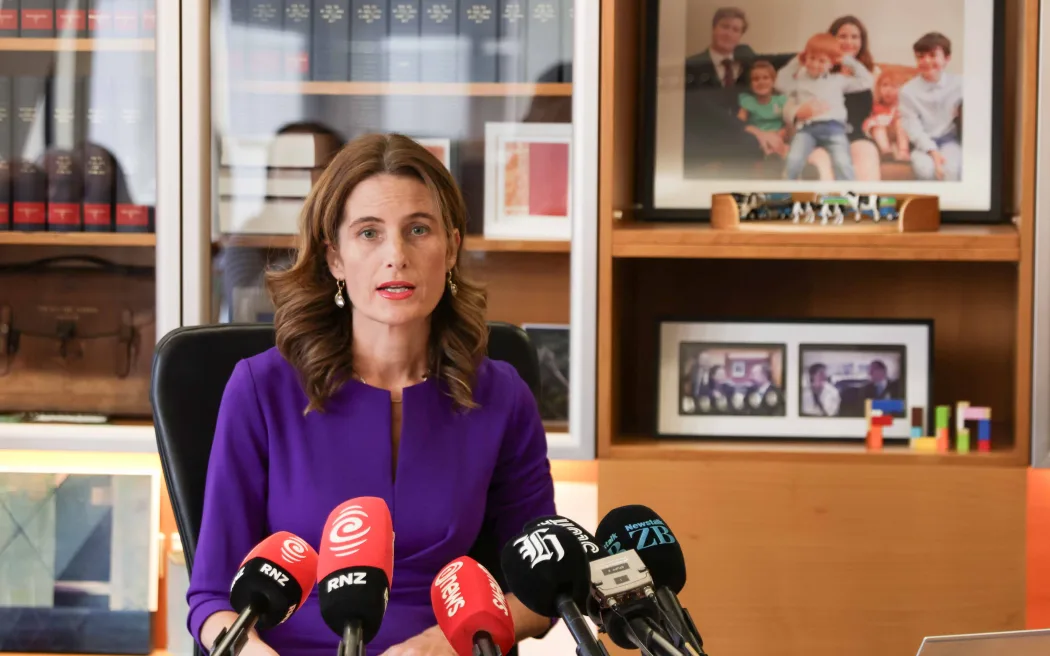
The government has announced plans to slash public service jobs by about 14 percent over the next three years in a shake-up it says will deliver $2.4 billion of savings.
The changes announced in a pre-Budget speech delivered by Finance Minister Nicola Willis on Tuesday would result in about 8700 job losses by mid-2029.
“Historically, core public service numbers have been equivalent to about 1 percent of the population. After a period of largesse under the last government it now hovers around 1.2 percent.
“We will be tracking progress towards a numerical target of no more than 55,000 full-time equivalent public service employees by July 2029. That’s 8700 fewer than were employed in December last year,” Willis said.
There are currently just over 63,000 full-time public servants, which is a slight decrease under this coalition government from the high of approximately 65,000 in the 2024/25 year.
Willis has outlined an overhaul of the public service designed to “reduce the number of government departments, increase the use of AI and other digital tools, and deliver significant savings”.
“Businesses and households are using AI every day and, while parts of the public sector have seized the opportunity to innovate, others are still locked into outdated ways of doing things that prioritise box-ticking over outcomes,” she told a Business North Harbour audience.
“Our government is as frustrated as you are by the fragmentation and silos, the complexity, the status-quo thinking and the dangerously slow take up of digital and AI technologies.
“In too many parts, the back-office of government still looks like an eighties relic, run on old-fashioned systems, with slow bureaucratic processes that are too often about box-ticking rather than improving outcomes,” Willis said.
The current public service operating model is reaching its limits, according to the finance minister, and “failing to meet the expectations Kiwis have in 2026, let alone what they’ll expect in 2036 and beyond”.
The government plans to put a “sinking lid on agencies’ operating budgets” over the next four years to drive progress in the three areas Willis has outlined as her priorities.
“Over the next four years these initiatives will deliver savings of $2.4b which will be re-deployed to deliver more health services, lift educational outcomes, build infrastructure and strengthen the defence force and police.

Christopher Luxon said it will be case-by-case when it comes to what and how agencies could be amalgamated. Photo: RNZ / Kim Baker Wilson
“New Zealanders expect public services that are responsive, effective and easy to use, but too often people and businesses are still navigating fragmented systems, duplication and outdated processes,” Willis said.
Public Service Minister Paul Goldsmith said the job cuts announced would be specific to core public services, and would not include teachers, doctors, nurses, other Health NZ staff, police, or defence personnel.
“Progress will be monitored regularly, with agencies expected to demonstrate improvements in productivity, delivery and value for money,” Goldsmith said.
Speaking to reporters at Parliament on Tuesday morning, Christopher Luxon said there was a “real opportunity to leverage technology” to be more efficient with taxpayer dollars.
Luxon said it would be case-by-case when it comes to what and how agencies could be amalgamated.
“There will be cases where it doesn’t make sense for it to come together, but there are also lots of cases where we have endlessly duplicated IT services, accounts payable services, lots of back office functions … and what I’ve observed coming from outside of politics is that you know the system has just been the system for 30 to 40 years, and no one ever asked the fundamental question of, right, well, why do we have 16 ministers interfacing with an organisation like MBIE.”

Photo: RNZ / Samuel Rillstone
Having just recently visited Singapore, the prime minister said it was a good example of a country better applying AI and technology in the public service.
“Even look at the work that’s been happening in Malaysia and other parts of Southeast Asia as well.
“You’ve got people who need to purchase a house, they go around a very convoluted process, trying to prove their identity, trying to prove their income, that can be automated. You think about a Mum with an 11 and a nine-year-old, and one needs eye glasses, and she’s trying to work out her working for families tax credits. There’s a whole bunch of better ways in which we can deliver those results,” he said.
Infrastructure Minister and Hutt South MP Chris Bishop is overseeing the amalgamation of the ministries for the environment, housing and urban development, transport, and the local government functions of internal affairs.
The stand-up date for the new ministry – MCERT – is 1 July but Bishop says it will be years before the savings are seen.
“This is about setting the public service up for the future. It’s not about immediate savings in the next six months or even the next year, it’s about setting the public service up to be firstly a better partner for local government.
“One of the points I make to local government is that central government has been a useless partner with them in terms of grappling with the great challenges facing us, from housing through to climate adaptation, through to infrastructure funding and financing, we’ve been hopeless at it, and part of the reason we haven’t been very good at it is that we haven’t organised ourselves properly.

Chris Hipkins. Photo: RNZ / Marika Khabazi
“So that is the big driver for the creation of MCERT,” he said on his way to caucus.
Bishop also pushed back on the idea that Wellington and the Hutt Valley are public service cities and would be deeply impacted by the proposed cuts.
“This idea that the Hutt Valley is just made up of public servants who get on the train in their walk shorts and go to Wellington every day for work is offensive and wrong about the Hutt Valley.
“It is an amazing place, in the same way that every suburb of Wellington is, with incredible businesses, and we’ve got to stop stereotyping Wellington as just this boring public service town. It is so much more than that, and we need to stop thinking about it like that,” Bishop said.
Labour leader Chris Hipkins said the changes on the table were “not good news for New Zealanders”.
Speaking ahead of his party’s caucus meeting on Tuesday, Hipkins said “more than half of the jobs in question are outside the Wellington region”.
“So, these are frontline people working all over the country, they’re social workers working with vulnerable kids and families, people working in our prisons, people working at our border, people working in the conservation estate, they are frontline jobs.”
Hipkins told Morning Report there were a lot of contradictions within the proposal so he wanted to see the details.
“Bigger isn’t always better, bigger government departments aren’t always more efficient than smaller departments. Some of the bigger agencies are the most bureaucratic, with the most double handling,” he said.
“So I don’t think bigger is always better.”
Hipkins isn’t against a more integrated and technology driven public service, but said there were limitations to that.
“All of those could potentially be good things, but setting arbitrary targets to potentially reduce the public service by 10,000 people. There is no way you could reduce that many people working for our public service without reducing frontline services.”
Labour proposed its own cuts to the public service in late 2023, when in government, to the tune of 2 percent.
Asked about how many jobs would have been lost then, Hipkins said the advice he had was “there were a lot of vacancies that would be unfilled, and that they would just disestablish those jobs, so they wouldn’t have resulted in people losing their jobs”.
“There would have ultimately been a disestablishment of a number of jobs,” he said.
Source: RNZ



Latest News
Opportunities to mitigate multi-million-dollar RNZ budget blowout likely missed – experts
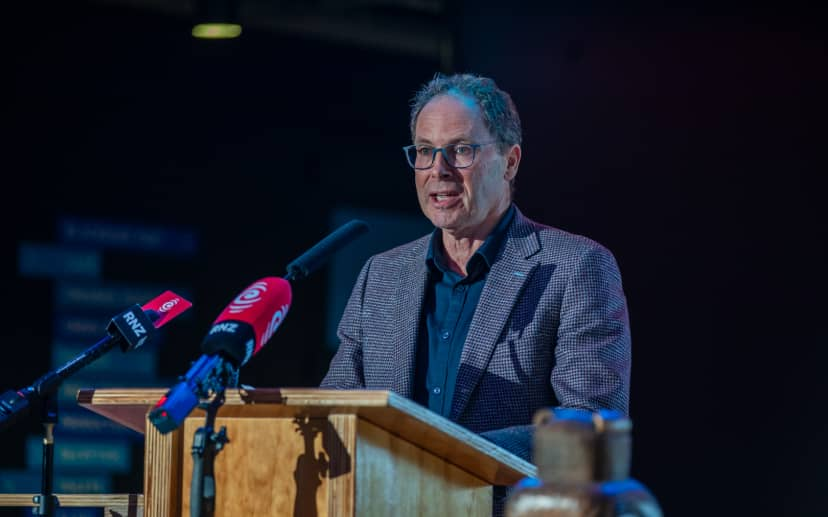
Multiple opportunities to identify and mitigate a multi-million-dollar budget blowout at RNZ appear have been missed, according to the former executive director at Audit New Zealand.
The public broadcaster on Monday revealed a near $12 million shock financial loss after a litany of financial blunders, which will now lead to sweeping job cuts.
The $11.8m loss is more than 25 times the $470,000 RNZ had expected to lose over the year to June.
CEO Paul Thompson took responsibility for the result, and said internal reports gave an inaccurate picture of the finances, meaning the scale of the loss only became clear in October.
RNZ’s former chief financial officer Hilary Parker resigned unexpectedly in early October.
The board said it would commission an independent review into what went wrong.
Independent contractor Stephen Walker, who left the Audit Office earlier this year, said the size of the loss was surprising, as was the length of time it took to identify it – months after the financial year ended.

Supplied / OAG
“Probably more of a concern is that they had seemingly been unaware that they were running up a significant deficit until they were in the preparation stage of their annual report in October.”
Walker said public entities typically produced monthly financial reports.
An interim audit also took place before the end of the financial year, he said, but if the organisation hadn’t identified significant losses at that stage, the auditor could also be in the dark.
“It seems that there’s a real weakness in forecasting and budgeting that’s occurred here and that the monthly accounts, when they’re produced, either haven’t identified these significant variances against budget or the magnitude of them really hasn’t come to light until right towards the end of the financial year,” Walker said.
“And really at that point, there’s no opportunity for the chief executive, the leadership team to take, and the board to take, any corrective action because the year has effectively been completed.”
Walker said the “significant miss” was difficult to account for given it was more than 10 percent of RNZ’s total funding.
He said based on RNZ’s annual report, financial complexity didn’t appear to be a factor.
“This $11.8m loss isn’t made up of one particular item … it seems to have been contributed to by a number of separate expense lines running over budget. So I don’t think it’s necessarily to do with complexity.”
Among the errors, RNZ wrongly counted $2m from land sales as income in its budget. Staff costs also came in $3.2m over budget, including $1.4m in redundancy payments.
Professor at Auckland University’s business school Norman Wong said based on media reports the issues identified were “significant and troubling”.

Supplied / University of Auckland
“But recognising the sale of land as income in their budget is a basic error that one would have expected to have been caught and corrected well before it got to this point.”
With funding reductions at RNZ over the past two years, Walker expected greater scrutiny of financial results.
“Virtually every public entity has had their annual budget reduced. And so you would expect … the leadership team on a monthly basis and board – I’m not sure how frequently the board will consider the information – but you would expect them to be interrogating the results on a regular basis throughout the year,” he said.
Walker said initiating an independent review was the correct course of action and that he’d want to understand what information the leadership team and the board were regularly receiving.
He said he’d “love to say” surprising financial results were rare, but conceded they occured on a semi-frequent basis during his time leading the Audit Office.
“The benefit of independent scrutiny by the Audit Office – and the auditors providing that support to the Auditor General – [is] that the reporting is fairly presented at the end of the year, whether it’s good, bad or ugly.”
rnz


Police say person who fired gun at officers still at large

New Zealand sides named for RLWC finals

Parliamentary Service working on extra chairs and offices for increased number of MPs


-

 Latest News2 months ago
‘Chilling’: Business groups speak out against National’s supermarket break-up plan
-

 NZ News2 months ago
Tom Phillips report: The missed opportunities to find the children
-

 Latest News2 months ago
Cars bearing Chinese police markings stir unease in Auckland
-

 Politics2 months ago
National vows to try to split Pak’nSave and New World
-

 Fiji News2 months ago
Plans to have new Constitution by Dec 24th 2026
-

 NZ News2 months ago
Cop who stole $68,000 can now be named as champion Muay Thai fighter Haimona Tamati-Te Paki
-

 Politics2 months ago
MBIE confirms botched biometric projects costs blown out to $50.7 million
-

 Latest News2 months ago
Five Karangahape Road venues lose their liquor licences after police intervention