

World
Australians and New Zealander last to be evacuated from hantavirus-hit cruise ship

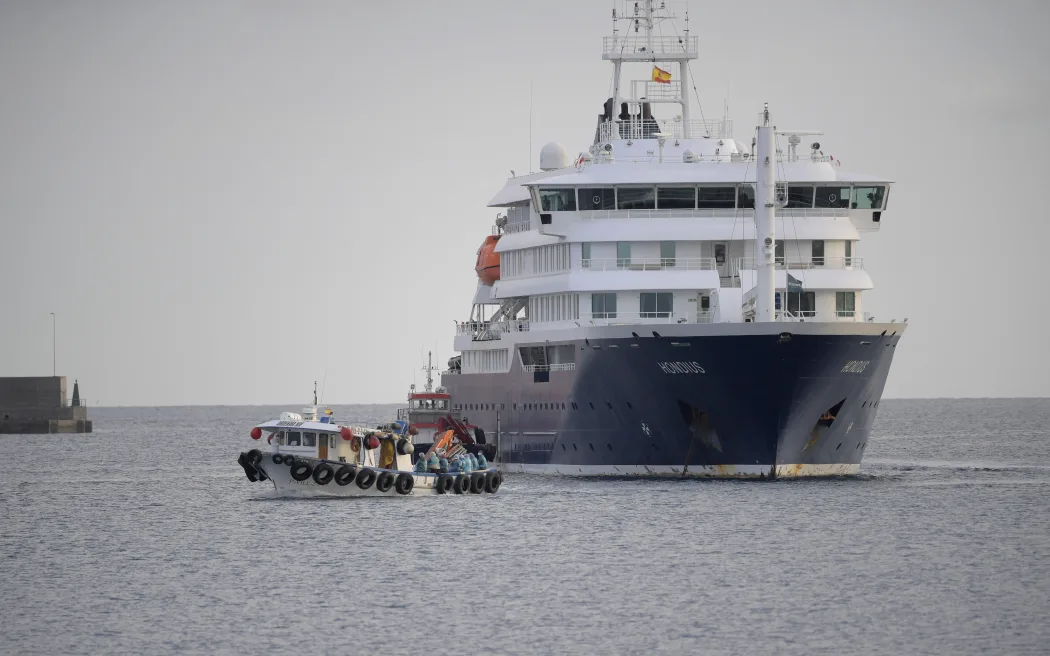
A Kiwi onboard a cruise ship that has been hit by the hantavirus is expected to quarantine in Australia as they – and Australian travellers – are the last to be evacuated.
Passengers on the MV Hondius cruise ship have started to disembark marking a long and complex evacuation process that will see 149 passengers and crew ferried to shore on small boats, then flown to their home countries.
The ABC reports that a group of four Australians and one permanent resident, as well as one New Zealander on board the ship will be among the last to disembark, due to the length of time it will take for their repatriation flight to arrive from Australia.
A department spokesperson said – while exact details were being finalised – they expected the New Zealander would undergo quarantine when they arrived in Australia.
New Zealand health officials would not confirm that, but Dr Corina Grey, director of public health at the Ministry of Health, said in a statement discussions were ongoing regarding options to repatriate the New Zealander, in collaboration with international partners.
Grey told Checkpoint that officials do have powers to force someone with a notifiable disease such as hantavirus into quarantine, but the New Zealander was being “very cooperative”.
She would not confirm what Australian officials have said regarding plans for the New Zealander to quarantine in Australia.
“It’s a complex situation, so the situation is evolving, but we can provide more detail as the situation evolves.”
She said health officials had been in touch with a second New Zealander who was on-board, but had disembarked earlier, and they did not have plans to re-enter New Zealand.
She reasserted that the health risk to New Zealanders remained low, and the virus was not generally transmissible from person to person.
Should anyone from the MV Hondius need to return to New Zealand for quarantine, public health was “very well-placed” to support them, she said.
Reuters correspondent Victoria Waldersee told Morning Report passengers clad in protective gear were taken off the ship in small boats grouped by nationality and brought to the shore of Tenerife in the Canary Islands.
They were then transported by military buses to the airport which was a 10 minute drive away and put on planes provided by their respective governments to take them back to their home country, she said.
The process was designed to ensure there was no contact with any members of the public and passengers were only taken off the boat when their evacuation plane had arrived.
Most people had already been evacuated but the flight to Australia which will also carry the passenger from New Zealand is not set to arrive until tomorrow evening, she said.
The other one to leave tomorrow is a flight from the Netherlands which will take passengers from a host of different countries whose governments had not provided a plane, Waldersee said.

Turkish citizens prepare to board a plane bound for Turkey carrying evacuated passengers at the Tenerife Sur-Reina Sofia airport on the island of Tenerife on 10 May, 2026. Photo: AFP
Three people have died since the outbreak, and five passengers who left the ship before the outbreak was declared have been confirmed to have been infected with hantavirus.
One of five French people flown back to France is showing symptoms of hantavirus, the French Prime Minister Sebastien Lecornu said.
“One of them showed symptoms in the repatriation plane,” he posted on X. “These five passengers have immediately been placed in strict isolation until further notice.
“They are getting medical treatment and will have tests and a medical check-up,” he added.
The jet carrying the evacuated French cruise ship passengers landed a little before 4.30pm Sunday local time at Le Bourget airport, north of Paris, AFP journalists saw.
Shortly afterwards, they were transferred to a convoy of five ambulances and taken under police escort to the Bichat hospital in Paris.
The World Health Organisation has recommended that people evacuated from the cruise ship should quarantine for at least 42 days of quarantine either at home or in hospital and daily health checks.
But the actual quarantine process is being managed by each individual country, Waldersee said.
Health officials sought to reassure Tenerife locals that the evacuees would not come into any contact with the island’s population and informed them that hantavirus was only transmissible between humans who had very close contact.
The Ministry of Health’s director of public health Dr Corina Grey, said discussions were ongoing regarding options to repatriate a New Zealander on board the cruse ship.
Health authorities and consular officials were in close contact with the New Zealander to provide support and advice, Grey said.
New Zealand’s public health services were well positioned to support anyone returning to New Zealand following possible exposure to Hantavirus, Grey said, including quarantine if needed.
“Our focus is on supporting this individual and protecting the public from any public health threat. We will take steps necessary to protect public health, but it is important to note the risk to the New Zealand public remains low.”
Hantavirus was not Covid-19, Grey said, and while it could be severe it was not easily transmissible from human to human.
– RNZ / ABC/ AFP / Reuters


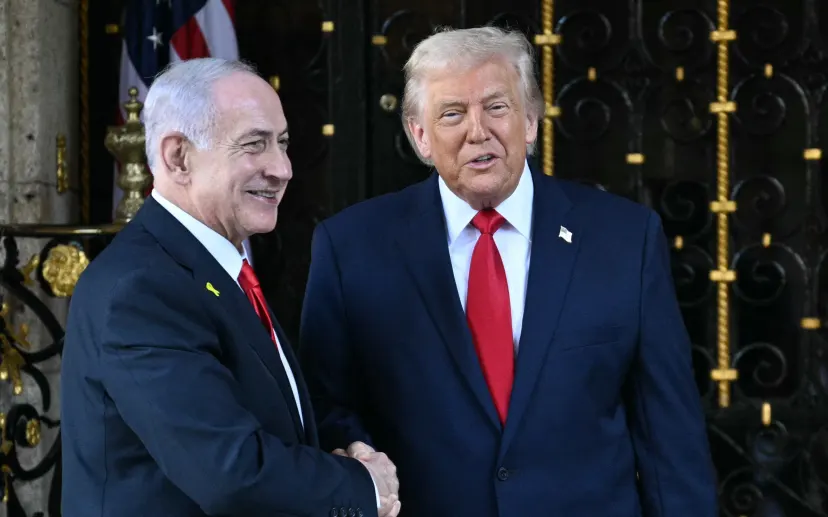
Israeli Prime Minister Benjamin Netanyahu boasted of his endorsement from Donald Trump on the eve of Israel’s election, suggesting the two leaders could restart their war against Iran if he wins, after Trump said they should “finish the job”.
“US President Donald Trump has come with a friendship that has never existed before between an Israeli prime minister and an American president. And it is doubtful we will ever have such a friendly president again,” Netanyahu said in a televised appearance late on Sunday night. “He has another two years, and he says he is calling on you to vote for me.”
In his own social media post on Sunday, Trump, who launched the Iran war jointly with Netanyahu in February, said: “Vote for Bibi Netanyahu for Prime Minister, we have to finish the job that we started!”
Netanyahu said Trump was willing to take action “that would finally, finally, remove the Iranian threat”, but only as long as Netanyahu himself remains in power.
“And I have already instructed the Mossad and the IDF (military) to bring down this regime, to bring down this regime because that is the only way to put an end to this threat,” Netanyahu said, referring to Israel’s main intelligence service and military.
Asked for comment on Netanyahu’s remarks, White House Deputy Press Secretary Anna Kelly said: “As President Trump stated, Iran is in very bad condition, both economically and militarily, and the blockade will remain in full force and effect, with oil flowing in record numbers of barrels through the Hormuz Strait.”
“The United States will not be attacking Iran at any time prior to the midterm elections,” Kelly added via email, referring to the November 3 vote in the US.
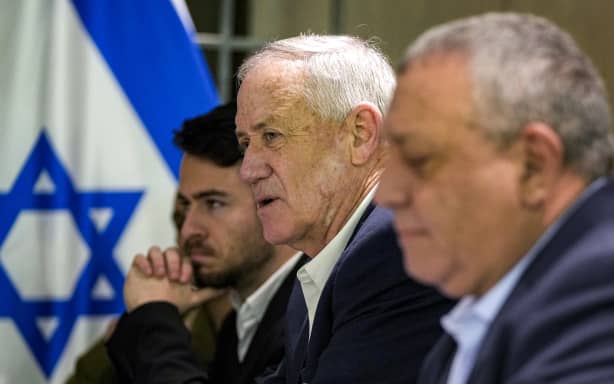
Netanyahu’s leading opponent, centrist former military Chief of Staff Gadi Eisenkot, posted his own comments on social media, praising Trump as “a true friend of Israel”.
“I value his efforts and his commitment to Israel’s security, and I am confident that he will work in full cooperation with any leader chosen by the people.”
Mark Schiefelbein / POOL / AFP
Eisenkot accuses Netanyahu of fear-mongering
Tuesday’s vote, Israel’s first since the October 7, 2023, Hamas attacks, is the first chance for voters to deliver a verdict on the worst security failure in generations and the wars on multiple fronts that followed.
With Netanyahu already at the helm of the most right-wing government in Israeli history, politics have shifted even further to the right. Nearly all Jewish-led parties, including that of the hawkish Eisenkot, now oppose the “two-state solution” that underpinned decades of peace negotiations with the Palestinians.
But many voters say the divisive politics of Israel’s longest-serving leader make the country weaker. Polls suggest Netanyahu’s Likud Party will lose seats, potentially depriving his coalition of right-wing, far-right and ultra-Orthodox parties of its narrow majority.
Eisenkot and an array of opposition parties ranging from the rump of the centre-left to the right, also have no clear path to unseat him.
Netanyahu, 77, is an unrivaled master of political survival: the only time since 2009 that opponents managed to wrest him briefly from the premiership, it took four inconclusive elections within two years to get him out. He was back 18 months later.
Neither side planned major public events for Monday. But both posted on social media, drumming on the election’s major themes: for Netanyahu, that he is the only leader with the mettle to face down Israel’s enemies; for his opponents, that his divisive politics have weakened the country.
Netanyahu shared an AI-generated video on Monday of Iran’s Supreme Leader Ayatollah Mojtaba Khamenei, whose father Ali Khamenei was killed on the first night of US-Israeli strikes on Iran in February. Lying in a hospital bed, the younger Khamenei says his own vote would be “definitely not Bibi. Another term like this and I will be meeting my father sooner than expected.”
On Sunday Netanyahu posted a computer-generated photo of a mushroom cloud over Tel Aviv, saying Israel was in existential danger from Iran.
Eisenkot responded by accusing him of “relying on a campaign of fear-mongering, lies, and threats – including images of nuclear bombs in the heart of Tel Aviv. This time, it won’t work for him.”
Trump’s endorsement of Netanyahu carries its own political risks a week before a legislative election in which his own Republicans are seeking to hold onto power.
The Iran war is deeply unpopular in the United States, blamed for a surge in prices especially for fuel. Major fighting has been suspended for months after ceasefire negotiations held without Israeli participation.
Source: Reuters & RNZ


Police say person who fired gun at officers still at large

New Zealand sides named for RLWC finals

Parliamentary Service working on extra chairs and offices for increased number of MPs


-

 Latest News2 months ago
‘Chilling’: Business groups speak out against National’s supermarket break-up plan
-

 NZ News2 months ago
Tom Phillips report: The missed opportunities to find the children
-

 Latest News2 months ago
Cars bearing Chinese police markings stir unease in Auckland
-

 Politics2 months ago
National vows to try to split Pak’nSave and New World
-

 Fiji News2 months ago
Plans to have new Constitution by Dec 24th 2026
-

 Politics2 months ago
MBIE confirms botched biometric projects costs blown out to $50.7 million
-

 NZ News2 months ago
Cop who stole $68,000 can now be named as champion Muay Thai fighter Haimona Tamati-Te Paki
-

 Latest News2 months ago
Five Karangahape Road venues lose their liquor licences after police intervention