

World
‘Completely unprecedented’: Women linked to ISIS charged with ‘crimes against humanity’


The ABC can reveal new details about the alleged treatment of a Yazidi woman who says she was held captive in the home of ISIS-linked Australians in Syria, including two women who have just returned to Melbourne and are facing slave-related charges.
The Yazidi woman also confirmed to the ABC that she has been interviewed by the Australian Federal Police and would be willing to testify in any proceedings.
Four women and nine children linked to ISIS returned home to Australia on Thursday evening, and upon their arrival two women were arrested on crimes against humanity charges, while a third was detained on terrorism-related offences.
On the ABC’s Foreign Correspondent program in 2023, two Yazidi women alleged they were held captive in Syria in the home of Melbourne man Mohammed Ahmad, the husband of Kawsar Abbas, 53, and father of Zeinab, 31, and Zahra, 33.
The three women have returned to Australia after spending more than a decade in Syria.
The ABC understands it is Kawsar and Zeinab who are facing charges of crimes against humanity, including enslavement. Kawsar is also accused of slave trading.
One of the Yazidi women, Sarab, told Foreign Correspondent she was 11 when she was abducted by ISIS and 13 when she was taken to the home of Mohammed Ahmad, whom she knew as “Abu Omar”.

Janai Safar was arrested by police upon her arrival in Sydney. Photo: ABC News
Ahmad has previously told the ABC he, his wife and daughters had travelled to Syria for his son Omar’s wedding in 2014, only to discover his son had sworn allegiance to ISIS.
He said he and his family were then trapped in the ISIS caliphate.
Sarab alleges Abu Omar brought her into his house for a trial.
“I had to stay with them for three days and if they liked my work, they were going to buy me,” she told Foreign Correspondent.
“It was very unpleasant. I was their slave and they could do whatever they wanted to me.
“My life was controlled by them. It felt like my existence did not matter.”
In previously unreported comments from the 2023 interview with Foreign Correspondent, Sarab said she had trouble understanding the Australian family. She alleged that one of the daughters would get angry at her for not understanding Arabic, as Yazidis traditionally speak a Kurdish dialect.
Sarab said one of the other daughters taught her some English words so that if she stayed with them, she could communicate.
One day, when she forgot to wash the dishes, Abu Omar put her in a room alone and his Syrian daughter-in-law locked her in there for 12 hours with no food, Sarab alleged.
After three days, Sarab was returned to the ISIS captor who had sent her to do the trial at Abu Omar’s home.
“Initially, they kept me there for three days. But then they said that they won’t buy me, because they don’t want to buy slaves,” she said.
A second Yazidi woman, Tayseer, told Foreign Correspondent in 2023 that she was held by Abu Omar for more than a year.
“He treated me horribly,” she said.
“I was a minor, they enslaved me and held me at their place.”

Mohammed Ahmad has denied allegations he kept Yazidi women as slaves. Photo: ABC News
Tayseer said she was made to cook and clean. But unlike Sarab, Tayseer alleged she was raped multiple times by Abu Omar.
Mohammed Ahmad has previously denied the allegations and said it was his now-dead son who had kept a Yazidi woman in their home.
Tayseer told Foreign Correspondent she had been made to film videos of the family living in the ISIS caliphate to send to their relatives in Australia.
Both Tayseer and Sarab said they had been interviewed by the AFP, with Tayseer recalling the AFP had shown her some of the videos taken of the family during her time in the home.
Sarab alleges that after she left the Australian family, she saw the daughters again later when they came to her captor’s house to use the internet after their brother had been killed in fighting.
“They said they wanted to tell their extended family about the news, and that they were happy. They were happy because for them, death in fighting was glorious,” she said.
On the plane before their arrival in Australia, the ABC asked the cohort about the slavery allegations, and one said they were prepared to face what was “thrown at them”.
Speaking to the ABC in recent days, Sarab said she would be willing to testify in court if charges were laid.
“[It is] important because [there are] many Yazidis in Australia, it’s important for them,” she said.
“We can’t leave [the ISIS-linked Australians] to live life like any person in Australia.”
Investigators believe evidence thresholds met
The Australian government said it had been preparing for the return of ISIS-linked Australians from Syria since 2014. The ABC understands 21 Australians remain in the camp known as Al-Roj in the north-east of the country.
Earlier in the week, AFP Commissioner Krissy Barrett said ASIO, the AFP, as well as state and territory law enforcement had been prepared for the ISIS-linked women to return to Australia for more than a decade, with investigators “collecting evidence and information in Syria, at a time when Syria was a war zone, with no functioning government”.
“That evidence and information were to determine whether Australians who travelled to Syria may have committed Commonwealth offences, including terrorism offences, such as entering or remaining in declared areas, and crimes against humanity offences such as engaging in slave trading.”

Alleged ISIS fighters fly the group’s flag in 2015. Photo: AFP
She said the larger cohort of Australians who had been living in Al Roj were all under investigation.
Legal experts agree there is no precedent in Australia for successfully prosecuting crimes against humanity, such as slave trading, and that the burden of evidence was high.
“The question would be whether or not there’s been any evidence of enslavement of persons in Syria at all and what role at all the women played in that process; whether they just happen to be family members within the family unit, in which the male member was conducting this activity; or whether they were coordinating this activity,” said Donald Rothwell, an international law professor at the Australian National University.
He said proving the women’s involvement would require “a fairly high evidentiary burden to be met”.
On Thursday night, AFP Assistant Commissioner Counter Terrorism Stephen Nutt said the agency believed it had met the appropriate evidentiary thresholds.
United Nations special rapporteur on human rights Ben Saul said testimony from alleged victims was “absolutely some of the best evidence.”
“Along with sometimes … Islamic State’s own documentation. When running these kinds of slavery markets, there in some cases were paper trails.”
The other complicating factor is the conditions the women relatives of Ahmad were living under.
Dr Rothwell said the way in which any defendants “may have been coerced or facing duress would certainly be taken into account”.
In some cases, forced recruitment or taking part in Islamic State’s activities under conditions which were not voluntary could be “complete defences”, according to Dr Saul, but in other cases that may not “necessarily exonerate a person”.
“It does depend upon the degree of personal culpability – how much freedom of choice you had in those circumstances,” he added.
Crimes against humanity ‘unprecedented’
Former United States diplomat Peter Galbraith, who has spent more than a decade helping Yazidi women formerly enslaved by ISIS, said any abusers should not be free in Australian society.
He has worked with dozens of enslaved women who had children born of rape by their ISIS captors but were forcibly separated from those children when the caliphate collapsed.
Galbraith has helped them reunite with their children and settle them in safe countries – including some in Australia.
He said some of the women he helped “were kidnapped and enslaved before they finished their education” and they were “working at” building a life in their adopted home.
“I certainly don’t think any of these young Yazidi women should ever be in a position of running into one of these people on the street,” he said.
“That’s just one of the most horrific things that results from these situations.”
Galbraith said he believed the security risk of these ISIS-linked women returning to Australia was “overrated” and that there “ought to be more sensitivity” shown to any alleged victims.
He said he was concerned about the difficulty of securing convictions in Australia.
“Just because you come from Australia doesn’t mean that you should be treated any better or any differently than a Syrian or Iraqi who committed the same crimes,” he said.
Dr Saul said Australia had not successfully prosecuted international crimes since the middle of the last century when Japanese war criminals were convicted.
He said the women being charged with crimes against humanity was “groundbreaking”.
“We only got crimes against humanity charges on the books in 2002 when we became party to the International Criminal Court,” he said.
“There are two war crimes prosecutions of Australian soldiers on foot at the moment, but [there has] never been a crimes against humanity charge or prosecution or conviction.”
Dr Rothwell said the situation was “completely unprecedented”.
“There’s really no precedent of any such charges being brought before an Australian court,” he said.
Source: ABC News & RNZ

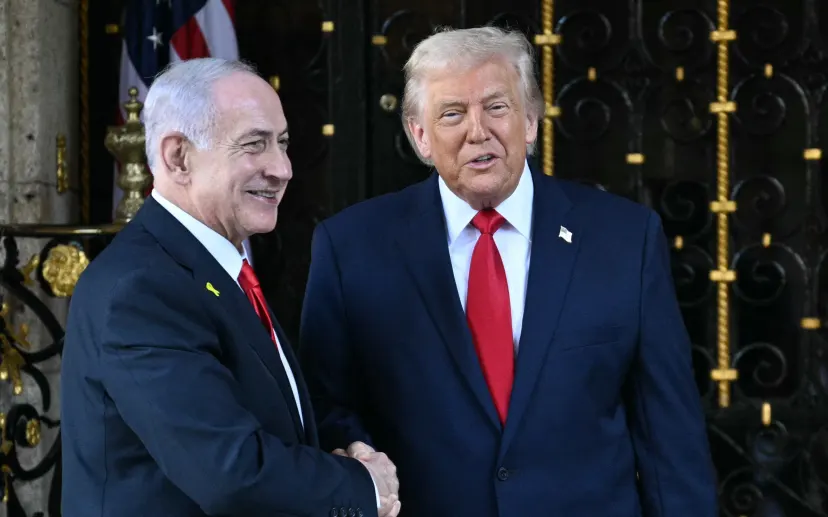
Israeli Prime Minister Benjamin Netanyahu boasted of his endorsement from Donald Trump on the eve of Israel’s election, suggesting the two leaders could restart their war against Iran if he wins, after Trump said they should “finish the job”.
“US President Donald Trump has come with a friendship that has never existed before between an Israeli prime minister and an American president. And it is doubtful we will ever have such a friendly president again,” Netanyahu said in a televised appearance late on Sunday night. “He has another two years, and he says he is calling on you to vote for me.”
In his own social media post on Sunday, Trump, who launched the Iran war jointly with Netanyahu in February, said: “Vote for Bibi Netanyahu for Prime Minister, we have to finish the job that we started!”
Netanyahu said Trump was willing to take action “that would finally, finally, remove the Iranian threat”, but only as long as Netanyahu himself remains in power.
“And I have already instructed the Mossad and the IDF (military) to bring down this regime, to bring down this regime because that is the only way to put an end to this threat,” Netanyahu said, referring to Israel’s main intelligence service and military.
Asked for comment on Netanyahu’s remarks, White House Deputy Press Secretary Anna Kelly said: “As President Trump stated, Iran is in very bad condition, both economically and militarily, and the blockade will remain in full force and effect, with oil flowing in record numbers of barrels through the Hormuz Strait.”
“The United States will not be attacking Iran at any time prior to the midterm elections,” Kelly added via email, referring to the November 3 vote in the US.
Netanyahu’s leading opponent, centrist former military Chief of Staff Gadi Eisenkot, posted his own comments on social media, praising Trump as “a true friend of Israel”.
“I value his efforts and his commitment to Israel’s security, and I am confident that he will work in full cooperation with any leader chosen by the people.”
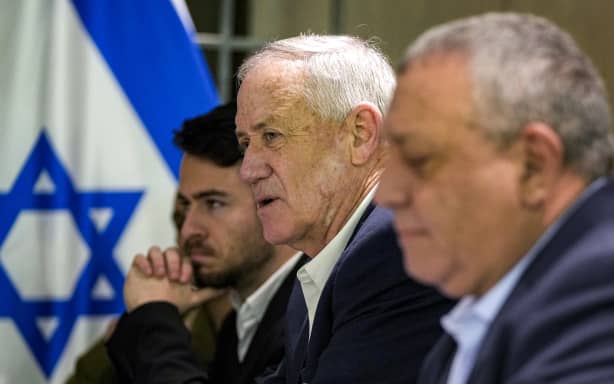
Mark Schiefelbein / POOL / AFP
Eisenkot accuses Netanyahu of fear-mongering
Tuesday’s vote, Israel’s first since the October 7, 2023, Hamas attacks, is the first chance for voters to deliver a verdict on the worst security failure in generations and the wars on multiple fronts that followed.
With Netanyahu already at the helm of the most right-wing government in Israeli history, politics have shifted even further to the right. Nearly all Jewish-led parties, including that of the hawkish Eisenkot, now oppose the “two-state solution” that underpinned decades of peace negotiations with the Palestinians.
But many voters say the divisive politics of Israel’s longest-serving leader make the country weaker. Polls suggest Netanyahu’s Likud Party will lose seats, potentially depriving his coalition of right-wing, far-right and ultra-Orthodox parties of its narrow majority.
Eisenkot and an array of opposition parties ranging from the rump of the centre-left to the right, also have no clear path to unseat him.
Netanyahu, 77, is an unrivaled master of political survival: the only time since 2009 that opponents managed to wrest him briefly from the premiership, it took four inconclusive elections within two years to get him out. He was back 18 months later.
Neither side planned major public events for Monday. But both posted on social media, drumming on the election’s major themes: for Netanyahu, that he is the only leader with the mettle to face down Israel’s enemies; for his opponents, that his divisive politics have weakened the country.
Netanyahu shared an AI-generated video on Monday of Iran’s Supreme Leader Ayatollah Mojtaba Khamenei, whose father Ali Khamenei was killed on the first night of US-Israeli strikes on Iran in February. Lying in a hospital bed, the younger Khamenei says his own vote would be “definitely not Bibi. Another term like this and I will be meeting my father sooner than expected.”
On Sunday Netanyahu posted a computer-generated photo of a mushroom cloud over Tel Aviv, saying Israel was in existential danger from Iran.
Eisenkot responded by accusing him of “relying on a campaign of fear-mongering, lies, and threats – including images of nuclear bombs in the heart of Tel Aviv. This time, it won’t work for him.”
Trump’s endorsement of Netanyahu carries its own political risks a week before a legislative election in which his own Republicans are seeking to hold onto power.
The Iran war is deeply unpopular in the United States, blamed for a surge in prices especially for fuel. Major fighting has been suspended for months after ceasefire negotiations held without Israeli participation.
Source: Reuters & RNZ


Police say person who fired gun at officers still at large

New Zealand sides named for RLWC finals

Parliamentary Service working on extra chairs and offices for increased number of MPs


-

 Latest News2 months ago
‘Chilling’: Business groups speak out against National’s supermarket break-up plan
-

 NZ News2 months ago
Tom Phillips report: The missed opportunities to find the children
-

 Latest News2 months ago
Cars bearing Chinese police markings stir unease in Auckland
-

 Politics2 months ago
National vows to try to split Pak’nSave and New World
-

 Fiji News2 months ago
Plans to have new Constitution by Dec 24th 2026
-

 NZ News2 months ago
Cop who stole $68,000 can now be named as champion Muay Thai fighter Haimona Tamati-Te Paki
-

 Politics2 months ago
MBIE confirms botched biometric projects costs blown out to $50.7 million
-

 Latest News2 months ago
Five Karangahape Road venues lose their liquor licences after police intervention