

NZ News
Boarding house evicts 26 people with two days’ notice

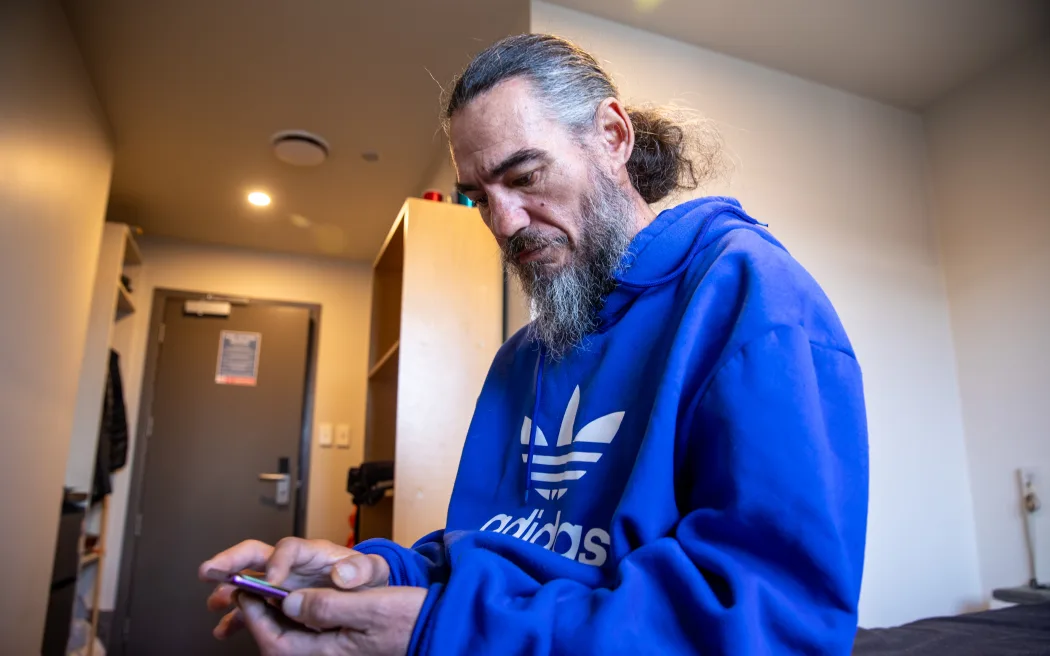
Auckland boarding house managers say they evicted 26 vulnerable people with just two days’ notice, because of safety fears.
The five tenants were rehoused – the rest were squatters and social service outreach teams had to scramble to find them shelter.
Bryan Watling had been living at St Albans Lodge in Mt Eden for about seven years, after 15 years sleeping rough in the city centre.
Last month, he was among those at the derelict 22-bedroom boarding house who were served eviction notices, with just two days to move out – on health and safety grounds.
He said the boarding house became unsafe when squatters took over most of the rooms.
“Just the wrong people moved in and a lot of strangers, you’d wake up at three in the morning to go to the toilet or something, walk out of your room and there’d be total strangers standing there eye wide from the meth use and it was kind of scary at times because you just don’t know what state of mind they’re in.”
Watling said he got clean of meth 12 years ago and, due to a spinal condition, cannot work.
He started spending his days out, to avoid the place that had become his home.
“I’d go back from going into town or something and there’d be a bunch of people in the kitchen spotting on the stove. I think Malcolm, he had his room broken into by a couple of them, there was constant swearing and yelling.”
Watling said some squatters took the doors off shared bathroooms and kitchens, to sell.
“Looked like a hurricane had gone through the place, it was terrible. I’d walk out of my room, there’d be boards with nails sticking out. It was shocking.”

St Albans Lodge. Photo:
Just off Dominon Road, St Albans Lodge has a property value of $3.1 million and is earmarked for demolition – $3m of the value is in the land.
It is owned by a developer who brought in Charlton Property Management to manage the boarding house a year ago.
Fred Ofa owned the property management company and said tenants were given 90 days notice to move before health and safety became a concern and the two-day notice was issued in July.
He feared for the residents’ safety because the fire alarm system had been repeatedly broken.
“At any time if a fire was to arise no-one would know about it so we took it on to remove the tenants and house them rather than have something happen to them during their stay at St Albans.”
He said he did not want another Loafers Lodge tragedy.

Fred Ofa. Photo: Nick Munro
This week, a man is facing court, charged with murdering five people by setting fire to the Wellington boarding house more than two years ago.
Ofa said the five St Albans tenants were offered rooms at a nearby boarding house under his company’s management.
Charlton Property managed eight boarding houses in Auckland and Ofa said it had its own stringent policies and standards, given tenants were often vulnerable.
“First of all, every tenant gets a tenancy agreement, all the boarding facilities have healthy homes, a lot of the ones that are commercial have BWOF (Building Warrant of Fitness). We do have extra security and building managers.”
Ofa said there were many boarding houses operating outside of those boundaries and he would like to see the sector regulated, with more oversight from both local and central government.

A boarding house in Auckland under Charlton Property Management Photo: Nick Munro
It came as social services warned hundreds of otherwise homeless people in Auckland, including families, were turning to these lodges, which were unregulated.
Over the last eight months, outreach teams from Kāhui Tū Kaha had been door-knocking Auckland’s lodges to meet the owners and work alongside them to support the vulnerable people under their roofs.
That outreach was financially supported by Auckland Council as part of its ongoing commitment to address homelessness in the region.
Its regional partnership lead on homelessness, Ron Sukyer, said when people were evicted from St Albans Lodge the council played an advisory supporting role to help tenants.
“We advised Lifewise, a council outreach partner, on the legalities required for eviction notices and how to register concern with the Tenancy Tribunal,” he said.
“We also connected with other accommodation providers to seek available options for those who had been displaced, including the Ministry of Social Development.”

An aerial view of St Albans Lodge. Photo:
Lifewise chief executive Haehaetu Barrett said it was hard to find housing for the St Albans Lodge squatters.
“People were given two days notice which caused huge distress and we were able to help some of those but that’s how it is in the boarding home environment,” she said.
“There’s a crisis, they’re having to be used and we haven’t pipelined appropriately for the transition of people coming out of [emergency housing] motels into appropriate housing so it’s definitely highlighted that people who use boarding houses often don’t get the support they need.”
Barrett said people staying at boarding houses often had complex needs and may have fallen through the cracks of mental health or addiction services.
She said it was important they were housed safelty with wraparound support.

Bryan Watling at a boarding house he moved into after being evicted from another at short notice in July 2025. Photo: Nick Munro
It has been three weeks since Bryan Watling moved from St Albans Lodge to his new place which he said was an upgrade – he has an ensuite.
“Oh mate you know I couldn’t explain it, just grateful really.”
Watling said although the move from St Albans Lodge was daunting, he appreciated the help from the boarding house managers and agreed with the eviction.
“I actually thought at one stage if something doesn’t happen someone’s going to get killed. That’s pretty much how bad it was.”
Source: RNZ



Latest News
Opportunities to mitigate multi-million-dollar RNZ budget blowout likely missed – experts

Multiple opportunities to identify and mitigate a multi-million-dollar budget blowout at RNZ appear have been missed, according to the former executive director at Audit New Zealand.
The public broadcaster on Monday revealed a near $12 million shock financial loss after a litany of financial blunders, which will now lead to sweeping job cuts.
The $11.8m loss is more than 25 times the $470,000 RNZ had expected to lose over the year to June.
CEO Paul Thompson took responsibility for the result, and said internal reports gave an inaccurate picture of the finances, meaning the scale of the loss only became clear in October.
RNZ’s former chief financial officer Hilary Parker resigned unexpectedly in early October.
The board said it would commission an independent review into what went wrong.
Independent contractor Stephen Walker, who left the Audit Office earlier this year, said the size of the loss was surprising, as was the length of time it took to identify it – months after the financial year ended.

Supplied / OAG
“Probably more of a concern is that they had seemingly been unaware that they were running up a significant deficit until they were in the preparation stage of their annual report in October.”
Walker said public entities typically produced monthly financial reports.
An interim audit also took place before the end of the financial year, he said, but if the organisation hadn’t identified significant losses at that stage, the auditor could also be in the dark.
“It seems that there’s a real weakness in forecasting and budgeting that’s occurred here and that the monthly accounts, when they’re produced, either haven’t identified these significant variances against budget or the magnitude of them really hasn’t come to light until right towards the end of the financial year,” Walker said.
“And really at that point, there’s no opportunity for the chief executive, the leadership team to take, and the board to take, any corrective action because the year has effectively been completed.”
Walker said the “significant miss” was difficult to account for given it was more than 10 percent of RNZ’s total funding.
He said based on RNZ’s annual report, financial complexity didn’t appear to be a factor.
“This $11.8m loss isn’t made up of one particular item … it seems to have been contributed to by a number of separate expense lines running over budget. So I don’t think it’s necessarily to do with complexity.”
Among the errors, RNZ wrongly counted $2m from land sales as income in its budget. Staff costs also came in $3.2m over budget, including $1.4m in redundancy payments.
Professor at Auckland University’s business school Norman Wong said based on media reports the issues identified were “significant and troubling”.

Supplied / University of Auckland
“But recognising the sale of land as income in their budget is a basic error that one would have expected to have been caught and corrected well before it got to this point.”
With funding reductions at RNZ over the past two years, Walker expected greater scrutiny of financial results.
“Virtually every public entity has had their annual budget reduced. And so you would expect … the leadership team on a monthly basis and board – I’m not sure how frequently the board will consider the information – but you would expect them to be interrogating the results on a regular basis throughout the year,” he said.
Walker said initiating an independent review was the correct course of action and that he’d want to understand what information the leadership team and the board were regularly receiving.
He said he’d “love to say” surprising financial results were rare, but conceded they occured on a semi-frequent basis during his time leading the Audit Office.
“The benefit of independent scrutiny by the Audit Office – and the auditors providing that support to the Auditor General – [is] that the reporting is fairly presented at the end of the year, whether it’s good, bad or ugly.”
rnz


Police say person who fired gun at officers still at large

New Zealand sides named for RLWC finals

Parliamentary Service working on extra chairs and offices for increased number of MPs


-

 Latest News2 months ago
‘Chilling’: Business groups speak out against National’s supermarket break-up plan
-

 NZ News2 months ago
Tom Phillips report: The missed opportunities to find the children
-

 Politics2 months ago
National vows to try to split Pak’nSave and New World
-

 Latest News2 months ago
Cars bearing Chinese police markings stir unease in Auckland
-

 Fiji News2 months ago
Plans to have new Constitution by Dec 24th 2026
-

 NZ News2 months ago
Cop who stole $68,000 can now be named as champion Muay Thai fighter Haimona Tamati-Te Paki
-

 Politics2 months ago
MBIE confirms botched biometric projects costs blown out to $50.7 million
-

 Latest News2 months ago
Five Karangahape Road venues lose their liquor licences after police intervention