Little has been documented about the involvement of migrants from India in New Zealand’s dairy industry.
Even less has been written about their role in helping the Waikato region become the country’s dairy production powerhouse, producing more than 20 percent of the nation’s milk supply.
While exact figures are not available, families of the pioneering Indian households in the North Island region believe the number engaged in dairy farming exceeds 100.
“Easily,” says Naginder Singh Nagra, owner of Nagra Farms in the Waikato village of Gordonton. “Look at the area surrounding Gordonton, Morrinsville and Whitikahu [and] you will find at least 100 Indian families, mainly from the state of Punjab, doing dairy farming. Most of them, like us, have been doing it for generations.”
Nagra’s family has resided in the region for more than half a century, with his grandfather, Gurcharan Singh Nagra, purchasing the family’s first farm in Otorohanga in 1960s.
“My father, Gian Singh Nagra, carried the business forward, and we moved to Huntly and then to Gordonton,” Nagra says. “Now, we own five farms here within a radius of three kilometres. We have over 2000 cows in total and produce around 800,000 kilogrammes of milk solids every year.”
The Bola family is another pioneering household that has been milking cows in the region for generations.
“Our family’s New Zealand history began in 1913 when my great grandfather, Baram Singh Ark, landed here for the first time,” says Sandeep Singh Bola, who owns the Bola Holstein Friesians Farm in the Waikato settlement of Whitikahu.
Ark was one of the earliest Punjabis to set foot on New Zealand soil.
Early pioneers
In a book titled Indians and the Antipodes, historians Sekhar Bandyopadhyay and Jane Buckingham argue that Indian migrants were living in New Zealand as early as the 19th century.
“The first Indian to achieve fame [in New Zealand] was an Anglo-Indian from [the Indian state of] Goa who arrived in 1853, having previously worked at the California gold fields,” the authors write. “Edward Peter, later known as ‘Black Peter’, was a farm labourer and gold prospector.”
A memorial to the 19th-century prospector, calling him Edward Peters, was unveiled near Milton in Central Otago in 2009.
A census taken in 1881 indicated that six Indians were living in New Zealand at the time.
In a book titled Punjabis in New Zealand: A History of Punjabi Migration 1890-1940, historian W.H. McLeod says brothers Bir and Phuman (Phomen) Singh Gill probably arrived in New Zealand around 1890.
Nevertheless, Punjabi migrants didn’t really participate in dairy farming until the 1920s.
“The first definite example of a Punjabi dairy farm appears to be a small 50-acre (20-hectare) property near the Waikato township of Kihikihi, purchased by Harnam Singh … during the rates period 1918/19,” McLeod writes. “This purchase evidently preceded that of the celebrated ‘Hindu farm’, which was acquired soon after by Inder Singh Mahasha.”
However, the 1920s wasn’t a particularly good decade for Indians, as “all Punjabi farms acquired to date had ended in failure,” McLeod writes.
McLeod did highlight several successful Indian dairy farms that prospered in the 1930s, including farms owned by Mela Singh in Manunui near Taumarunui, Sarwan Singh in Morrisville, Mangal Singh in Otorohanga and Gajja Singh in Manawaru.
He writes that seven farms in the region are believed to have been owned by Punjabis before World War II hostilities broke out.
“With numbers such as these, one can scarcely claim that the dairy farming phase was in full swing by the time the war began … [but] the phase had nevertheless begun,” he writes. “The 1930s merely provided a beginning with the significant development coming later.”
That growth was to come in the 1960s and ’70s.
Farming aptitude
“My grandfather, Basanta Singh Bindra, came to New Zealand in 1920,” says Surjeet Singh Bindra, owner of Bindra Farms. “His son – my father, Daulat Singh Bindra – moved here with us in [the] 1950s to help him [with] market gardening in Pukekohe.
“In 1970, all of us moved to Gordonton when we purchased our first dairy farm. Now, the family owns three dairy farms here, with a total area of around 650 acres (260 hectares), where we milk 500-plus cows, producing about 12,000 litres every day.”
Bindra is appreciative of the support the wider farming community gave them in the early days.
“At that time, we only had about 10-12 Indian families doing dairy farming here,” he recalls. “Luckily, we [had] good neighbours. Everybody used to go to each other’s farm and help … in preparing hay and silage. Now, things are different as everything is mechanised.”
The Bolas’ farming journey also began around the same time, with Karamjit Singh Bola relocating to New Zealand in 1969. He married Baram Singh Ark’s granddaughter and Sandeep Singh Bola’s mother, Mindho Kaur Singh.
In 1972, the recently married couple bought their first herd of 65 jersey cows. Six years later, they bought 50 hectares of farmland in Whitikahu and doubled their herd size.
In 1989, the couple bought 116 hectares of farmland in the same region on Law Rd.
“In total, the family has about 350 hectares of land, with over 1400 cows,” Bola says. “I managed this one – 140 hectares, with about 400 cows – and we produce about 190,000 kilogrammes of milk solids every year. The nearby farm is managed by [my] late brother’s family.”
The nearby estate is the award-winning Bola Lawwal Holsteins farm, which has the longest dairy barn in the Waikato region – 245 metres in length – processing milk from 1000 cows.
The farm won the regional supreme prize at the 2023 Waikato Ballance Farm Environment Awards in Hamilton.
“The free-stall barn system enables cows to be provided with a fresh total mixed ration that ultimately means they produce less methane than outdoor, fresh-pasture-fed cows,” the New Zealand Farm Environment Trust said in a statement in March 2023.
“In awarding the Regional Supreme Award, the judges commended the fifth-generation farming family’s resilience and commitment to honouring their legacy, and their passion for progressive dairy systems.”
The Indian farming households that were established in the 1970s are often praised for their resilience and graft.
Hardial Singh Deo, owner of Deo Farms on Tahuna-Ohinewai Rd to the northeast of Hamilton, came to New Zealand in 1970 with $2 in his pocket.
“I was lucky my older sister was already here, which helped me settle in,” Deo says.
“I started as a dairy factory worker. In 1979, I purchased a 50-acre (20-hectare) dry stock farm. Things changed in 1988, when I purchased my first dairy farm in New Zealand, a 100-acre (40-hectare) property at Whitikahu Rd. Now, we have about 200 acres (80 hectares) here, where we milk 250 cows producing over 100,000 kilogrammes of milk solids yearly.”
His son, Ajmer, has followed in his father’s footsteps, expressing pride at being able to continue the community’s farming heritage.
“Not only are there many of us [Kiwi Indians who are second-generation or older] carrying forward our family legacy, our production is also consistently above average,” he says.
Harkrishen Singh Kung, who came to New Zealand in 1954, is also proud of the community’s overall contribution.
“The family started in Ngatea in the Hauraki Plains first, before we purchased our first farm in Piako Rd in 1973,” Kung says. “In 2001, we moved to Seddon Rd where we are currently located.”
Kung’s son, Charndeep, manages the family farm near Puketaha in the Waikato region.
“We have two farms, where we milk about 650 cows, producing over 200,000 kilogrammes of milk solids every year,” Charndeep says. “I feel very lucky that we have been able to build on the foundation laid by early settlers in the prime dairy farming region of New Zealand.
“It’s unfortunate not many outside Waikato know much about the legacy of Indian dairy farmers and the contribution they have made.”
Nagra agrees.
“Things were not easy for our forefathers,” Nagra says. “You need capital to start any business, and getting loans for Indians was very tough. But they persisted and now we are here, where the majority of farms in the surrounding areas are owned by Indians.”
The pioneering households that ultimately proved to be successful have attracted other Indian farmers to the industry, he says.
“I see a lot of new migrants, especially from rural India, taking up dairy farming here,” he says. “They are doing very well.”
New farmers on the block
Brothers Manoj Kumar and Sumit Kamboj moved to New Zealand as international students in 2011, winning the prestigious Share Farmer of the Year award 10 years later.
At that time, they shared a 50/50 milking operation at a 285-hectare dairy farm in the Tararua settlement of Eketahuna that had 460 cows.
In December, Trade Minister Todd McClay described the brothers as an “extraordinary achievement for first-generation New Zealanders”.
Hailing from a farming family in the Indian state of Uttarakhand, the brothers had experience milking cows but not at the scale they were expected to oversee in New Zealand.
“After completing our studies, we became contract milkers in 2013,” Kamboj says.
“In 2016, we got our first gig as share milkers, where we were milking 480 cows. This was massive compared to what we were used to back home,” he says, adding that two farmers would typically look after 10 cows.
The brothers are now based on a 530-hectare dairy farm in Ashburton that has 2100 cows. They plan to buy their first farm next year.
“Our future plans include taking the learnings from the dairy sector back to Uttarakhand, especially the knowledge of running large-scale farms,” Kamboj says. “We want to help small-sized farm owners in India scale up and increase their productivity.”
Ever since winning the farming award in 2021, the brothers have hosted local government officials from Uttarakhand as well as a high-level delegation from India’s largest dairy brand, Amul.
The brothers have also held talks with India’s National Dairy Development Board when its representatives visited Wellington earlier this year.
“India is very keen to learn our dairy farming systems and practices,” Kamboj says.
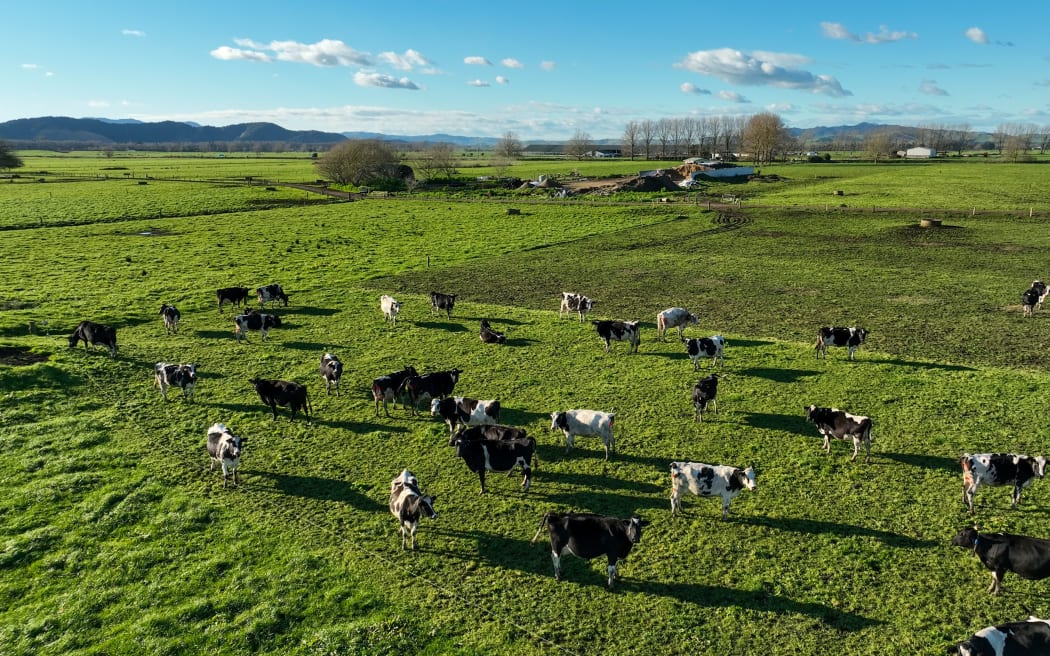
The Bindra family owns three dairy farms with a total area of around 260 hectares on which they milk more than 500 cows, producing about 12,000 litres every day. Photo: RNZ / Blessen Tom
Indeed, an example of one such collaboration already exists.
In 2012, Indian IT experts Deepak Raj, Sukhvinder Saraf and Pankaj Navani collaborated with former Fonterra director Earl Rattray to establish Binsar Farms in the north Indian state of Haryana.
Starting with just four hectares, the farms have since expanded fifteenfold. Total milk production at these farms stands at about 1 million litres that is delivered to an estimated 6000 homes daily.
“In addition, we have more than 10,000 customers who buy other milk products such as ghee and paneer on a regular basis,” Raj says. “We are also planning to expand into new products such as yoghurt, ice cream and flavoured milk.
“We are working with satellite farms and developing strong upstream with small- and medium-sized farmers here.”
The owners of Binsar Farms welcome the New Zealand dairy farm practices and technology they have adopted.
“The techniques are the [most] efficient and economical [way] of converting forage to milk,” Raj says. “The focus is towards milk solids and not on milk volume. We have also found that the Kiwi crossbreed is more sustainable.”
Meanwhile, Kiwi Indians continue to make waves in New Zealand’s dairy farm industry.
Jaspreet Singh, a farm manager at a 382-hectare property in Ashburton that has 1415 cows, won the 2024 Canterbury/North Otago Dairy Manager of the Year award in March.
At the same ceremony, Manjinder Johal was runner-up in the region’s Share Farmer of the Year category. He works as a contract milker on a 156-hectare property that has 615 cows.
Both prize-winners see farm ownership as their ultimate goal.
Nagra says the new generation of farmers from India appear to enjoy the same things that first brought migrants to New Zealand all those years ago.
“Dairy farming is a great occupation to be in. You live near nature and are surrounded my animals,” he says. “That’s why it appeals to us Punjabis who are used to the rural lifestyle. It was as true for the pioneers as it is for the recent arrivals.”
* Additional reporting by Nabeelah Khan, recipient of a 2024 RNZ Asia scholarship
Source: RNZ










 Latest News2 months ago

 NZ News2 months ago

 Latest News2 months ago

 Politics2 months ago

 Fiji News2 months ago

 Politics2 months ago

 NZ News2 months ago

 Latest News2 months ago