Connect with us

HTML Image

i

World

Israeli tanks reach central Rafah as strikes continue

Published

on

Israeli forces have reportedly reached the centre of the southern Gaza city of Rafah and seized a strategically important hill overlooking the nearby border with Egypt.

Witnesses and local journalists said tanks were stationed at al-Awda roundabout, which is considered a key landmark.

They also said tanks were on Zoroub Hill, effectively giving Israel control of the Philadelphi Corridor – a narrow strip of land running along the border to the sea.

The Israeli military said its troops were continuing activities against “terror targets” in Rafah, three weeks after it launched the ground operation there.

Western areas of the city also came under intense bombardment overnight, residents said, despite international condemnation of an Israeli air strike and a resulting fire on Sunday that killed dozens of Palestinians at a tented camp for displaced people.

The Israeli military said it was investigating the possibility that the fire was caused by the explosion of weapons stored by Hamas in the vicinity.

It also denied reports from local health and emergency services officials on Tuesday afternoon that tank shells had hit another camp in al-Mawasi, on the coast west of Rafah, killing at least 21 people.

The UN says around a million people have now fled the fighting in Rafah, but several hundred thousand more could still be sheltering there.

Israel has insisted that victory in its seven-month war with Hamas in Gaza is impossible without taking Rafah and rejected warnings that it could have catastrophic humanitarian consequences.

The Israel Defense Forces (IDF) began what they called “targeted” ground operations against Hamas fighters and infrastructure in the east of Rafah on 6 May.

Since then, tanks and troops have gradually pushed into built-up eastern and central areas while also moving northwards along the 13km border with Egypt.

On Tuesday, they reportedly reached the city centre for the first time.

Witnesses and local journalists told the BBC that tanks had seized control of al-Awda roundabout amid intense artillery fire.

The roundabout, which is only 800m from the border, is the location of major banks, government institutions, businesses, and shops.

One witness said they saw soldiers position themselves at the top of a building overlooking the roundabout and then begin to shoot at anyone who was moving.

Video posted online meanwhile showed tank track marks on a road about 3km west of al-Awda roundabout and 300m from the Indonesian field hospital, which was damaged overnight.

Earlier, residents told the BBC that tanks seized Zoroub Hill, about 2.5km north-west of al-Awda roundabout, after gun battles with Hamas-led fighters.

The hill is the highest point along the Egyptian border and its seizure means the entire Gazan side of the border is now effectively under Israeli control.

About 9km of the Philadelphi Corridor to the south, including the Rafah border crossing, has already been seized by Israeli forces.

Zoroub Hill also overlooks western Rafah, where residents said there had been the heaviest air and artillery strikes overnight since the start of the Israeli operation.

A local journalist said the bombardment forced hundreds of families to seek temporary shelter in the courtyard of a hospital, while ambulances struggled to reach casualties in the affected areas.

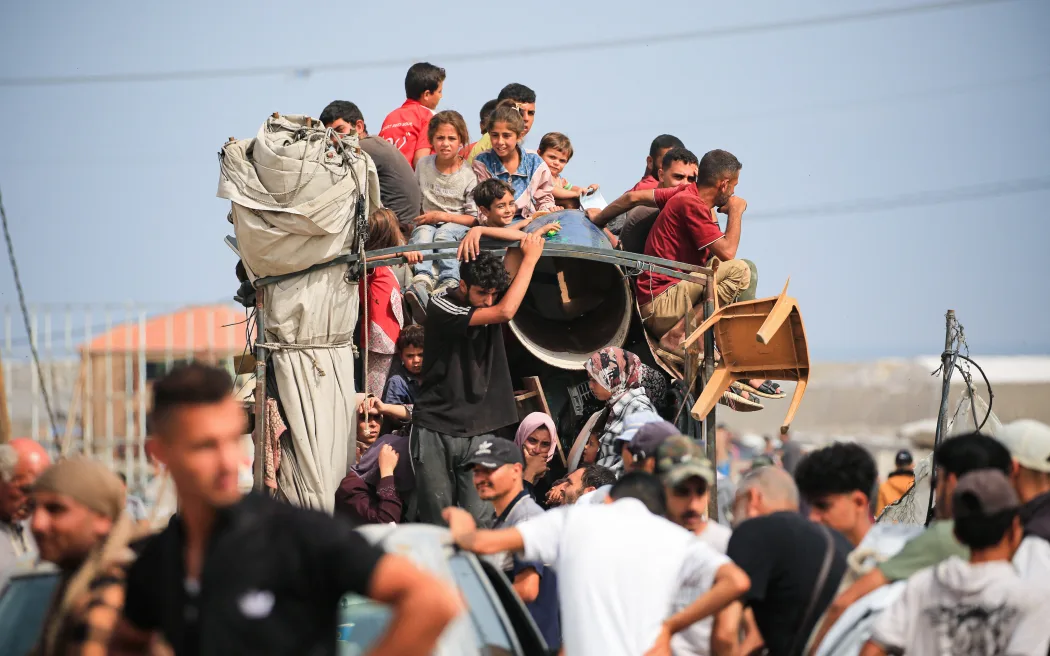
At dawn, thousands of people were seen heading north, crammed into cars and lorries and onto carts pulled by donkeys and horses.

“The explosions are rattling our tent, my children are frightened, and my sick father makes it impossible for us to escape the darkness,” resident Khaled Mahmoud told the BBC.

“We are supposed to be in a safe zone according to the Israeli army, yet we have not received evacuation orders like those in the eastern [Rafah] region,” he added. “We fear for our lives if no-one steps in to protect us.

The IDF did not comment on the various reports but put out a statement saying that “overnight troops operated on the Philadelphi Corridor while conducting precise operational activity based on intelligence indicating the presence of terror targets in the area”.

“The activity is being conducted as efforts are continuing to be made in order to prevent harm to uninvolved civilians in the area,” it added.

“The troops are engaging with terrorists in close-quarters combat and locating terror tunnel shafts, weapons, and additional terrorist infrastructure in the area.”

The IDF has told civilians in eastern Rafah to evacuate for their own safety to an “expanded humanitarian area” stretching from al-Mawasi, a coastal area just north of Rafah, to the central town of Deir al-Balah.

Reuters news agency cited local health officials as saying at least 21 people had been killed when Israeli tank shells hit a cluster of tents in al-Mawasi on Tuesday. An official in the Hamas-run civil defence force also told AFP there had been a deadly Israeli strike on tents.

Graphic video footage circulated by Palestinian media appeared to show at least five bodies lying on a sandy area surrounded by tents.

However, the IDF later said in a statement: “Contrary to the reports from the last few hours, the IDF did not strike in the humanitarian area in al-Mawasi.”

On Sunday night, at least 45 people – more than half of them children, women and the elderly – were killed when an Israeli air strike triggered a huge fire in a camp for displaced people near a UN logistics base in the Tal al-Sultan area, according to the Hamas-run health ministry.

Hundreds more were treated for severe burns, fractures and shrapnel wounds.

The IDF said it was targeting two senior Hamas officials in the attack, which happened hours after Hamas fighters in south-eastern Rafah launched rockets towards the Israeli city of Tel Aviv for the first time in months.

Israeli Prime Minister Benjamin Netanyahu said a “tragic incident” had occurred “despite our immense efforts to avoid harming non-combatants” and promised a thorough investigation.

IDF chief spokesman Rear Admiral Daniel Hagari said on Tuesday that the strike had targeted a structure used by the Hamas commanders which was away from any tents, using “two munitions with small warheads”.

“Following this strike, a large fire ignited for reasons that are still being investigated. Our munitions alone could not have ignited a fire of this size,” he said.

Rear Adm Hagari added that investigators were looking into the possibility that the fire was caused by the explosion of weapons or ammunition stored in a nearby structure, and played what he said was an intercepted telephone conversation between two Gazans suggesting that. The audio recording could not immediately be verified.

Sam Rose of the UN agency for Palestinian refugees, Unrwa, told the BBC from western Rafah that the killing of so many civilians could not be dismissed as an accident.

“Gaza was already one of the most overcrowded places on the planet. It is absolutely impossible to prosecute a military campaign involving large-scale munitions, strikes from the sky, the sea, the tanks, without exacting large-scale civilian casualties,” he said.

“It seems like we are plumbing new depths of horror, bloodshed and brutality with every single day. And if this isn’t a wake-up call, then it’s hard to see what will be.”

Last week, the International Court of Justice (ICJ) ordered Israel to “immediately halt its military offensive, and any other action in the Rafah Governorate, which may inflict on the Palestinian group in Gaza conditions of life that could bring about its physical destruction in whole or in part”.

Israel launched a military campaign in Gaza to destroy Hamas in response to the group’s cross-border attack on southern Israel on 7 October, during which about 1200 people were killed and 252 others were taken hostage.

At least 36,090 people have been killed in Gaza since then, according to the Hamas-run health ministry.

Source: BBC and RNZ

Continue Reading
Click to comment

Leave a Reply

Your email address will not be published. Required fields are marked *

World

Voters deliver historic rebuke to Trump as Democrats win House and Senate

Published

on

By Joseph Ax, Brad Heath and Jason Lange

Democrats seized control of both the Senate and House on Tuesday (US time), scoring sweeping victories in Republican strongholds for the first time in generations as tens of millions of voters delivered a scathing rebuke to President Donald Trump.

Voters in conservative bastions who had propelled the president to his second term in office just two years ago swung dramatically toward Democrats, fueled by deep frustration over the unpopular war with Iran, anxiety over the high cost of living and anger at Trump’s stewardship of the country.

Kansas elected its first Democratic senator since the Great Depression nearly a century ago. In South Carolina, a state that Trump carried by nearly 18 points in 2024, Democrats turned aside his hand-picked Senate candidate.

And in Texas, the biggest Republican state, Democrats ended a decades-long losing streak in seismic fashion, winning a Senate seat and ousting three-term Governor Greg Abbott.

The results will usher in a new era of divided government in Washington, following two years in which the Republican-controlled Congress rarely exercised its power to rein in Trump.

Once seated in January, Democrats are expected to use their power to investigate Trump’s administration, family and allies and demand concessions on major legislation. The Democratic Senate can block Trump’s nominees, including any US Supreme Court justices should a vacancy arise.

“There is now a generational remake of the Senate map that is going to change America,” said Chuck Schumer, the party’s Senate minority leader. “Americans voted for change, and now Democrats must deliver.”

Trump, who is barred by the US Constitution from seeking a third term, has exercised an iron grip on his party for most of the last decade. But the new balance of power in Washington may accelerate his lame-duck status, as attention turns toward the 2028 presidential race and potential successors begin competing for political influence in a post-Trump world.

Despite worries from Democrats that Trump might seek to overturn the election results, as he did in 2020, the president accepted the outcome, congratulating Democrats in an interview with Fox News. He also said he would work with Democrats on issues such as immigration, though he threatened to veto any “insane” bills they passed.

rnz

Continue Reading

World

Cold case solved: DNA links serial killer Ted Bundy to 1974 murder of Utah teen

Published

on

A Utah cold case tied to notorious serial killer Ted Bundy has been solved.

Fifty-two years to the day her body was found, detectives closed the investigation into the murder of 17-year-old Melissa Ann Smith. DNA evidence identified Bundy as the killer, investigators revealed Tuesday.

Smith’s body was found by hunters in a wooded area bordering Salt Lake and Summit counties on 27 October, 1974. The investigation into her murder has remained open since that day, until now.

A recent break in a Utah County cold case is being attributed to the resolution. Investigators say the same DNA profile used to identify Bundy as the killer of Laura Ann Aime was used to solve Smith’s murder.

Developments in that case brought the Smith investigation back to the surface and helped resolve the decades-old mystery, Summit County Sheriff Kacey Bates said.

Tuesday’s announcement was hinted at by Utah County investigators in April, when they announced the closure of the Aime cold case, which was tied to Bundy. At the time, a UCSO detective said the DNA profile used to link Bundy to the murder had been shared with other departments, with the hope that it could lead to closing more cases.

Bundy, who is confirmed to have killed and assaulted women across Washington, Oregon, Colorado, Utah and Florida between 1974 and 1978, confessed to 28 murders but is believed to be responsible for hundreds of deaths.

He was executed by electric chair in Florida in 1989.

Source: RNZ & CNN

Continue Reading

World

Netanyahu touts Trump endorsement on eve of vote, suggests they may restart war on Iran

Published

on

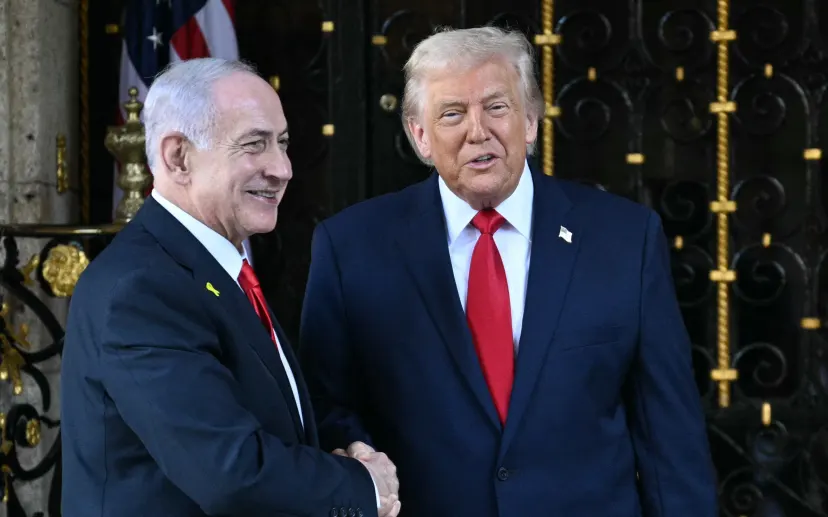
Israeli Prime Minister Benjamin Netanyahu boasted of his endorsement from Donald Trump on the eve of Israel’s election, suggesting the two leaders could restart their war against Iran if he wins, after Trump said they should “finish the job”.

“US President Donald Trump has come with a friendship that has never existed before between an Israeli prime minister and an American president. And it is doubtful we will ever have such a friendly president again,” Netanyahu said in a televised appearance late on Sunday night. “He has another two years, and he says he is calling on you to vote for me.”

In his own social media post on Sunday, Trump, who launched the Iran war jointly with Netanyahu in February, said: “Vote for Bibi Netanyahu for Prime Minister, we have to finish the job that we started!”

Netanyahu said Trump was willing to take action “that would finally, finally, remove the Iranian threat”, but only as long as Netanyahu himself remains in power.

“And I have already instructed the Mossad and the IDF (military) to bring down this regime, to bring down this regime because that is the only way to put an end to this threat,” Netanyahu said, referring to Israel’s main intelligence service and military.

Asked for comment on Netanyahu’s remarks, White House Deputy Press Secretary Anna Kelly said: “As President Trump stated, Iran is in very bad condition, both economically and militarily, and the blockade will remain in full force and effect, with oil flowing in record numbers of barrels through the Hormuz Strait.”

“The United States will not be attacking Iran at any time prior to the midterm elections,” Kelly added via email, referring to the November 3 vote in the US.

Netanyahu’s leading opponent, centrist former military Chief of Staff Gadi Eisenkot, posted his own comments on social media, praising Trump as “a true friend of Israel”.

“I value his efforts and his commitment to Israel’s security, and I am confident that he will work in full cooperation with any leader chosen by the people.”
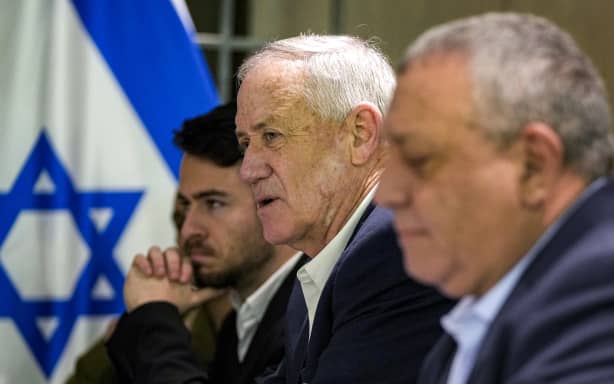
Former Israeli Defence Minister Benny Gantz (2nd-R) and former Israeli army chief of staff Gadi Eisenkot (R), both members of the current Israeli five-person war cabinet led by Prime Minister Benjamin Netanyahu, meet with the visiting US Secretary of State in Tel Aviv on February 8, 2024. (Photo by Mark Schiefelbein / POOL / AFP)
Former Israeli Defence Minister Benny Gantz (2nd-R) and former Israeli army chief of staff Gadi Eisenkot (R).

Mark Schiefelbein / POOL / AFP

Eisenkot accuses Netanyahu of fear-mongering

Tuesday’s vote, Israel’s first since the October 7, 2023, Hamas attacks, is the first chance for voters to deliver a verdict on the worst security failure in generations and the wars on multiple fronts that followed.

With Netanyahu already at the helm of the most right-wing government in Israeli history, politics have shifted even further to the right. Nearly all Jewish-led parties, including that of the hawkish Eisenkot, now oppose the “two-state solution” that underpinned decades of peace negotiations with the Palestinians.

But many voters say the divisive politics of Israel’s longest-serving leader make the country weaker. Polls suggest Netanyahu’s Likud Party will lose seats, potentially depriving his coalition of right-wing, far-right and ultra-Orthodox parties of its narrow majority.

Eisenkot and an array of opposition parties ranging from the rump of the centre-left to the right, also have no clear path to unseat him.

Netanyahu, 77, is an unrivaled master of political survival: the only time since 2009 that opponents managed to wrest him briefly from the premiership, it took four inconclusive elections within two years to get him out. He was back 18 months later.

Neither side planned major public events for Monday. But both posted on social media, drumming on the election’s major themes: for Netanyahu, that he is the only leader with the mettle to face down Israel’s enemies; for his opponents, that his divisive politics have weakened the country.

Netanyahu shared an AI-generated video on Monday of Iran’s Supreme Leader Ayatollah Mojtaba Khamenei, whose father Ali Khamenei was killed on the first night of US-Israeli strikes on Iran in February. Lying in a hospital bed, the younger Khamenei says his own vote would be “definitely not Bibi. Another term like this and I will be meeting my father sooner than expected.”

On Sunday Netanyahu posted a computer-generated photo of a mushroom cloud over Tel Aviv, saying Israel was in existential danger from Iran.

Eisenkot responded by accusing him of “relying on a campaign of fear-mongering, lies, and threats – including images of nuclear bombs in the heart of Tel Aviv. This time, it won’t work for him.”

Trump’s endorsement of Netanyahu carries its own political risks a week before a legislative election in which his own Republicans are seeking to hold onto power.

The Iran war is deeply unpopular in the United States, blamed for a surge in prices especially for fuel. Major fighting has been suspended for months after ceasefire negotiations held without Israeli participation.

Source: Reuters & RNZ

Continue Reading

Trending

Copyright © 2026 The Buzz: Powered by Apna Network Limited - Concept by Digital Hub NZ