By Aubrey Belford, Stevan Dojcinovic, Jared Savage, and Kelvin Anthony
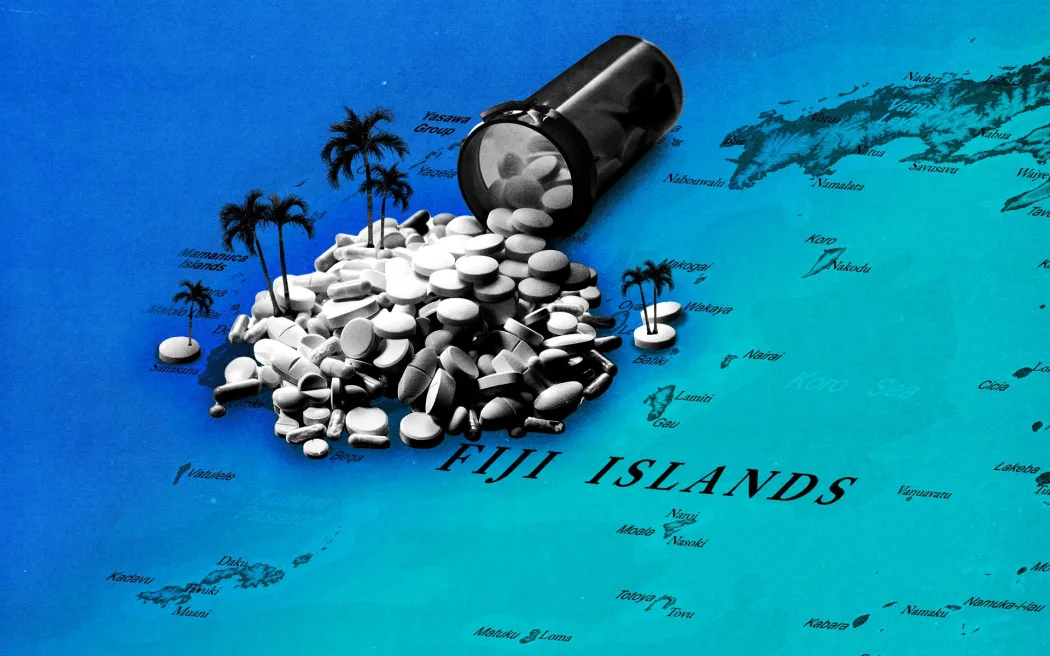
- The operator of a Pacific-wide network of pharmacy companies, Aiyaz Mohammed Musa Umarji, was sentenced to four years prison in New Zealand in August for illegally importing millions of dollars worth of pseudoephedrine, a precursor chemical of methamphetamine.
- Umarji, a Fijian national, had long been a target of police in his home country but had for years escaped justice thanks to what Fijian and international law enforcement say was an unwillingness by the previous authoritarian government of Frank Bainimarama to seriously tackle meth and cocaine trafficking.
- Fiji’s new government, which was elected last December, is now investigating donations that Umarji and his family made to the previous ruling party, as well as “potential connections” to top law enforcement officials.
Until recently, Aiyaz Mohammed Musa Umarji was – in public at least – a pillar of Fiji’s business community.
With ownership of a Pacific-wide pharmacy network, Umarji and his family were significant donors to the party that repressively ruled the country until it lost power in elections last December. He was also a major figure in sports, serving as a vice president of the Fiji Football Association and as a committee member in soccer’s global governing body, FIFA.
And he did it all as an internationally wanted drug trafficker.
Umarji’s fall finally came in August this year, after he ended a period of self-imposed exile in India and surrendered himself to authorities in New Zealand to face years-old charges. He pleaded guilty and was sentenced to four years in prison for importing at least $5-$6 million New Zealand dollars’ ($2.9-3.5 million) worth of pseudoephedrine – a precursor for methamphetamine – into the country.
His sentencing was hailed by Fijian police as a blow against a “mastermind” whose operations stretched across the region.
But behind the conviction of Umarji, 47, lies a far murkier story of impunity, a joint investigation by OCCRP, the Fiji Times, the New Zealand Herald, and Radio New Zealand has found.
Umarji was able to thrive for years amid a failure by senior officials of Fiji’s previous authoritarian government to confront a rise in meth and cocaine trafficking through the Pacific Island country.
And when New Zealand authorities finally issued an international warrant for his arrest, Umarji was able to flee Fiji under suspicious circumstances.
Reporters found that Umarji and his family donated at least 70,000 Fijian dollars ($31,000) to the country’s former ruling party, FijiFirst, in the years after he was first put under investigation. This included 20,000 Fijian dollars ($8,700) given to the party ahead of last December’s election – roughly three years after he was first charged. The party’s general secretary, Aiyaz Sayed-Khaiyum, was Fiji’s long-serving attorney general and justice minister at the time.
Reporters also found that the Umarji family’s business network has continued to expand despite his legal troubles, and currently operates in three Pacific countries. The newest of these pharmacy companies, in Vanuatu, was founded just last year.
Fiji’s minister for immigration and home affairs, Pio Tikoduadua, told OCCRP an investigation has been opened into how Umarji was able to flee the country.
He said authorities are also investigating donations Umarji and his family made to FijiFirst, and any “potential connections” he may have had to top officials in the former government, including Sayed-Khaiyum and the now-suspended police commissioner, Sitiveni Qiliho.
“Certainly, I am deeply concerned about the potential influence of drug traffickers in Fiji, especially over officials and law enforcement,” Tikoduadua said. “The infiltration of these criminal elements poses a significant risk to our society and institutions.”
Umarji declined a request for an interview and did not respond to follow-up questions. His Auckland lawyer, David PH Jones, said a request from reporters contained “numerous loaded questions which contain unsubstantiated assertions, a number of which have little or nothing to do with Mr Umarji’s prosecution”.
Sayed-Khaiyum and Qiliho did not respond to written questions.
‘A hub of the Pacific’
The rise in drug trafficking through Fiji is just one part of a booming trans-Pacific trade that experts and law enforcement say has become one of the world’s most profitable.
In Australia, the most recent data shows that drug seizures have more than quadrupled over the last decade, and Australians now consume 4.7 tonnes of cocaine and 8.8 tonnes of meth a year. In much smaller New Zealand, drug users strongly prefer meth to cocaine, consuming roughly 720 kilograms a year.
Consumers in both countries pay some of the highest prices on earth for cocaine and meth, much of it exported from the Americas. Lying in the vast blue expanse between the two points are the Pacific Islands.
“Fiji is a hub of the Pacific. You’ve got the ports, you’ve got the infrastructure, and you’ve got the ability to come in and out either by [water] craft or by airplane,” said Glyn Rowland, the New Zealand Police senior liaison officer for the Pacific.
“So that really leaves Fiji quite vulnerable to be in that transit route off to New Zealand and off to Australia.”
Fiji has long been eyed by international organised crime for its strategic location close to Australia and New Zealand’s multi-billion dollar drug markets. In the early 2000s, for example, an international police operation took apart a “super lab” in Fiji’s capital, Suva, run by Chinese gangsters with enough precursor chemicals to produce a tonne of meth.
But after early successes, Fiji in recent years went cold on the fight against hard drugs.
The previous government of Frank Bainimarama, who first took power in a 2006 coup, showed little interest in tackling meth and cocaine trafficking, according to current and former law enforcement officers from Fiji and the US. Despite recent signs that trafficking was increasing, the police force under Bainimarama’s hand-picked commissioner, Qiliho, seemed to overlook the problem, the officers told OCCRP.
Bainimarama did not respond to questions.
Ernie Verina, the Oceania attaché for US Homeland Security Investigations (HSI), said his agency had become worried about trafficking through Fiji.
In mid-2022, HSI assigned an agent to be based in the country. But when the agent raised the issue of meth with top officials from Bainimarama’s government, he was met with total pushback, Verina said.
“Categorically, like, ‘There is no meth’,” Verina said of the Fijian response.
“That’s what they told the agent.”
A lot of influence
Despite high-level denials, Fiji’s narcotics police were very much aware of the country’s drug trafficking crisis. In fact, they had long had Umarji in their sights. But he was a difficult target.
As far back as 2017, Umarji was identified as “one of the tier one” suspected traffickers in the country, said Serupepeli Neiko, the head of the Fiji Police’s Narcotics Bureau.
While the drug trade through Fiji is also the domain of transnational organised crime groups, Umarji was suspected of having carved out a niche for himself by using his network of pharmacies, Hyperchem, to legally import pseudoephedrine and divert it onto the black market, Neiko said.
In early 2017, Umarji and one of his colleagues were charged with weapons possession after scores of rifle bullets were found on his yacht, moored in his hometown of Lautoka. But the charges were “squashed in court,” Neiko said.
“So that gave a red flag to us that a [drug trafficking] case against Umarji would have been challenging as well.”
A former senior Fijian officer, who declined to be identified because he is not authorised to speak to the media, put it more bluntly: “Umarji had a lot of influence with the previous government.”
Reporters found no evidence that any senior Fijian officials intervened against investigations into Umarji. But the perception that he had influence was powerful, current and former police officers said.
Indeed, since the fall of Bainimarama’s government last year, multiple senior officials have faced charges that they abused their positions, but none have been convicted. The suspended police commissioner, Qiliho, and the former prime minister, Bainimarama, were both acquitted by a court on 12 October of charges that they had illegally interfered in a separate police investigation.
Former Attorney General Sayed-Khaiyum is also currently facing prosecution in another unrelated abuse of office case.
Despite becoming a top-level police target, Umarji continued to expand his influence in Fiji. Company records show that, in 2015, he and his wife, Zaheera Cassim, opened Hyperchem companies in Fiji, Solomon Islands, and a now-defunct branch in Samoa.
In May 2017, Umarji opened a new company, Bio Pharma, in New Zealand.
Ahead of elections the following year, Umarji and his relatives donated a total of at least 50,000 Fijian dollars to the FijiFirst party, declarations from the Fiji Elections Office show.
Umarji also made a name for himself in soccer, getting elected a vice president of the Fiji Football Association in December 2019.
Pills and cash
By 2019, it was clear that avenues for a Fijian investigation were closed. So police in New Zealand stepped in instead. Reporters were able to reconstruct what happened next via court records and interviews.
While seconded that year to Fiji’s Transnational Crime Unit, New Zealand detective Peter Reynolds heard whispers about Umarji’s alleged criminal activity from his local colleagues. On returning to New Zealand, he decided to take things into his own hands.
Digging through police files, Reynolds found a lucky break in a case from nearly two years prior.
In late 2017, an anonymous member of the public had reached out to an anti-crime hotline with a tip that a businessman, Firdos “Freddie” Dalal, had a suspicious amount of money in his home in suburban Auckland. Acting on a warrant, police made their way inside and found NZD$726,190 in cash and 4000 boxes of Actifed, a cold and flu medicine that contains pseudoephedrine.
Known as Operation Duet, the investigation that led to Dalal’s conviction provided the information that Reynolds needed to go after Umarji. It turned out that Dalal, who owned an Auckland-based freight forwarding company, was also listed as the director of Umarji’s New Zealand company, Bio Pharma.
Reynolds soon figured out how it all worked. Using his Pacific-wide Hyperchem network, Umarji ordered Actifed pills to be delivered from abroad to his pharmacies in Fiji and Solomon Islands. The shipments were set to transit through New Zealand, where Dalal’s forwarding company was responsible for the cargo.
While the drugs sat in a restricted customs holding area, Dalal simply went inside and swapped them out for other other medicine, such as anti-fungal cream, which was then sent on to their island destinations. The purloined pseudoephedrine was sold on New Zealand’s black market.
Dalal did not respond to questions.
In just three shipments between January and October 2017, Umarji’s operation brought in an estimated 678,000 Actifed pills containing about 40.7 kilograms of pseudoephedrine, Auckland District Court would later find.
But if deciphering Umarji’s operation was straightforward, arresting him would prove anything but.
New Zealand Police filed charges against Umarji in December 2019, but Reynolds told the Auckland court that he believed they faced little chance of getting Umarji to voluntarily fly to Auckland and show up in court.
“If the summons were to be served it would likely result in Umarji fleeing [Fiji] to a country that has no extradition arrangements with New Zealand,” the detective said in an affidavit.
So New Zealand authorities decided to go through the arduous process of requesting extradition. In November 2021, a Fijian court agreed to the request, and New Zealand Police issued an Interpol red notice.
Despite all the effort, within days Fiji Police had to contact their New Zealand counterparts with an embarrassing admission: Umarji had fled the country, and was in India.
New Zealand Police’s Pacific liaison, Rowland, declined to comment on how Umarji was able to flee Fiji, but added: “The reality is, sometimes corruption isn’t about what you do. Sometimes corruption is about what you don’t do, or turn a blind eye to.”
Despite his legal troubles, Umarji remained a respectable public figure in Fiji, thanks in part to a restrictive media environment that made it difficult for reporters to look into him in detail. In May 2021, while Umarji was still in Fiji and his extradition case was pending, he was elected to FIFA’s governance, audit and compliance committee. He kept the position even after his flight abroad later that year, and was re-elected unopposed as Fiji Football Association vice president this June. He only resigned both positions on 7 August, two days before his sentencing.
FIFA and the Fiji Football Association did not respond to questions.
Umarji also made little effort to hide during his exile in India. At one stage last year, he recorded an online video testimonial for a stem cell clinic outside of Delhi where he said he was getting treatment for diabetes. His family’s second round of donations to FijiFirst, 20,000 Fijian dollars ahead of last December’s elections, were similarly made while Umarji was on the run.
But the drug trafficker eventually tired of exile. In early 2022, he first contacted his high-powered Auckland lawyer, Jones, to arrange his surrender to New Zealand Police. He pleaded guilty to the Auckland court earlier this year and was allowed to return to Fiji to sort his affairs before handing himself in for sentencing.
New focus
With Umarji now in prison, Fijian authorities say they are continuing to investigate his operations.
Umarji’s pharmaceutical business continues to run with his wife, Cassim, at its head. Cassim has for years been a significant public face for the businesses, including publicising its charitable work. She declined to respond to reporters’ questions.
OCCRP visited Umarji’s companies in Lautoka in late June, during the period in which he was allowed by the New Zealand court to briefly return to Fiji. Reporters found a bustling network of businesses, including a well-staffed warehouse and office on the edge of town for Hyperchem.
Reporters contacted Umarji by phone from the warehouse’s reception area, but he declined to come out for an interview and referred reporters to his lawyer.
Homeland Security Investigations’ Verina said the new government of Fijian Prime Minister Sitiveni Rabuka has since removed roadblocks to investigating these sort of trafficking operations.
“We have started to see enforcement operations and arrests and holding individuals accountable for the methamphetamine smuggling,” Verina said.
Additional reporting by Lydia Lewis (RNZ) and George Block (New Zealand Herald)
Source: RNZ
Photo: James O’Brien






 Latest News2 months ago

 NZ News2 months ago

 Politics2 months ago

 Latest News2 months ago

 Fiji News2 months ago

 NZ News2 months ago

 Politics2 months ago

 Latest News2 months ago