Labour leader Chris Hipkins believes there are better ways to bring down the cost of housing, electricity and groceries than new taxes.
But in at least three of those areas – electricity, banking and groceries – a third-term Labour-led government would not rule out taxes on excessive profits, should other measures fail to rein them in.
“Tax is not the only way you can tackle inequality,” Hipkins – whose grasp on the prime ministership is looking shakier with every poll – told Mata this week.
Te Māngai PāhoTe Māngai Pāho Photo: Te Māngai PāhoNo captionPhoto: supplied
“The policies that we are introducing and implementing as a government are actually I think making a meaningful difference on inequality.”
An IRD document released in April, the High-Wealth Individuals Research Project Report, found the wealthiest New Zealanders pay an effective tax rate about half that the rest of us do, largely through untaxed capital gains.
Despite this, support for the idea from his former revenue minister and it being a key plank of likely coalition partner the Greens’ platform, Hipkins has ruled out implementing any kind of wealth tax, should Labour lead the next government.
He has also ruled out a comprehensive capital gains tax, despite the recommendation from the Tax Working Group to target capital gains to ease the burden placed on wage and salary earners.
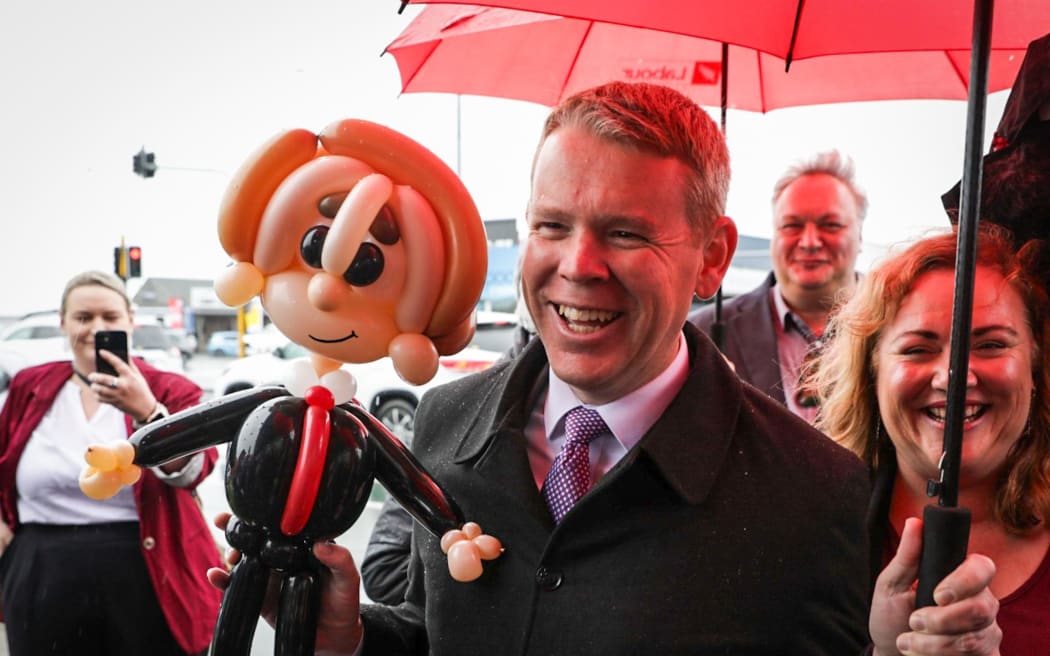
Labour leader Chris Hipkins with his mini-me in balloon form, gifted by Labour supporters outside a store in Nelson, where he was campaigning for the election on 11 September, 2023.Labour leader Chris Hipkins with his mini-me in balloon form, gifted by Labour supporters outside a store in Nelson, where he was campaigning for the election on 11 September, 2023. Photo: RNZ / Nathan Mckinnon
Housing
Currently, the bright-line test means residential property – aside from the family home in most instances, and a few other situations – attracts a capital gains tax if it is sold sooner than 10 years after purchase. National wants to lower this to two years.
Hipkins said other suggestions – such as a land tax, as proposed by The Opportunities Party – were not on the table.
“It’s not something we’re looking at at the moment,” Hipkins told Mata host Mihingarangi Forbes.
“The main form of land tax we have at the moment is local government rates, which are levied on a combination of land and asset value – whatever sits on top of that land – so we already have that at the moment. We’re not proposing to expand that further.
“The one area where I have seen proposals is around transport infrastructure – that’s what’s called ‘value capture’, which is effectively a form of land tax or land levy, based on where you’re building new roads and who’s capturing the value from those. We have left that open. The National Party are promising they’re effectively going to do it – we’ve left it open as an option, but we’re not proposing to go further than that.”
Asked why the average Kiwi had to pay about 20 percent of their income in tax (on average) while landowners making money that way did not, Hipkins said the gains should be “realised” before they were taxed.
“Levying people based on assets they own that they may never realise the gain from, it wouldn’t be an equitable way of taxing people.”
He gave the example of a family-owned farm which might be “worth millions”, but the present owners would not necessarily have the income to pay a land tax.
Ultimately, the key to making homes affordable for both buyers and renters was increasing supply, Hipkins said.
“The fundamental challenge around housing in New Zealand is we haven’t built enough houses over a long period of time – we’re talking decades – to keep up with population growth that we have. No matter how you fund it, it’s never going to be possible to turn that around overnight because building the volume of houses that we need to build takes time.
“We’ve really ramped up our house building programme and we’re seeing real results coming out of that now. My message is really, we can’t afford to turn back. We can’t afford to stop … we’ve got to keep it going.”
Mihingarangi Forbes.Mihingarangi Forbes on Mata. Photo: Mata
Labour originally promised 100,000 homes by 2028 under its KiwiBuild plan. Hipkins said so far it had only managed about 3000.
“It’s not hit the targets we had originally envisaged for KiwiBuild, but we’ve found other ways of actually delivering on the overall approach. For example., scaling up our state house build programme … actually in terms of targeting the demographic who are homeless and the most vulnerable, that’s actually going to reach that demographic faster than KiwiBuild would be able to reach them.”
He said about 13,000 new state homes had been built since 2017 with “more coming”, and the private sector had also become “very active” too. Stats NZ figures showed consents peaked at over 50,000 for the first time in 2022, and have slightly slipped since then.
Electricity and banking
In the last financial year, the big four energy companies – Contact, Genesis, Meridian and Mercury – reported a combined $2.7 billion in profits.
The big banks have also reported near-record profits of late, as interest rates rise.
Asked if they could be subject to an excess profits tax, Hipkins said his preference would be to use regulatory measures and increased competition to keep prices in check.
“[The electricity] market is in a period of significant transition as we move away from burning fossil fuels to a much greater reliance on renewable energy, which will mean prices ultimately don’t grow as fast as they would if we were still going to be relying on fossil fuels.
“Some of that money will be money that’s reinvested, for example, to actually make sure we actually have the renewable electricity generation assets that we need to be able to meet that demand.”
That lines up closely with what the power retailers themselves have said, Contact Energy chief executive Mike Fuge saying there was an “incredible amount of investment that’s going in to the industry at the moment to decarbonise”.
Hipkins left the possibility of taxing excess profits in both industries on the table, however.
“I would never rule out … that if companies continue to make excessive profits, the government might do more in that area. But my first port of call would be more in the regulatory space to make sure they aren’t making those kind of big, unjustifiable profits in the first place.”
He placed the blame for rising electricity prices on the market reforms of the late 1990s, despite Labour being in power – either alone or in coalition – for about 15 of the past 23 years.
“The challenge is you can’t unscramble an egg – once that’s been done, it’s been done … I want to see us focused on creating a renewable energy electricity market, which includes the ability for people to generate their own electricity – more solar and more initiatives like that … that is actually going to be cheaper.”
As for the banks, which do not have any need to invest in overhauling the entire way they do business, Hipkins said there had been some “pretty robust conversations”.
“It is not an area where I’m not ruling out doing more things in the future, but my focus really is on making sure that that market is competitive, rather than necessarily introducing new forms of taxation.”
He blamed some of the profits the banks had made on the pandemic, and that did not mean “those profits are going to continue” in the post-pandemic environment.
Groceries
Food prices have been rising faster than inflation generally, between 9 and 12 percent annually over the past couple of years. Labour has promised to combat this by cutting GST off fruit and veges, a policy widely panned by economists and tax experts.
Even if retailers did pass the savings on to customers, fruit and veges would likely still be more expensive on average than they were a year ago.
The Commerce Commission in 2022 estimated the supermarkets were making about $430m a year in excess profits.
Hipkins said the government had been doing more to help rein in grocery prices, such as appointing a grocery commissioner and breaking up the supermarket duopoly on wholesale supply chains.
“The work that we’re doing to change wholesale distribution supply chains – at the moment they’re locked up by two big companies – so that more competitors have access to that, that will actually make a difference in making the market more competitive, so that those kind of excess profits that we’ve seen cannot be generated in the first place.
“It won’t happen overnight, but I think we will see progress over the next year or two.”
VIA RNZ







 Latest News2 months ago

 NZ News2 months ago

 Politics2 months ago

 Latest News2 months ago

 Fiji News2 months ago

 NZ News2 months ago

 Politics2 months ago

 Latest News2 months ago