Connect with us

HTML Image

i

NZ News

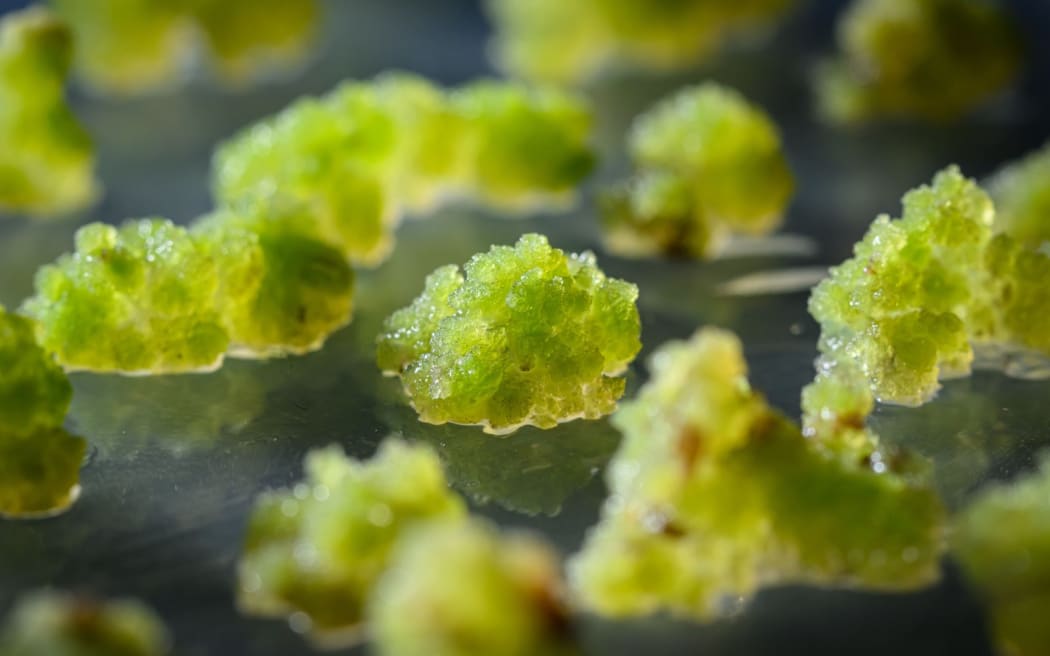
Canterbury scientists working to create ‘balls of fruity deliciousness’

Published

on

A team of Canterbury scientists believes fruit production using lab-grown plant cells could be a solution to challenges facing growers.

The work of the Plant and Food Research team, who are exploring fruit production with not a tree, bush or vine in sight, has been described as groundbreaking.

Researchers on the trials hope to recreate the taste and nutritional benefits of regular fruit.

The team at its Lincoln site, south of Christchurch, have been working with cells from several different fruits, including blueberries, apples, cherries, feijoas, peaches, nectarines and grapes, for the past 18 months.

Plant and Food Research’s five-year trials are funded through the Ministry of Business, Innovation and Employment’s Strategic Science Investment Fund.

Food by Design programme leader Ben Schon said although it’s “early days”, they were excited by what they had found so far.

“Cellular horticulture currently has a smaller profile than cellular agriculture and aquaculture,” he said.

“But we believe this is a really exciting area of science where we can utilise our expertise in plant biology and food science to explore what could become a significant food production system in the future.”

The challenge was to create an end product that was nutritious and had a taste, texture and appearance that people were familiar with.

Schon said they were yet to hit this key marker.

“In order to grow a piece of food that is desirable to eat, we will need more than just a collection of cells. So we are also investigating approaches that are likely to deliver a fresh food eating experience.

“The aim isn’t to try and completely replicate a piece of fruit that’s grown in the traditional way, but rather create a new food with equally appealing properties.”

Unlike the burgeoning lab-grown meat sector, its fruit counterpart is small globally. High interest and development in controlled environment and cellular food production systems have been reported, with more than 80 companies worldwide looking to commercialise lab-grown meat and seafood

Strategy leader Dr Samantha Baldwin said cellular growing could solve some major hurdles food producers are facing, including climate change and urban population growth.

“Globally, we are seeing rapid growth in both the vertical farming, controlled environment growing as well as cell-cultured meat spaces.

“It’s possible that cell-cultured plant foods could be a solution to urban population growth, with requirements for secure and safe food supply chains close to these urbanised markets.”

Baldwin said the methods could be of use to outdoor fruit growers, including providing a better understanding of fruit cell behaviour.

“We’re talking about cellular horticulture, but actually that knowledge of how the fruit tissue is made, how it ripens, how that is then sensed by the consumer, all of that can actually go into outdoor production in improving the flavour, the taste, the texture of what is being currently grown in the orchards.”

Similarly, other groups have pointed to the enormous possibilities of growing fruit in a controlled environment.

FoodHQ represented the country’s food innovation organisations. Chief executive Dr Victoria Hatton described the work as “groundbreaking”.

“Once you have the science behind the innovation sorted, you can create anything from that.

“I have a vision of these balls of fruity deliciousness being available to me, so I don’t have to eat a whole apple for instance to get the nutrients and the goodness.”

Source: RNZ

Continue Reading
Click to comment

Leave a Reply

Your email address will not be published. Required fields are marked *

Latest News

Police say person who fired gun at officers still at large

Published

on

Police say a person who fired a gun at officers in Napier is still at large.

Eastern District Commander Superintendent Joel Lamb said Police tried to stop a vehicle in the Pirimai Area at about 10pm on Tuesday.

He said someone in the back seat pointed what was presumed to be a firearm at officers pursuing the vehicle.

“Staff have then heard two distinct gunshots as the firearm was discharged.

“Fortunately, neither of our officers were injured, and the patrol vehicle did not sustain any damage.”

He said hours later, the vehicle was seen travelling north on the Waikato Expressway towards Auckland.

Police seized the vehicle at an address in Manurewa, but they had not found the alleged offender.

Lamb said people who lived at the Manurewa address were engaging with Police.

He said Eastern District and Counties Manukau Police were making enquiries.

“Presenting a firearm at a Police officer is a serious escalation that puts our staff and the wider community at risk. This behaviour is entirely unacceptable.

“We are taking this incident extremely seriously and will be pursuing all lines of enquiry to locate the offender and hold them accountable.”

Police asked anyone who witnessed the incident to contact Police on 105 or online using the reference number 261111/3764.

Information could also be provided anonymously via Crime Stoppers on 0800 555 111.

rnz

Continue Reading

Latest News

New Zealand sides named for RLWC finals

Published

on

The players tasked with ending Australia’s Rugby League World Cup dominance have been named.

The Kiwis and Kiwi Ferns have announced their squads for this Sunday’s World Cup finals in Brisbane.

Both sides are chasing their first titles since 2008, and both are looking to end their opponents run of three crowns in a row.

“Our Kiwi Ferns have been so dominant in years gone by, and we want to bring dominance back to this jersey, so I think it will be a case of who wants it more,” said co-captain Georgia Hale of the impending clash.

The Kiwis get a major boost for the final as they welcome back Ronaldo Mulitalo after he served a one-match ban for a high tackle against Fiji Bati.

Mulitalo replaces Charnze Nicoll-Klokstad, who moves to the six-man bench, which again includes utility Te Maire Martin, middle forwards Naufahu Whyte, Erin Clark and Xavier Willison plus fullback Keano Kini.

Loose forward Joseph Tapine will make his 30th Test appearance in a familiar pack again, including second-rowers Isaiah Papali’i and Briton Nikora, and props James Fisher-Harris and Moses Leota.

Winger Jamayne Isaako is on the cusp of claiming the New Zealand record for most Test points.

His five goals against Tonga lifted his career points tally to 225 – level with Shaun Johnson – while centre Casey McLean goes into the final with 16 tries in just eight Tests.

Fisher-Harris will again captain the team.

Fullback Ponga said the goal of the group was clear.

“We have high expectations around what we want to achieve, and obviously winning a world Cup is one of them.”

Meanwhile, Ricky Henry has selected a settled side to take on the Jillaroos, led by their lethal centre combination of Stacey Waaka and Mele Hufanga.

Veteran Apii Nicholls takes the number one jersey, Leianne Tufuga and Mackenzie Wiki on the wings.

Henry has stuck with his halves pairing of Chantay Kiria-Ratu and Raecene McGregor with Alexis Tauaneai, Georgia Hale and Otesa Pule up front.

Rounding out the starting pack is Shaniece Monschau, Kaiyah Atai, and Angelina Teakaraanga-Katoa.

“We have been building well throughout the tournament; we understand the Jillaroos side, and will give it our all to make New Zealand proud this weekend,” said Henry.

RLWC Finals:

Kiwi Ferns vs Jillaroos- 6.10pm

Kiwis vs Kangaroos – 9.35pm

Sunday November 15

Suncorp Stadium, Brisbane

Live blog updates on RNZ

Kiwi Ferns:

1. Apii Nicholls 2. Leianne Tufuga 3. Mele Hufanga 4. Stacey Waaka 5. Mackenzie Wiki 6. Chantay Kiria-Ratu 7. Raecene McGregor 8. Alexis Tauaneai 9. Georgia Hale 10. Otesa Pule 11. Shaniece Monschau 12. Kaiyah Atai 13. Angelina Teakaraanga-Katoa.

Interchange: 14. Ashleigh Quinlan 15. Annessa Biddle 16. Shannon Mato 17. Ivana Lauitiiti.

Reserves: 18. Brooke Anderson 19. Zahara Temara 20. Brianna Clark 21. Abigail Roache 22. Tenika Willison.

Kiwis:

1. Kalyn Ponga, 2. Jamayne Isaako, 3. Dane Gagai, 4. Casey McLean, 5. Ronaldo Mulitalo, 6. Kodi Nikorima, 7. Jahrome Hughes, 8. James Fisher-Harris (c), 9. Jeremy Marshall-King, 10. Moses Leota, 11. Isaiah Papali’i, 12. Briton Nikora, 13. Joseph Tapine (v/c).

Interchange: 14. Te Maire Martin, 15. Naufahu Whyte, 16. Erin Clark, 17. Xavier Willison.

Reserves: 18. Keano Kini, 19. Phoenix Crossland, 20. Charnze Nicoll-Klokstad, 21. Scott Sorensen, 22. Leo Thompson.

rnz

Continue Reading

Latest News

Opportunities to mitigate multi-million-dollar RNZ budget blowout likely missed – experts

Published

on

Multiple opportunities to identify and mitigate a multi-million-dollar budget blowout at RNZ appear have been missed, according to the former executive director at Audit New Zealand.

The public broadcaster on Monday revealed a near $12 million shock financial loss after a litany of financial blunders, which will now lead to sweeping job cuts.

The $11.8m loss is more than 25 times the $470,000 RNZ had expected to lose over the year to June.

CEO Paul Thompson took responsibility for the result, and said internal reports gave an inaccurate picture of the finances, meaning the scale of the loss only became clear in October.

RNZ’s former chief financial officer Hilary Parker resigned unexpectedly in early October.

The board said it would commission an independent review into what went wrong.

Independent contractor Stephen Walker, who left the Audit Office earlier this year, said the size of the loss was surprising, as was the length of time it took to identify it – months after the financial year ended.

Stephen Walker.
Independent contractor Stephen Walker is a former executive director at Audit New Zealand.

Supplied / OAG

“Probably more of a concern is that they had seemingly been unaware that they were running up a significant deficit until they were in the preparation stage of their annual report in October.”

Walker said public entities typically produced monthly financial reports.

An interim audit also took place before the end of the financial year, he said, but if the organisation hadn’t identified significant losses at that stage, the auditor could also be in the dark.

“It seems that there’s a real weakness in forecasting and budgeting that’s occurred here and that the monthly accounts, when they’re produced, either haven’t identified these significant variances against budget or the magnitude of them really hasn’t come to light until right towards the end of the financial year,” Walker said.

“And really at that point, there’s no opportunity for the chief executive, the leadership team to take, and the board to take, any corrective action because the year has effectively been completed.”

Walker said the “significant miss” was difficult to account for given it was more than 10 percent of RNZ’s total funding.

He said based on RNZ’s annual report, financial complexity didn’t appear to be a factor.

“This $11.8m loss isn’t made up of one particular item … it seems to have been contributed to by a number of separate expense lines running over budget. So I don’t think it’s necessarily to do with complexity.”

Among the errors, RNZ wrongly counted $2m from land sales as income in its budget. Staff costs also came in $3.2m over budget, including $1.4m in redundancy payments.

Professor at Auckland University’s business school Norman Wong said based on media reports the issues identified were “significant and troubling”.

Norman Wong.
Norman Wong.

Supplied / University of Auckland

“But recognising the sale of land as income in their budget is a basic error that one would have expected to have been caught and corrected well before it got to this point.”

With funding reductions at RNZ over the past two years, Walker expected greater scrutiny of financial results.

“Virtually every public entity has had their annual budget reduced. And so you would expect … the leadership team on a monthly basis and board – I’m not sure how frequently the board will consider the information – but you would expect them to be interrogating the results on a regular basis throughout the year,” he said.

Walker said initiating an independent review was the correct course of action and that he’d want to understand what information the leadership team and the board were regularly receiving.

He said he’d “love to say” surprising financial results were rare, but conceded they occured on a semi-frequent basis during his time leading the Audit Office.

“The benefit of independent scrutiny by the Audit Office – and the auditors providing that support to the Auditor General – [is] that the reporting is fairly presented at the end of the year, whether it’s good, bad or ugly.”

rnz

Continue Reading

Trending

Copyright © 2026 The Buzz: Powered by Apna Network Limited - Concept by Digital Hub NZ