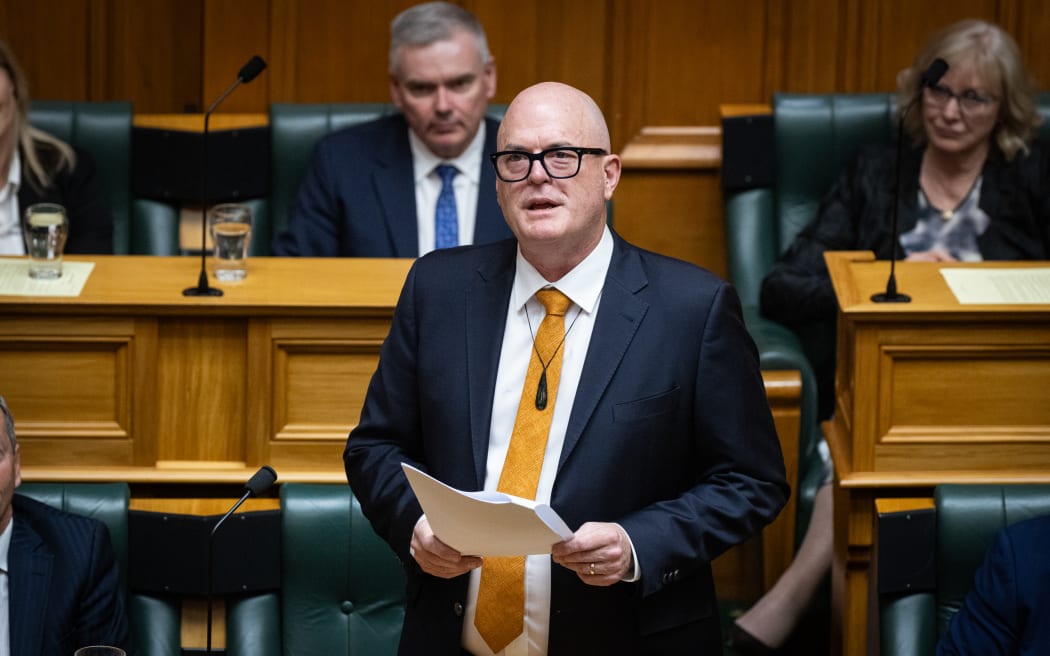
After Todd Muller’s valedictory in Parliament on Wednesday, the next MP up to the plate was the avuncular National Party MP Ian McKelvie. He listed National Party Leaders he had served under (six of them), and on reaching the short tenure of Muller ad-libbed “we just heard today what might have been”.
There was a murmur of concurrence among the many present, and there were quite a few. Even Jim Bolger had popped into the Speaker’s gallery briefly for Muller’s speech. It had certainly been unusual, and notable. It left folk pondering how a longer tenure might have altered his party, and left me wondering why MPs tend to wait until their very final words to get properly honest. Politic considerations are a too-effective halter.
Like all valedictories he thanked his family, staff and supporters (though unusually he started with the thanks). Like most farewells he threw in a few jokes and self-deprecating stories.
“By my late-teens, I was determined to one day stand in this place—so determined, in fact, that according to Michelle, on our first date, I used that pretty cool pick-up line about how much I wanted to be an MP. Clearly I was a keeper.”
But unlike many valedictories there was no long list of accomplishments or aggrandising. He went with “I have done some things well, some less well, but I gave it my best.”
Instead, the bulk of his time was spent speaking thoughtfully and powerfully on problems and risks. Each of three issues packed a wallop, and he did not spare his own colleagues.
“I hope political colleagues, the wider House, and media can see these comments for what they are — personal not political, conciliatory not critical, wary but not lacking in hope.”
On Climate Change
He began with climate change, about which he spent much time negotiating the Zero Carbon Act with Green co-leader James Shaw. He was bracingly, unusually honest about the climate reality.
“The nations of the world will not keep global warming to below 1.5 degrees, rather they will overshoot 2 degrees by some measure. As the global climate continues to warm, New Zealand will bear significant costs due to the impacts of climate change and attempting to adapt to it over time. These impacts, on our coastal and stretched infrastructure, will dwarf the medium-term challenges and costs of emission reductions.”
Usually, politicians focus on hope and positivity. MPs would call the headlights of an oncoming train ‘the warming promise of a welcoming dawn’. Muller was over the politic in politics.
“I believe the Climate Commission must mature into an institution that this House respects. But that respect will come from telling truth to power. That truth will be uncomfortable for us all. We are a tiny country seeking to play a meaningful role in global action on climate, but we must be realistic about our size, distance from market, infrastructure vulnerabilities, and balance sheet capacity.
“But all that strategic context cannot mask the inevitable: we must reduce our gross emissions and seek efficient ways to offset them in the short term. It is a challenging path for a country so small and so distant, but it will become impossible if dispassionate assessments of complex options provided by the Climate Change Commission get drowned out by simple tag-lines of denialism or catastrophisation, or even kick-it-down-the-roadism.
“As we sit here today, we cannot meet the gaze of our youth on climate action and that should not sit easy with us.”
He was definitely not playing cheerleader for the policy approach of his own coalition.
Nicola Willis elbows Christopher Luxon in the face while embracing Todd Muller after his valedictory address. Nicola Willis elbows Christopher Luxon in the face while embracing Todd Muller after his valedictory address. Luxon copped a fair bit of implicit criticism during his predecessor’s speech, and now copped one from his own deputy. Photo: VNP / Phil Smith
On Mental Health
Muller has spoken before about his own anxiety and its brutalising impact.
“To become leader of New Zealand’s most successful political movement was humbling and exciting in equal measure, but as is well documented, such sentiment was quickly subsumed by anguish and horror. As I slowly pulled the pieces of my life together, I struggled with regret and loss.”
This wasn’t completely new territory, but it was his first chance to hold his colleagues and the wider House to account eye-to-eye. With unusual frankness he criticised his party colleagues for leaning into blame rather than support after he bent under the strain.
“I turned up here late-2020 caught between trying to apologise and rebuilding a career, walking around constant triggers of what might have been. There were many messages of support from this place, which I was grateful for, but, unfortunately, behind the public utterances of many, there remained a persistent view that somehow having a mental breakdown was a function of poor political execution, as opposed to a contributor to it.
“I acknowledge this is a sensitive space, but we should be open about the unique challenges of experiencing poor mental health when you are a political figure. It is important to provide suitable space for rehabilitation, including some distance from scrutiny and accountability. We do that for cancer; we should do it for poor mental health.
“In my case, that largely happened with the mainstream media, but less so with some in my party still coming to terms with a terrible 2020 result. I hope that when the occasion arises in the future, for it surely will, empathy replaces silence, and understanding [replaces] blame.”
Mental health policy is a regular political sport. Muller wants that to stop.
“This needs to be the bipartisan cause. I commend MPs for establishing a cross-party committee on mental health, but we are losing New Zealanders, every day, including a friend of mine just last week. We can’t care for them to the level they need, and we have to fix it. When you or someone you love is suffering, you don’t care about political blame, you don’t care about policies or working groups or reviews or dollars to be spent over the next four years; you just want someone to help—you just want the pain to stop. We have to support the many hands that can reach out to them.”
Todd Muller is embraced by Te Paati Maori Co-leader Rawiri Waititi after his valedictory address.Todd Muller is embraced by Te Paati Maori Co-leader Rawiri Waititi after his valedictory address. Photo: VNP / Phil Smith
On Race: Māori and the Treaty
Most MPs spend the last portion of a valedictory thanking endless lists of names, like the world’s longest Oscar acceptance speech. Muller, rather, focussed the crux of his farewell on the threat of a widening political dichotomy, especially on race.
Rather than a precis, here it is extant.
“There is a broad change occurring in New Zealand that concerns me, and I can sense in our private moments, concerns many in this House. There is anger at a level I have not seen before. Boiling frustration, weaved through the personal conversations of many of our fellow New Zealanders. From this discontent swells greater partisanship, which is fuelling a level of political toxicity that is corrosive to our society.
“I think the most explicit example of community division at the moment is the issue of Māori and economic and political aspirations. There are two polar opposite views that are pulsing through our communities. One: that this country is being radicalised by the Māorification of our society, and the other is that we are very slowly, but inexorably, moving to a Treaty-centred future which was imagined in 1840.
“From these opposing philosophies emerge policies calling for the Treaty’s impact on New Zealand’s life to be seriously curtailed, and policies that seek to apply Treaty principles more broadly to guide all we do in this House. There is a building resentment that fundamental legislative changes are occurring without due consultation, and there is intense frustration that the promise of 183 years ago continues to be denied. As we would hope in a representative democracy, these perspectives are not only represented in this House, they sit side by side, but their world views could not be more at odds.
“How we deport ourselves on this issue matters. We are a House of Representatives, political debate in this unique New Zealand cauldron should be strong, ideas tested, and their articulation critiqued. But we must ask ourselves: are we standard bearers of civility and decency or amplifiers of division? We set an example here, and the ability to temper our language when we are fighting for closely-held beliefs is not a weakness, but a strength. We need to model the capacity to disagree with respect.
“The two great tribes of New Zealand politics—the Labour Party and the National Party—have a real responsibility here. As collective representatives of the significant majority of the country, we need to be mindful of where these debates and policies are taking us. One of the great examples of bipartisanship of the last 30 years has been our focus on settling historical Treaty claims—often in innovative and inclusive ways. But the areas of common agreement around the role of the Treaty in New Zealand are being eroded by increasingly fierce and partisan demands and responses.
“We progress as a society when the centre holds, whilst slowly moving that centre to reflect the changing nature of our aspirations and beliefs. But if the centre collapses because the extremes are too unyielding, or either one of the main parties rapidly moves to embrace that extreme, we put the bonds that bind our society at great peril. But the political centre has to move as well.
“I believe one person, one vote is the bedrock of democracy, but bedrocks can be built on, so where there is inequality in political representation, we should be open to ensuring these voices can see a pathway for greater representation. For if our political institutions are to endure, they must reflect our changing country.
“In 1993, I voted against MMP; I was fearful that the National Party’s political power was going to be diffused. I was right, it has been. We lost the clean efficiency of majority Governments, but gained the capacity to govern taking into account a more diverse range of perspectives. The future is more of that, not less. Framing Māori aspiration as a binary choice between radicalism and conservatism is as dangerous as rapid changes to our institutions without due diligence and consultation.
“So I ask the two great tribes of New Zealand politics to quietly begin refreshing and strengthening their relationships across the aisle on this kaupapa, and work together to allow the centre of NZ politics to move, but also to hold.”
MPs seldom speak so honestly. It is often a one-time thing, on their way out the door. There are likely many reasons they can’t or don’t prior to departure. Among them is the knowledge that honest words can be used as cudgels against you. The more thoughtful and honest your speech the more cudgels might be wrought from your words, especially in an atmosphere of corrosive “political toxicity”.
RNZ’S THE HOUSE – JOURNALISM FOCUSSED ON PARLIAMENTARY LEGISLATION, ISSUES AND INSIGHTS – IS MADE WITH FUNDING FROM PARLIAMENT’S OFFICE OF THE CLERK.
VIA RNZ







 Latest News2 months ago

 NZ News2 months ago

 Latest News2 months ago

 Politics2 months ago

 Fiji News2 months ago

 Latest News2 months ago

 Politics2 months ago

 NZ News2 months ago