A lack of helicopter fuel supplies delayed the search for victims of the Enchanter maritime tragedy for more than four and a half hours.
The Transport Accident Investigation Commission (TAIC) report into the sinking of the Enchanter in March 2022 – released today – has criticised New Zealand’s search and rescue operations.
Watch TAIC chief commissioner Jane Mears and chief investigator of accidents Naveen Kozhuppakalam outline the details of the report:
The Doubtless Bay-based Enchanter was returning from a fishing charter to the Three Kings Islands, about 50km north of Cape Reinga, when it was hit by a large wave near North Cape.
The vessel capsized – tearing off the cabin and flybridge – and throwing all eight passengers and two crew into the water.
Five were winched to safety by the Northland Rescue Helicopter in extremely challenging conditions, but the bodies of the remaining five were not found until two days later.
The report stopped short of saying the men may have survived if fuel had been available in the remote Far North, but it did say the chances of survival after an accident were greater if search and rescue operations were conducted promptly.
The 104-page TAIC report makes nine urgent recommendations to the Ministry of Transport and Maritime New Zealand.
The commission has called for better application of existing maritime rules, new rules about access to lifejackets, tracking devices for commercial boats, more search and rescue training, dedicated search and rescue aircraft for remote operations, and better fuel storage for remote areas.
Chief investigator of accidents Naveen Kozhuppakalam said the cause of the Enchanter capsize was a “catastrophic, unrecoverable knock-down by an unanticipated big wave”.
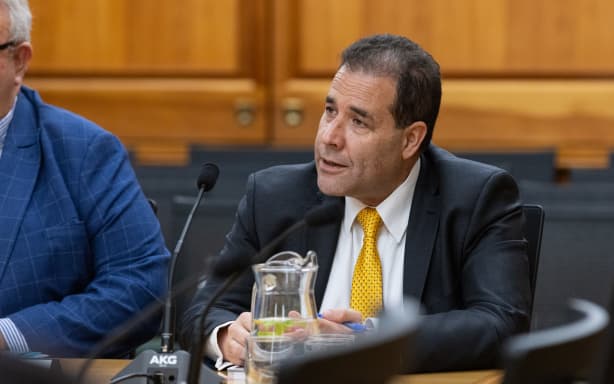
Naveen KozhuppakalamNaveen Kozhuppakalam Photo: RNZ / Samuel Rillstone
“The wave rolled the vessel in an instant, forcing the superstructure and side windows into the water, exceeding superstructure design parameters. The side windows imploded and the superstructure comprising the main saloon and flybridge separated from the hull, resulting in full capsize. The hull remained inverted but afloat,” he said.
The crew managed to activate an emergency radio beacon and the New Zealand Rescue Coordination Centre initiated a search and rescue.
“The first rescue helicopter to arrive retrieved five people from the upturned hull and other flotsam. The crew of that first helicopter excelled at the high-risk task of wet winching in the dark over water. Their expertise was instrumental in saving the lives of five people,” Kozhuppakalam said.
“When that helicopter was full of people and left the scene, the survivability clock was ticking for remaining survivors. Their immediate hazards included time in the water, hypothermia, swimming ability; injuries sustained during the capsize; and pre-existing medical conditions. Nobody was wearing a lifejacket so they relied mainly on bits of boat for flotation.”
Kozhuppakalam said three of the missing men were alive in the water when last seen by the survivors.
However, a search and rescue operation involving multiple aircraft and surface vessels took almost two days to find them. By that time, they were dead.
Kozhuppakalam said delays in mustering crews delayed deployment of further rescue helicopters, and for four hours and 36 minutes, a lack of available fuel prevented helicopters searching for the remaining five people in the water.
This was partly because fuel supplies in the Far North were set up for air ambulances, not for extended search and rescue operations in remote areas.
Kozhuppakalam said it was “virtually certain” that one, or a combination, of factors – including the delayed search – had an effect on survivability.
“Limited floatation support – no-one wore, or had immediate access to lifejackets. The liferafts likely did not automatically deploy.
“Detectability: Missing people would have been hard to see in the water at night.
“The tragedy is that all of these factors had an effect on survivability.”
TAIC’s recommendations required the immediate attention of the Secretary for Transport and the Director of Maritime New Zealand.
“This report is about more than the tragic accident involving the Enchanter. It is system-wide, nationwide because the safety issues affect everyone on board a commercial or recreational vessel. And everyone on board deserves to be safe,” Kozhuppakalam said.
The report stated the Enchanter should have been able to withstand the sea conditions off North Cape at the time.
However, it was possible the vessel had strayed into the water around Murimotu Island, an area prone to occasional large waves that peaked as they entered shallow waters. The TAIC report noted a disagreement between investigators and the skipper regarding where the accident occurred.
Because the capsize was so sudden no one was wearing, or had access to, lifejackets.
It was likely the liferafts had failed to automatically deploy, leaving the men to cling to the hull or pieces of wreckage to stay afloat.
The five who died in the sinking were Geoffrey James Allen, 72, Michael Patrick Lovett, 72, Richard Eldon Bright, 63, and Mark Keith Walker, 41, all from Cambridge, and Mark Kenneth Sanders, 43, from Te Awamutu.
Kozhuppakalam said there was much to be done to ensure there was capacity to respond to major events.
“In the grand scheme of things, this is a 16m boat with 10 passengers on board and it seems from this operation that this was at the upper end of capacity and capability for New Zealand, when in fact, at any given point there will be larger vessels with more people operating in more remote areas.
“The commission’s recommendation is to raise this important safety issue.”
Mears said the liferafts on the Enchanter “weren’t quite the right type”.
Asked about lifejackets continually coming up as an issue, Mears said: “It’s very frustrating … we have made other recommendations about the need for lifejackets to be mandated in other circumstances.
“We do think lifejackets should be mandatory.”
Maritime New Zealand is carrying out a separate investigation into liability for the tragedy.
That has already led to charges being laid in the Kaitāia District Court against skipper Lance Goodhew and his company, Enchanter Charters.
Goodhew and his company face Health and Safety at Work charges of exposing passengers to a risk of death or serious injury.
The company also faces a charge of the skipper failing to have a current medical certificate, a breach of the Maritime Transport Act.
The case was adjourned and will be called again later this month.
Maritime New Zealand responds
Maritime New Zealand says it is taking on board some of the recommendations directed at the agency and others connected with work done by its Rescue Coordination Centre.
Director Kirstie Hewlett said it was a “complicated response”, requiring aircraft to quickly respond from around the top of the North Island, which played a key role in five people being rescued.
The thoughts of everyone at Maritime New Zealand went out to everyone affected by the tragedy, she said.
“I want to thank everyone who was involved in the response, from our people at RCCNZ, through to those who went out in trying conditions, to undertake rescues and then continue to search for the missing.”
The agency “partially” accepted the recommendations regarding its surveyors, who inspected vessels, she said.
“This is because we already engage with, and notify, surveyors around rule and regulation changes and provide clarification around the intent of rules.
“We are undertaking work to further strengthen our approach to monitoring surveyors, and are currently out consulting on an increase to our capacity to support this.”
Maritime NZ was also considering the recommendation around requirements for automated identification systems (AIS) to be fitted on passenger vessels outside inshore limits and the stowage of life jackets.
“The matter around AIS systems is already one that is on our regulatory reform programme to explore. Progressing it could improve response times and can accurately give location data. The stowage of life jackets is something new we will look at.
“Both rules changes will also need to be considered alongside other priorities. Ultimately, it will be for ministers to decide whether to approve the development of new rules.”
Meanwhile, the Rescue Coordination Centre was looking at the recommendations around search and rescue.
“After the incident, RCCNZ undertook an internal review into its coordination of the response, and has since made several improvements to its procedures.
“We will support any response by Te Manatū Waka and the New Zealand Search and Rescue Secretariat.”
However, as the matter was now before the courts, Maritime New Zealand was “not in a position to comment further”.
Te Manatū Waka Ministry of Transport (MOT) New Zealand Search and Rescue Secretariat director Duncan Ferner said in a statement MOT “would like to acknowledge this tragedy and lives lost on the Enchanter. Our thoughts are with the family members of all the crew and passengers on board”.
“We welcome the recommendations in the report. We will work through the recommendations and how they may be implemented, with our colleagues across the New Zealand Search and Rescue Council. Some work in this area is already underway.”
VIA RNZ





 Latest News2 months ago

 NZ News2 months ago

 Politics2 months ago

 Latest News2 months ago

 Fiji News2 months ago

 NZ News2 months ago

 Politics2 months ago

 Latest News2 months ago