A 10-year-old New Zealand girl’s bid to study in China was thrown into disarray after questions emerged about her nationality when trying to secure a long-term visa for the stay.
The case highlights the complications some New Zealand-born young people face when trying to navigate the strict laws applied by several countries in Asia regarding dual citizenship.
Auckland resident Daniel Wei travelled to China with his wife and daughter under a short-term visa in May to visit family. Once there, they applied for a permanent resident visa to allow their daughter to study in China.
However, immigration authorities at the Guangzhou Public Security Bureau’s Tianhe branch rejected the application based on her nationality.
Since Wei was a New Zealand citizen when his daughter was born, she automatically received New Zealand citizenship under current legislation.
But immigration officials in Guangzhou argued that Wei’s daughter was a Chinese citizen because his wife only held a work visa at the time of her daughter’s birth and was still technically a Chinese citizen.
Immigration officials issued Daniel Wei’s daughter with a short-term visitor visa for her stay in China.Immigration officials issued Daniel Wei’s daughter with a short-term visitor visa for her stay in China. Photo: Supplied
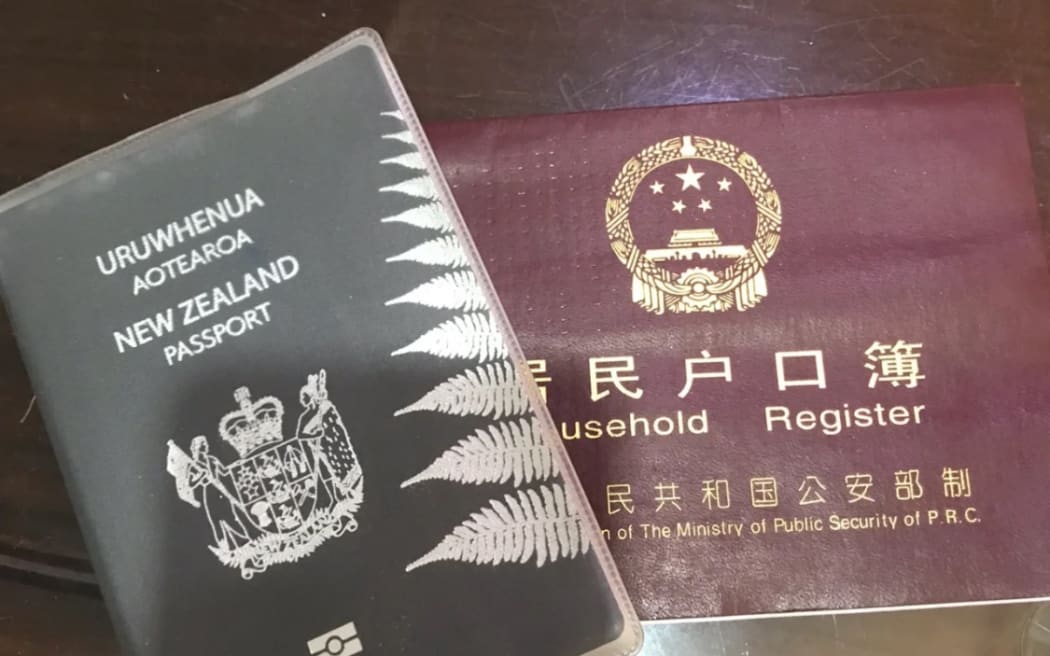
As a result, immigration officials in China instructed Wei to register with China’s mandatory hùkǒu system of household registrations and obtain a Chinese passport.
Wei and his wife filed another application for permanent residency with Guangzhou Public Security Bureau’s Huangpu branch but received the same answer.
Wei was perplexed.
“We thought our daughter should have the opportunity to choose her preferred nationality when she turns 18,” Wei says, referring to the age under law by which children born overseas to Chinese parents must decide on their nationality.
“I was shocked when my daughter was classified as a ‘nationality conflict’,” he says. “She was born in New Zealand and considers it her home. She is now very confused.”
Wei’s daughter is now in China under her New Zealand passport after getting travel permission from immigration officials.
Wei shared his story on Chinese social media platform Little Red Book, which has sparked a heated debate about dual citizenship.
Opinions appear to be evenly split, with some arguing his daughter should hold New Zealand citizenship since she was born in the country and has a New Zealand father.
However, others claim his daughter should hold Chinese citizenship because her mother does not have a visa that allows her to reside in New Zealand indefinitely.
Lack of recognition
Asia is the world’s most restrictive region in terms of dual citizenship, with only 65 percent of countries and territories allowing it, according to the Maastricht Center for Citizenship, Migration and Development. India, Japan and Singapore are among several countries in Asia that do not allow their citizens to hold dual nationality, although conditions vary between nations.
China also doesn’t recognize dual nationality and usually grants citizenship to children of Chinese parents who are born abroad unless they have obtained permanent residency or citizenship in another country.
By the same token, anyone who receives Chinese citizenship must renounce other nationalities.
Conversely, New Zealand allows multiple citizenships. A child born in New Zealand is automatically deemed to be a New Zealand citizen if at least one parent is a New Zealand citizen or permanent resident at their time of birth.
Parents in New Zealand can also apply for their child to be recognised as a citizen of their home country.
Notably, if the parents of a child born in New Zealand are from a country that does not allow dual citizenship, the child will need to obtain citizenship of their parents’ home country and renounce their New Zealand citizenship after they turn 18 years old. They would then need to obtain permanent residency if they wished to stay in New Zealand.
The only other way to ensure children from such nations share the same nationality as their parents is for the parents to travel to their home countries to give birth.
Sherry Li (right) lives in China with her daughter and mom.Sherry Li (right) lives in China with her daughter and mother. Photo: Supplied
Travel consultant Sherry Li lived in Auckland after securing permanent residency in New Zealand in 2018.
However, Li and her husband returned to Chengdu in 2021 to ensure their daughter was born in China and ease the concerns they held about her nationality.
The couple felt it would be more convenient if their daughter shared the same passport.
“If a child holds a New Zealand passport, we will need to apply for a visa for her when we go back to China, which isn’t convenient,” Li says. “In case of an emergency, it’s more convenient for the family to be able to travel together.”
Li says her daughter is free to decide which passport she would prefer to retain once she turns 18, as she is also still eligible for New Zealand citizenship. For now, however, she holds a Chinese passport and has been registered in China’s system of household registrations.
“When we decide to return to New Zealand, we will apply for a visitor visa for her,” Li says. “Upon arrival, we can begin the process for her permanent residency.”
A flexible policy?
Harris Gu, an immigration lawyer for Queen City Law in Auckland, has plenty of experience handling dual citizenship cases.
Harris Gu, a lawyer for Queen City LawHarris Gu, a lawyer for Queen City Law. Photo: Supplied
He says a child can be viewed as a Chinese citizen by the Nationality Law of China, with or without them wishing to acquire Chinese nationality.
However, the legislation cannot compel a child to renounce their New Zealand citizenship until after they have become an adult and demonstrate they are able to make a choice of their own volition.
“Should a child retain their foreign nationality, there is no provision in the Chinese citizenship law to have their Chinese citizenship renounced or revoked,” Gu says. “The provisions about revoking or renouncing Chinese citizenship do not apply to children. So, technically speaking, the child can retain both Chinese and NZ citizenship.”
Gu says a child who is born with New Zealand nationality but deemed to be a Chinese citizen by the Nationality Law of China can apply for a travel document to enter China.
“A Chinese passport isn’t necessary,” Gu says.
“They can wait until 18 to choose their preferred nationality. If they wish to keep their New Zealand passport, they renounce their Chinese nationality,” he says.
“You can say it’s a good policy for children born overseas,” Gu says. “The family unit will have more flexibility to return to China to live and work.”
The Chinese Embassy confirmed that China doesn’t recognize dual citizenship.
If any person holds Chinese and foreign nationalities, China views them as a Chinese citizen and will issue travel documents for them to visit China instead of a tourist visa, the embassy said.
If a child under the age of 18 holding dual citizenship insists on obtaining a visa to visit China, they must renounce their Chinese nationality through the Chinese Embassy in New Zealand or the National Immigration Administration in China, the embassy said.
Ruiping Ye, senior lecturer from the Faculty of Law at Victoria University of WellingtonRuiping Ye, senior law lecturer at Wellington’s Victoria University. Photo: supplied
Ruiping Ye, a senior lecturer in law at Wellington’s Victoria University, says that the law of New Zealand does not require a child to renounce their New Zealand citizenship if the child is also regarded as a Chinese national. She says China does not currently compel a child to renounce New Zealand citizenship either.
China signed an agreement on consular relations with New Zealand in 2003, providing travel facilitation for individuals who may claim dual nationality with both China and New Zealand, while noting that this doesn’t mean China formally recognizes dual nationality.
“China grants travel documents to children born overseas who are qualified for both nationality of the birth country and Chinese nationality. However, this appears to be an operational policy, so the nationality conflict has yet to be resolved through legal provisions,” Ye says.
“Dual nationality is convenient for people travelling overseas,” Ye says. “Citizens enjoy the rights granted by both states to their respective citizens, but people should bear in mind that the law also imposes civic responsibilities on citizens.”
VIA RNZ









 Latest News2 months ago

 NZ News2 months ago

 Latest News2 months ago

 Politics2 months ago

 Fiji News2 months ago

 Latest News2 months ago

 Politics2 months ago

 NZ News2 months ago