National is promising a suite of new roads and a rapid transit network for Auckland, using a mix of government funding and private equity.
Labour says National’s policy appears to be based on old costings, with the price of just four of the projects coming up between $2.8b and $4.8b short.
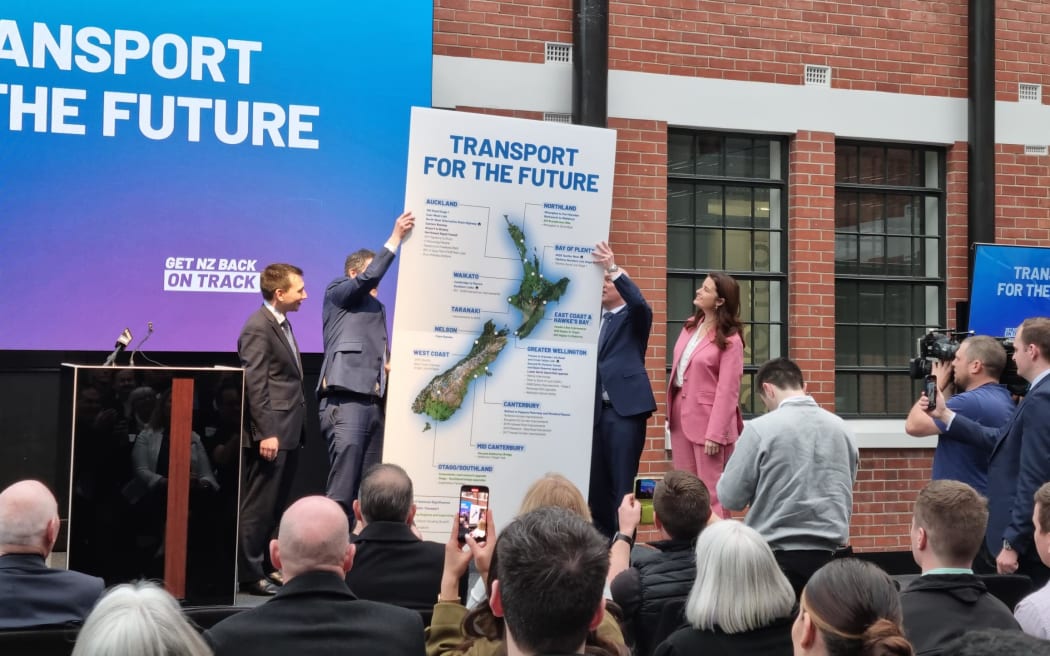
The party unveiled its Transport for the Future full policy, costed at $24.8 billion over 10 years, at Wintec in Hamilton on Monday.
It highlighted a focus on roads of national significance, public transport in Auckland and the lower North Island, and upgrades focused on rebuilding regions hit by Cyclone Gabrielle and resilience to future storms.
Funding for the projects would come from a mix of sources, including more than $7.4b from the National Land Transport Fund and nearly $6.3b from the government; reallocating more than $1.5b from the New Zealand Upgrade programme; and more than $9.5b from private funding.
Private funding would include a mix of value capture, cost recovery and equity finance. These are tools which give investors rights to build, develop nearby land, or recover funding through things like road tolling.
This would be supported by things like public transport subsidies and priority consenting and the party suggested it could appeal to investors including the Super Fund, KiwiSaver funds, or global investors.
Some details of the policy had already been publicised over the weekend, including plans for a four-lane highway from Whangārei to Tauranga, and a promise to scrap the Let’s Get Wellington Moving project.
Promised roads of National significance:
(Years indicate estimated project commencement)
Northland: Whangārei to Port Marsden Highway (1-3 years, $1.3b), Warkworth to Wellsford Expressway (4-10 years, $2.2b)
Auckland: Mill Road Stage 1 ($1.3b, 1-3 years), East-West Link ($1.9b, 1-3 years) North West Alternative State Highway ($2.3b, 4-10 years)
Bay of Plenty: SH29 Tauriko West ($1.9b, 4-10 years), Tākitimu Northern Link Stage 2 ($627m, 1-3 years)
Waikato: Cambridge to Piarere Expressway ($721m, 1-3 years) Southern Links ($600m, 4-10 years)
Greater Wellington: Petone-to-Grenada and Cross Valley Link north of Wellington ($1.8b, 4-10 years), second Mt Victoria tunnel and Basin Reserve upgrade ($2.2b, 3-5 years)
Nelson: Hope Bypass ($250m, 4-10 years)
Canterbury: Belfast to Pegasus motorway with Woodend bypass ($270m, 1-3 years)
Public transport:
Auckland: A rapid transit network, with public transport corridors in the North West ($2.9b, 4-10 years), Airport to Botany (2.1b with 1.1b from government, 4-10 years), and completion of the Eastern Busway ($717m, 1-3 years).
Lower North Island: Improvements to increase capacity and reliability on train services for passengers and freight ($874m, 1-3 years)
Repairs and resilience upgrades:
Hawke’s Bay Expressway, upgrading to four lanes (costings and timeframes not provided)
SH1 Brynderwyn Hills, prioritising 2018 business case (costings and timeframes not provided)
SH5 Napier to Taupō (costings and timeframes not provided)
SH2 Napier to Gisborne (costings and timeframes not provided)
Second Ashburton bridge ($113m, 1-3 years)
Queenstown road network upgrade ($100m over 10 years)
Otago-Southland bridge upgrades ($100m over 10 years)
The party also committed to existing and planned projects including a new two-lane road from O Mahurangi to Penlink, the four-lane Ōtaki-north of Levin corridor, the Melling Interchange in the Hutt Valley, and a second Waitematā Harbour crossing. It also promised to investigate – but not commit to – a range of other projects, and earmarked $200m for as-yet-unannounced projects.
Later stages for the party’s Whangārei-to-Tauranga plan would still be in planning by the time of the 2026 election. This includes about 50km between Port Marsden and Wellsford, 50km between Piaere and Tauriko including a new Kaimai Range route, and an alternative route for the Brynderwyns.
The party has previously campaigned on the Petone-to-Grenada and Cross Valley Link in the Hutt Valley, which have broad support from most parties in Parliament.
Waka Kotahi approved the Cross Valley Transport business case put forward by Hutt City Council in 2021, making way for government funding to bolster the $160m the council budgeted. However, the road is not expected to be complete until 2032-33.
National’s Christopher Luxon answers questions from reporters.National Party leader Christopher Luxon answers questions from reporters in Hamilton. Photo: RNZ / Libby Kirkby-McLeod
The Southern Links project in Hamilton was first looked into in 2013, but has remained unfunded. National’s policy repeated an early costing of $600m but Waka Kotahi has more recently given estimates of $1b to $1.5b.
National has long campaigned on building a four-lane Belfast to Pegasus motorway that was put on hold by Labour.
Reallocations would mean the cancellation of $270m in safety improvements for the existing Whangārei-to-Port Marsden Highway, $874m from earmarked to upgrade the existing Mill Road corridor, and $410m from the Port Marsden Rail Spur which would be put on hold.
The public transport boost for the lower North Island includes 22 new four-car tri-mode units, infrastructure upgrades to train stations, a new maintenance depot in Masterton, new stabling facilities for rolling stock in Wellington, Masterton and Palmerston North, and additional track maintenance work across the lower North Island network.
The roading upgrades would be overseen by the National Infrastructure Agency previously proposed by the party.
Roading network ‘needs a step change’ – Luxon
In a speech announcing the policies, party leader Christopher Luxon said National’s vision was for New Zealand to become one of the world’s leading small advanced economies, which would require more than incremental improvements.
“You can wish things were different, or you can make them different. Making them different is why I came to politics,” he said.
He talked about the need for greater productivity in New Zealand, saying one related element was transport networks and supply chains.
“Many parts of State Highway 1 and other key regional roads are simply dual carriageways and if you’re behind a logging truck approaching a big hill, you just sit tight and hope for a passing lane … there are chokepoints in various places.
“New Zealand’s roading network needs a step change.”
He said the four-lane highway linking Tauranga, Hamilton Auckland and Whangārei was the policy’s single most ambitious project.
“Most of our imports and exports arrive and leave in the so-called “golden triangle” and a faster and safer road linking ports and cities will drive growth and efficiency.”
The party’s transport spokesperson said the 13 new roads of national significance would also unlock tens of thousands of new houses in Auckland, Hamilton, Tauranga and Wellington.
“National’s vision is to provide New Zealanders with safer, faster and more reliable transport options so they can get to work, get their kids to school and freight can move around the country more easily,” he said.
Billions of dollars short, Labour warns
Transport Minister David Parker said National’s policy was “breathtakingly misleading”, with costings appearing to fall up to $4.8b short for just four of the big projects.
He said roading and materials costs had risen up to 45 percent between March 2021 and September 2022, labour costs went up 7.5 percent, and diesel, steel and bitumen had risen 90 percent, 57 percent, and 104 percent respectively.
He compared Waka Kotahi’s latest estimates for four of the projects to National’s numbers, saying the party’s SH29 upgrade estimate fell $600m to $1.35b short; the Warkworth-to-Wellsford project was between $1.3b and $1.8b short; Cambridge to Piarere would need $780m to $1.28b more, with Whangārei to Port Marsden $110m to $367m down.
Labour MP David ParkerDavid Parker Photo: RNZ / Angus Dreaver
Parker said people could bet on the costs being even higher when the other projects were included.
“National has form in this area – when they were last in government, they paid for new roads by slashing the road maintenance budget. That created a long-term resilience problem for our roading network, including the pothole explosion that this government has had to fix. Then they announced a $500 million pothole repair fund, paid for by raiding the road safety budget.
“Now they are putting up poorly costed roading promises across the country in their desperation to get a headline.”
He said public-private partnerships would make no difference as they would still be subject to the same cost pressures.
“The taxpayer is still paying for Transmission Gully,” he said. “National would have to fill the potholes in their roading projects budget by slashing maintenance spending and hiking road user charges and fuel excise duties.”
In a statement, Brown said it was rich for Parker to suggest a shortfall in National’s costings.
“National used the upper figures of the government’s own range of costings that are publicly available, and we have set aside a significant contingency of $1.4 billion,” he said.
He said the transport minister had in recent weeks said the latest cost estimate for the Cambridge to Piarere highway was $605m to $721m, and the minister today was claiming the estimated cost had roughly doubled.
“Either the minister hid the cost of the project at the start of this month when we asked for it, or he’s tasked officials to change the numbers to desperately justify his partisan attack,” Brown said. “We don’t need Mr Parker to point out that there’s inflation. That’s about the only thing that Labour has created.”
“The Labour government has utterly no credibility on transport project delivery, or sticking to a budget,” he said, pointing to the Auckland light rail project.
Green Party transport spokesperson Julie Anne Genter said National’s policy amounted to a visionless obsession with highways.
“What National has proposed is completely nonsensical, and will make pollution and congestion worse,” she said. “You cannot build your way out of traffic congestion by making more roads. The more you build, the more people drive … you can’t trust National with our climate.”
VIA RNZ







 Latest News2 months ago

 NZ News2 months ago

 Politics2 months ago

 Latest News2 months ago

 Fiji News2 months ago

 NZ News2 months ago

 Politics2 months ago

 Latest News2 months ago