

Latest News
Hipkins’ tax pledge could threaten coalition talks – Greens, Te Pāti Māori

The Greens and Te Pāti Māori are warning Labour that ruling out capital gains or wealth taxes could threaten their chances of a coalition deal.
National and ACT also say the promise is premature, and likely to be overridden.
Alongside the release of Budget documents today, Labour leader Chris Hipkins admitted he had shut down plans for a “tax switch” in this year’s Budget, which would have seen a tax-free bracket and a 1.5 percent tax on wealth above $5 million from 2024.
But he also went a step further, ruling out introducing any wealth tax or capital gains tax “under a government I lead”, an echo of a similar pledge from his predecessor Jacinda Ardern.
It conflicts with the priorities of the Green Party – who, polling has consistently showed, Labour would need to form a government.
Their policy – the first they announced this election – would to introduce an “income guarantee” of a tax-free bracket for all earnings under $10,000, funded by a new tax bracket of 45 percent on income over $180,000, and a 2.5 percent wealth tax on assets.
Labour would also likely need Te Pāti Māori, which has also spoken about plans to “tax the rich” as part of its election campaign this year.
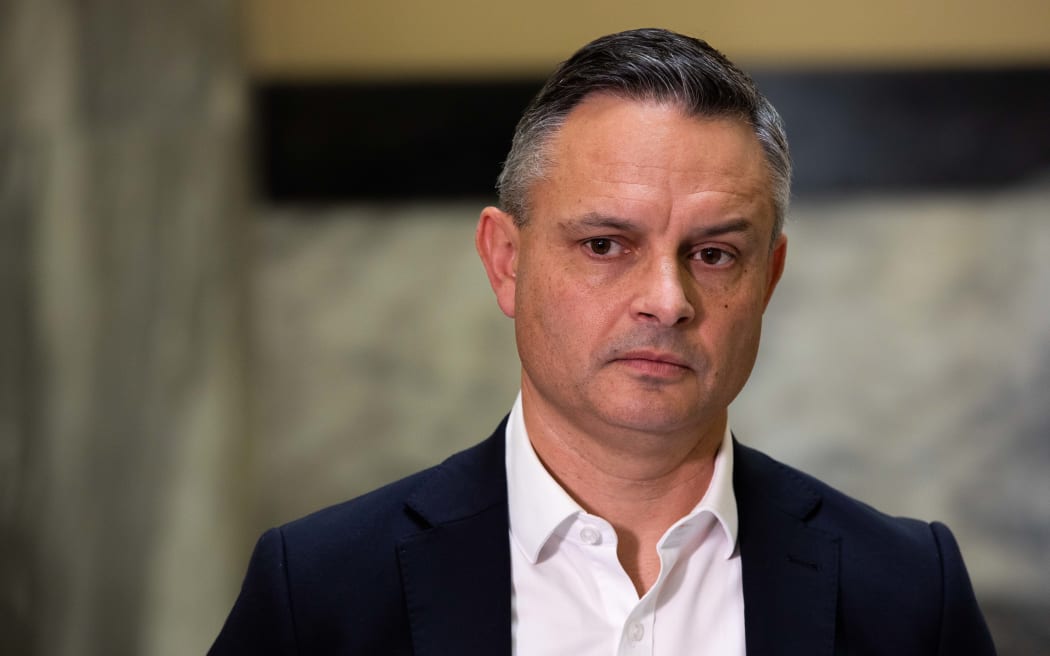
Both parties came out swinging, with the Greens’ co-leader James Shaw telling reporters it was disappointing, and Labour had “got it wrong”.
He said there was a “very real possibility” the Greens would not work with Labour as a result.
“It does depend on how many MPs we’ve got, and it does depend on the rest of the agreement – but we have always maintained the option of just sitting on the cross-benches … I think that there is a very real possibility of that,” he said.
“This is a priority for us, it has been a priority of ours for some time.
“I don’t think any political party leader can categorically rule out what the agenda of the next government is under MMP – that is ultimately for voters to decide.”
Shaw said the government had done “quite a good job” in lifting about 30,000 children above the material hardship line, but about 45,000 were still below it.
“I feel very strongly about this, and the Greens have campaigned for a progressive tax system for a very long time. We have said a number of times that poverty is a political choice.
“We’re a wealthy country, we have the ability to end poverty here. And ending poverty enables us to do more things as a country as well.”
In an earlier statement, he said governments had been tinkering on the edges of the tax system for too long, and “the time for tinkering is over, the time for political courage is now”.
“Governments have been tinkering at the edges – constrained by self-imposed refusal to tax the wealthy – instead of taking the bold decisions people need right now. If political leaders are not willing to take those decisions on behalf of the people of the country you purport to lead, then why be in politics at all?”
He thought Hipkins was a very principled politician with a deep commitment to public services and education, but “I don’t think that there’s any point in political power if you choose to do nothing with it”.
Te Pāti Māori co-leader Debbie Ngarewa-Packer was similarly scathing, saying for all Hipkins’ talk of “bread and butter” it was those struggling to put bread and butter on the table who would lose out.
“He is more concerned about winning voters who would be upset by any disruption to what they’ve seen be the norm, and I guess there has been a real ignorance and a normalisation of poverty as long as it’s not in your backyard. And that’s the status quo,” she said.
“The tax system is currently designed for the rich and it’s got to stop. We’ve got to bring a balance back into our nation. Our nation and our people deserve it.”
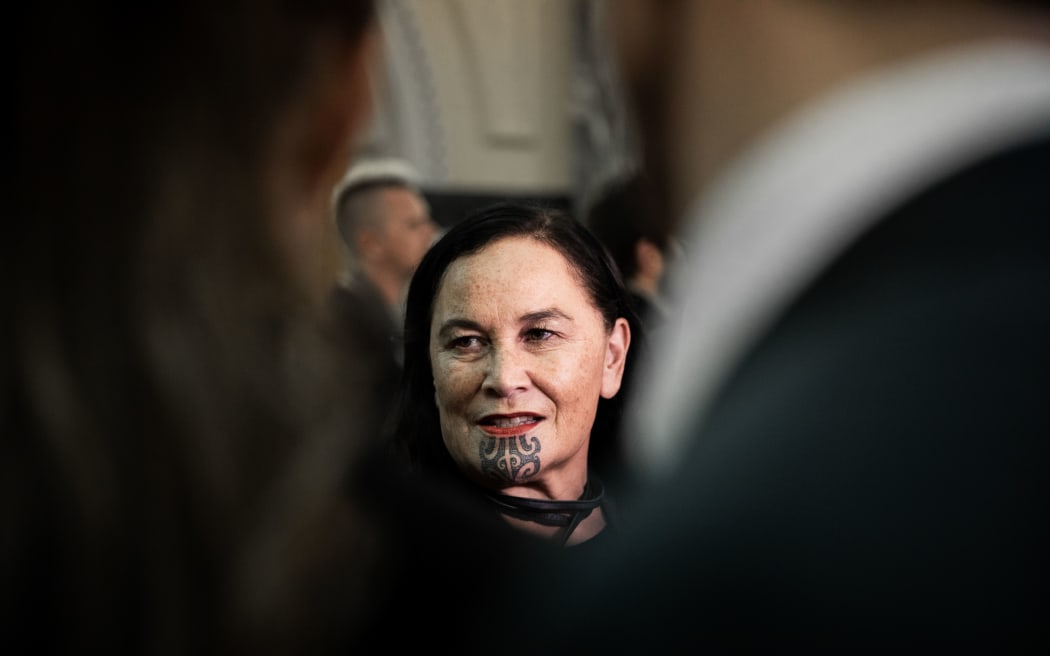
Te Pāti Māori co-leader Debbie Ngarewa-Packer Photo: RNZ / Samuel Rillstone
She said Hipkins was “arrogantly” saying he did not want to do business with either of the left-leaning minor parties.
“Whether it be the Greens or Te Pāti Māori, effectively saying he’s not open for business or negotiations, and I think that’s really unwise.
“Elderly can’t afford their food, families are working three jobs, we can’t afford to be a nation that continues like that.
“If you’re not going to tax the rich, if you’re not going to tax the houses, take GST off food, capital gains tax, then what are you doing? Basically you’re doing nothing, so what would we have to discuss?”
She said he did not really have the option of doing that.
“I don’t think the prime minister – or the polls – is in a position, to state what he would absolutely not do … he does not have the luxury to dictate how and what he will or won’t do to stop poverty.”
She stopped short of completely ruling out working with Labour if such a tax were not up for negotiation, however.
“We’ve always been open and honest about what it is that we require in a relationship, and that would be our values decision,” she said.
“They shouldn’t be and he shouldn’t be so callous as to sit there and say ‘I’m wanting to make whānau live well and be well, but actually I’m not open to any transformational change to achieve that.
“If he takes it off the table, what in hell is he proposing to rebalance and address pain and poverty in Aotearoa?”
RNZ


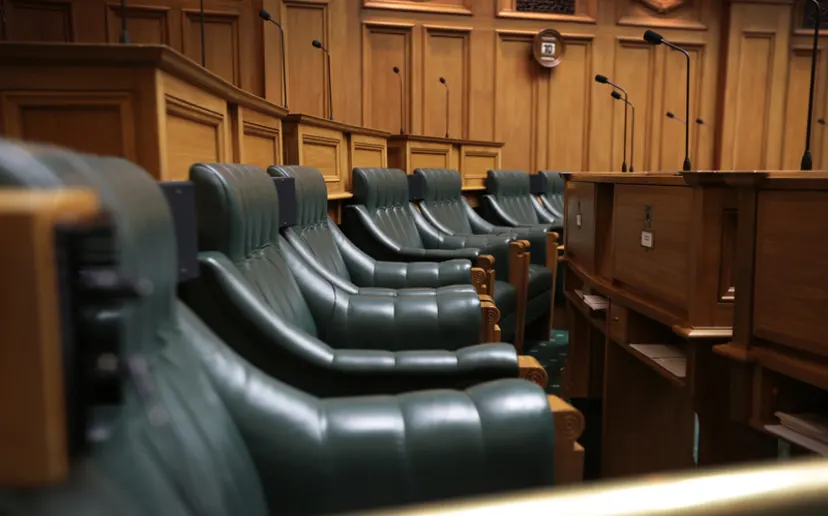
The chief executive of the Parliamentary Service is confident there will be enough room to accommodate the increased number of MPs and their staff coming into Parliament.
On current numbers, up to 131 MPs could be sitting in the Chamber following the election, brought on by a record overhang result.
Clerk of the House of Representatives Dr David Wilson told the Spinoff that currently the debating chamber had enough chairs to seat 124 MPs – including the Speaker of the House – and work was being done to accommodate more by altering the seating arrangement.
In a statement, Parliamentary Service chief executive Rafael Gonzalez-Montero said planning for a larger Parliament had been going for “some time”.
“Now that the election results have confirmed an increase to the number of members we are looking at several options.
“We are confident we will be able to accommodate all members within the Chamber.”
VNP / Phil Smith
Gonzalez-Montero said office accommodation for members and their staff would be “stretched” for a short time, but the new Members’ Building was only a few months away from “practical completion”.
That building – located behind Parliament – was due to be ready to occupy in April next year and had capacity to accommodate around 30 backbench MPs.
“All members should be in fit-for-purpose accommodation from that point,” Gonzalez-Montero said.
Following the 2023 election, 123 MPs sat in the Chamber – a record number at the time. That decreased to 122 following the resignation of National MP Judith Collins.
Collins held the seat of Papakura and stepped down in May and Parliament voted against holding a by-election because it was too close to the election.
The election result also meant high-ranking National Party MPs like Chris Bishop, Paul Goldsmith, Nicola Willis and Gerry Brownlee – Speaker of the House and an MP for 30 years – would likely not make it back into Parliament.
Only resigning or retiring MPs were permitted to give a valedictory speech meaning none of them would get the chance to give a valedictory statement.
Asked if their would be special allowances for valedictories, Wilson said in a statement that normally only MPs were allowed to speak in the House but the House could suspend its own rules or temporarily alter them.
“It could do so to allow former members to address the House.”
Wilson said no such arrangements could be made until the next Parliament opened and members sworn in.
rnz


Police say person who fired gun at officers still at large

New Zealand sides named for RLWC finals

Parliamentary Service working on extra chairs and offices for increased number of MPs


-

 Latest News2 months ago
‘Chilling’: Business groups speak out against National’s supermarket break-up plan
-

 NZ News2 months ago
Tom Phillips report: The missed opportunities to find the children
-

 Latest News2 months ago
Cars bearing Chinese police markings stir unease in Auckland
-

 Politics2 months ago
National vows to try to split Pak’nSave and New World
-

 Fiji News2 months ago
Plans to have new Constitution by Dec 24th 2026
-

 NZ News2 months ago
Cop who stole $68,000 can now be named as champion Muay Thai fighter Haimona Tamati-Te Paki
-

 Politics2 months ago
MBIE confirms botched biometric projects costs blown out to $50.7 million
-

 Latest News2 months ago
Five Karangahape Road venues lose their liquor licences after police intervention