Finance spokesperson Nicola Willis said while the government continued to make excuses, the data did not lie, showing New Zealand was in worse shape than many other comparable countries which had faced similar challenges “but none of which face the toxic economic predicament we now find ourselves in”.
“Excessive inflation, high interest rates, a severe balance of payments deficit and now recession: this is a dangerous combination that threatens New Zealanders’ livelihoods.”
She said National had been warning about the risks of the current approach and “it’s time to call time on policies that have been anti-growth, anti-business and that led New Zealand to where it is today”.
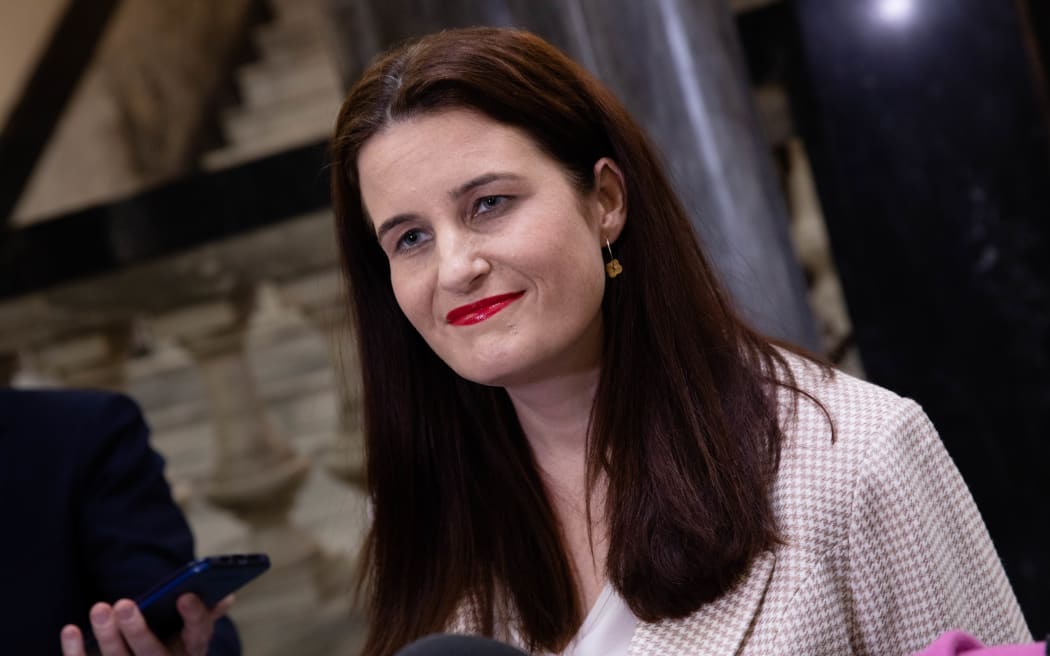
Deputy Leader of National Party Nicola WillisNational’s finance spokesperson Nicola Willis. Photo: RNZ / Angus Dreaver
Finance Minister
Finance Minister Grant Robertson said the economy was showing resilience after this year’s devastating weather events, with today’s figures “reflecting the impact of the Auckland Anniversary floods and Cyclone Gabrielle, with estimates of hundreds of millions of dollars of lost production and activity across agriculture, forestry, fishing, transport and manufacturing”.
“The result was not a surprise.
“We know 2023 is a challenging year as global growth slows, inflation has stayed higher for longer and the impacts of North Island weather events continue to disrupt households and businesses.”
Robertson defended accusations of economic mismanagement, saying “the fall in central government consumption shows the government is taking pressure off the Reserve Bank and interest rates with our careful and targeted spending”.
Finance minister Grant Robertson showing the cover of Budget 2023 the day before its revealFinance Minister Grant Robertson. Photo: RNZ / Angus Dreaver
ACT Party
ACT, however, said the government was running an “Afterpay economy” – buy now and pay later.
The core of the problem, leader David Seymour said, was low productivity.
“Too much government waste, too much red tape and regulation, means too much compliance time and not enough productive time.
“New Zealanders expect first world living standards, but the economy under Labour doesn’t produce them, so Kiwis borrow the gap between a second world economy and first world living standards.”
Union voice
The Council of Trade Unions, though, warned against any “exaggeration” of what the recession meant, as it was a direct result of Cyclone Gabrielle.
Council of Trade Unions economist Craig Renney said recession was a “scary word” but “literally, that’s occurred because we’ve had a cyclone, if it wasn’t for that cyclone and a couple of other one-off events, we’d have flat or positive growth, and we wouldn’t be in recession”.
The risk was that New Zealand talked itself into a more severe recession “in ways that aren’t helpful and aren’t backed up by data”.
What today’s data did show, was that “government spending, as opposed to private sector spending … is very much lagging”,” Renney said.
“And so when people talk about the government spending too much money, or the government is actually generating inflation or generating problems, government spending is falling on this basis.
“It’s playing its part and if we were to cut spending even further, that would likely actually exacerbate the GDP problem, rather than actually help or enhance the economy and output as we see it right now”.
Kiwibank economist
Kiwibank chief economist Jarrod Kerr said it was fair to take today’s results as a “red light flashing”. There were signs the recession could continue for the rest of the year and worker layoffs and less government tax take were likely.
“The economy has shown to be weaker than we were expecting. It started contracting sooner than most people thought, and it’s a little deeper than we thought. But it’s all about the outlook, and the outlook is still uninspiring.
“We think we’re going to see a couple of contractions later this year. So the second half of this year is going to be worse than the first half. And then I think we’ll see things steady up and improve hopefully over 2024, but that will require the Reserve Bank cutting interest rates from early next year.
“So it is a long shallow recession.”
Kiwibank chief executive Jarrod KerrJarrod Kerr Photo: Supplied / Gino Demeer
The current position of the economy indicated the Reserve Bank had gone too far with official cash rate adjustments, Kerr said.
“We’ve seen a rather heavy-handed aggressive approach from the Reserve Bank … they were one of the first in the world to start lifting rates – so congratulations there – but I think they’ve gone too far. I think we may find the last couple of rate hikes from the Reserve Bank weren’t needed.
“And that just means that they can turn around a bit sooner than most people, themselves included, expect.”
Treasury had taken a more optimistic approach to the numbers before the national budget, he said.
“Treasury revised their forecasts higher … most economists and the Reserve Bank of New Zealand didn’t, we still have recessions in our numbers.
“But even treasury’s forecasts, even even though they were revised higher and they said we’re not going to see a recession, they were forecasting very ordinary outcomes this year. So it looks like they were a little optimistic… and we’re seeing that in government revenues.
“So the tax take that the government’s getting is much lower than their forecast and that’s coming through in weaker GST, which is a sign of soft activity, and it’s also weaker corporate tax, … and that is a very clear sign of a softening economy.
How will the recession effect people?
Kerr said this time last year businesses were screaming out for more workers, but that has changed dramatically.
“It’s more around actually reducing their workforce. They’re worried about their revenue, they are worried about the amount of inventory they’re carrying, they’re worried about the demand for their product or service.
“So we’re actually going to start to see businesses laying off people. It’s not going to be mass layoffs, we’re not going to see a massive lift in unemployment, but we are going to see a lift in unemployment.
PM Chris Hipkins addresses the recession
Prime Minister Chris Hipkins emphasised a message that New Zealand was sailing smoothly despite choppy waters from the global recession and weather events.
Hipkins was speaking to media on Thursday afternoon from the opening of the Wai Ariki Hot Springs & Spa, an iwi-owned development in Rotorua.
He used the occasion to plug the government’s direction through the pandemic and work on the economy, exports and policing, and said their approach was what was needed to get the country through the storm.
Asked about how much responsibility the Labour coalition government took for the country entering recession, Hipkins emphasised the wider context.
“We have to acknowledge … economists [say] the effects on the second quarter were largely driven by the cyclone. It’s had a significant impact on our primary producing export industries and that’s reflected in the GDP numbers.
“The economists are also saying this is what they would describe as a technical recession and … there isn’t evidence that New Zealand’s experiencing a deep or prolonged economic downturn.”
Asked about whether the Reserve Bank’s monetary adjustments had been too aggressive, Hipkins said that was a matter for the Reserve Bank, and it was likely every economist would have a different opinion.
Challenged on whether the move into recession could cost Labour valuable ground with voters in an election year, he conveyed a message of steady hands at the helm.
“I think the Labour government will go into the election campaign with a proud track record: We’ve managed New Zealand’s economy through a number of very challenging times in recent years, including a global pandemic, including an international spike in inflation, and including the current economic turmoil that we’re seeing globally as well.
“This is part of a global economic downturn – New Zealand’s not immune from those things.
“We want to mitigate the cost of living, we want to make sure that we’re supporting Kiwi families through a cost of living spike. We want to ensure that we’re also supporting our businesses to continue to grow and expand, because that’s ultimately how we’re going to turn the economic picture around.
“But the work that we’ve done as a government to boost our exports, you see the evidence of that today in record export figures released this morning… that’s a sign that the strategy that we’ve got as a government – of growing our exports, growing our local industry … that’s off the back of very significant work our government’s done to boost our exports, to sign free trade agreements that are really going to be great for our exporters. These are the sort of things that are going to get New Zealand through.”
The government’s strategy from here would be more of the same, Hipkins said.
“We’ll do what we continue to do – we’re managing the government’s finances responsibly so we can get the government’s books back in balance. We’ll continue to look to how we can support Kiwi families dealing with a cost of living crisis.
“And we’ll look to continue to grow our exports and to grow jobs within the New Zealand economy, because that’s how we’ll get through.”
Green Party
The Green Party says the GDP figures show “it’s clearer than ever that Aotearoa needs the Green Party’s Income Guarantee”, under which people would get at least $770 a week, while a single parent would always have an income of at least $735.
Finance spokesperson Julie Anne Genter said recessions hit low-income people hardest “because they have smaller savings and tend to be in more precarious employment”.
“Many of these people are the essential workers who shouldered the cost of getting through the pandemic, and are now carrying the bill for the recovery.”
VIA RNZ







 Latest News2 months ago

 NZ News2 months ago

 Politics2 months ago

 Latest News2 months ago

 Fiji News2 months ago

 NZ News2 months ago

 Politics2 months ago

 Latest News2 months ago