

NZ News
Fire regulation proposal withdrawn just days before fatal Loafers Lodge fire

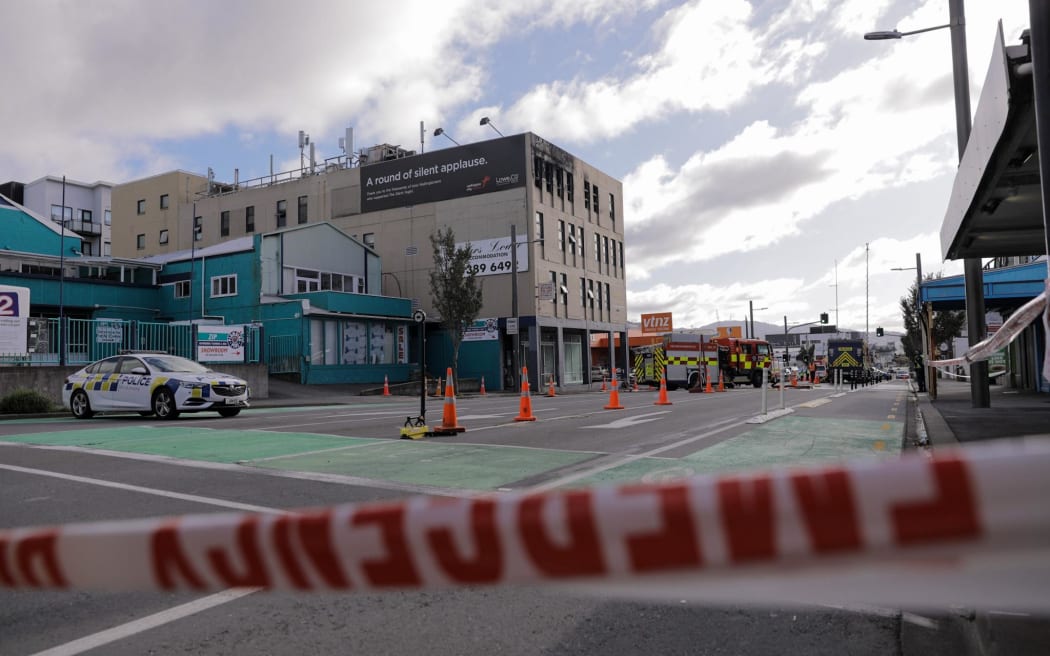
Government moves to bring in stronger fire protection for masses of infill housing, in some cases doubling it, have been stymied.
More than a year of work went into toughening up the rules to slow down the spread of fire in townhouses, terrace houses and other intensive housing types.
But key parts of the proposal were withdrawn in early May, just days before the fatal Loafers Lodge fire in Wellington last Tuesday.
That backdown was not because the housing industry does not think tighter fire regulations are needed, but because it does not agree how to go about it, and amid worries the moves will push up building costs, official documents show.
The tragedy in Newtown last week has sparked new scrutiny of fire regulations and a government review of rules around short-term accommodation.
But in the much bigger growth area of infill housing – terrace and townhouses and the like – the regulations have not kept pace with the government’s rush to change the law last year to allow intensification to combat the housing crisis.
Official reports state existing rules are inadequate in five ways, including for fires now inclined to be more severe and spread more rapidly between cheek-by-jowl housing.
So the building regulator proposed “changes to address fire risks in residential homes as a response to trends in construction that have increased the density of housing”.
Having failed to get key changes through this month, it told RNZ there would be renewed consultation.
New Zealand fire researcher Dr Kevin Frank, who is visiting his native Alberta, has watched something similar playing out across Canada.
“In the last week and a half since we’ve been here, there’s been two fires where they’ve lost multiple houses,” he told RNZ.
“About 20 years ago they started building houses closer together.
“Now when you get a house fire, you lose, like, up to five houses because it spreads so quickly the fire departments can’t react quick enough.”
Casualties were usually low because everyone had their own evacuation route.
But the damage done was high, Frank, of the building research association BRANZ, said.
Here, the regulator, the Ministry of Business, Innovation and Employment (MBIE), has managed to win industry agreement for better evacuation rules and interconnected smoke alarms, to apply from next year.
Interconnected smoke alarms “from a life-safety standpoint [was] probably the most important thing they were putting in there”, Frank said.
But at the same time, on 4 May, it withdrew proposals to raise fire resistance ratings for walls between houses from 30 minutes to an hour, to boost protections from internal and external fire spread, and to include more types of multi-unit properties under the tighter rules.
“There was a general acceptance that a greater fire resistance for the horizontal spread of fire was a good thing, but the way it was to be done didn’t have universal agreement,” said the ministry’s manager of building performance and engineering, Dave Gittings, in an interview.
There was disagreement about where the changes “increased the cost of new buildings without sufficient evidence of the benefits“, a ministry report said.
“MBIE will be withdrawing proposed changes to … increasing the scope of multi-unit dwellings [covered] … [and] increasing the life rating and property rating from 30 minutes to 60 minutes,” an update to industry said.
“So we’re going back and working out how we can actually do this,” Gittings said.
However, in the meantime more two- and three-storey infill housing will be built under the intensification booster laws and the inadequate fire regulations.
The ministry’s reset on one- to three-storey fire rules is also now complicated by it having to start a review about the mid-rise building safety risks raised by the Loafers Lodge fire.
“The [Housing Minister] has made it very clear that nothing is off the table,” Gittings said.
Recent research by Frank and Dr Colleen Wade shows New Zealand is mostly behind the US, Australia, Canada and the UK on fire protection for two storeys and above.

Dr Colleen Wade of the Fire Research Group. Photo: Supplied
Source RNZ



Latest News
Opportunities to mitigate multi-million-dollar RNZ budget blowout likely missed – experts

Multiple opportunities to identify and mitigate a multi-million-dollar budget blowout at RNZ appear have been missed, according to the former executive director at Audit New Zealand.
The public broadcaster on Monday revealed a near $12 million shock financial loss after a litany of financial blunders, which will now lead to sweeping job cuts.
The $11.8m loss is more than 25 times the $470,000 RNZ had expected to lose over the year to June.
CEO Paul Thompson took responsibility for the result, and said internal reports gave an inaccurate picture of the finances, meaning the scale of the loss only became clear in October.
RNZ’s former chief financial officer Hilary Parker resigned unexpectedly in early October.
The board said it would commission an independent review into what went wrong.
Independent contractor Stephen Walker, who left the Audit Office earlier this year, said the size of the loss was surprising, as was the length of time it took to identify it – months after the financial year ended.

Supplied / OAG
“Probably more of a concern is that they had seemingly been unaware that they were running up a significant deficit until they were in the preparation stage of their annual report in October.”
Walker said public entities typically produced monthly financial reports.
An interim audit also took place before the end of the financial year, he said, but if the organisation hadn’t identified significant losses at that stage, the auditor could also be in the dark.
“It seems that there’s a real weakness in forecasting and budgeting that’s occurred here and that the monthly accounts, when they’re produced, either haven’t identified these significant variances against budget or the magnitude of them really hasn’t come to light until right towards the end of the financial year,” Walker said.
“And really at that point, there’s no opportunity for the chief executive, the leadership team to take, and the board to take, any corrective action because the year has effectively been completed.”
Walker said the “significant miss” was difficult to account for given it was more than 10 percent of RNZ’s total funding.
He said based on RNZ’s annual report, financial complexity didn’t appear to be a factor.
“This $11.8m loss isn’t made up of one particular item … it seems to have been contributed to by a number of separate expense lines running over budget. So I don’t think it’s necessarily to do with complexity.”
Among the errors, RNZ wrongly counted $2m from land sales as income in its budget. Staff costs also came in $3.2m over budget, including $1.4m in redundancy payments.
Professor at Auckland University’s business school Norman Wong said based on media reports the issues identified were “significant and troubling”.

Supplied / University of Auckland
“But recognising the sale of land as income in their budget is a basic error that one would have expected to have been caught and corrected well before it got to this point.”
With funding reductions at RNZ over the past two years, Walker expected greater scrutiny of financial results.
“Virtually every public entity has had their annual budget reduced. And so you would expect … the leadership team on a monthly basis and board – I’m not sure how frequently the board will consider the information – but you would expect them to be interrogating the results on a regular basis throughout the year,” he said.
Walker said initiating an independent review was the correct course of action and that he’d want to understand what information the leadership team and the board were regularly receiving.
He said he’d “love to say” surprising financial results were rare, but conceded they occured on a semi-frequent basis during his time leading the Audit Office.
“The benefit of independent scrutiny by the Audit Office – and the auditors providing that support to the Auditor General – [is] that the reporting is fairly presented at the end of the year, whether it’s good, bad or ugly.”
rnz


Police say person who fired gun at officers still at large

New Zealand sides named for RLWC finals

Parliamentary Service working on extra chairs and offices for increased number of MPs


-

 Latest News2 months ago
‘Chilling’: Business groups speak out against National’s supermarket break-up plan
-

 NZ News2 months ago
Tom Phillips report: The missed opportunities to find the children
-

 Latest News2 months ago
Cars bearing Chinese police markings stir unease in Auckland
-

 Politics2 months ago
National vows to try to split Pak’nSave and New World
-

 Fiji News2 months ago
Plans to have new Constitution by Dec 24th 2026
-

 NZ News2 months ago
Cop who stole $68,000 can now be named as champion Muay Thai fighter Haimona Tamati-Te Paki
-

 Politics2 months ago
MBIE confirms botched biometric projects costs blown out to $50.7 million
-

 Latest News2 months ago
Five Karangahape Road venues lose their liquor licences after police intervention