

Uncategorized
Budget 2023: Hopes families ‘struggling to keep up’ with cost of living will get more support


Anti-poverty campaigners are hopeful of tangible support for New Zealand’s vulnerable in the so-called “no frills” Budget.
With the major announcement on cyclone recovery out of the way, the focus will be on what the government has up its sleeve to ease the cost of living.
The number of people accessing the Christchurch City Mission’s services had increased, and city missioner Corinne Haines said the level at which people struggled had changed.
“Once upon a time, years ago, it might be a single male, but now it’s families, and it’s families on incomes, with jobs, because they’re struggling to keep up with the increase in costs across everything,” she said.
Finance Minister Grant Robertson knows New Zealanders are looking to him for answers on the cost of living.
“It’s been a challenging Budget to put together, but it is one where I think that we’ve got the balance right,” Robertson said on Wednesday.
Despite an Inland Revenue report showing the country’s wealthiest are paying tax at a much lower rate than the rest of New Zealanders, the government has ruled out major tax changes – such as a capital gains tax, a wealth tax, or a tax cut – in the Budget.
But one option that could still be on the table is a tweak to Working for Families.
A review into the structure and design of the tax credit scheme has been with the Minister for Social Development for months.
When asked on Monday whether any decisions had been made on the review, the prime minister pivoted.
“I know you’re trying to lead me into talking about what is or isn’t in the Budget, and you’re just going to have to wait a couple more days,” he said.
Child Poverty Action Group economic spokeswoman Susan St John said Working for Families was inherently discriminatory – but that discrimination could be removed.
“The families who are not on a benefit, but in low paid work, have a substantial problem with Working for Families debt, because the payment that they get – that the caregiver gets – reduces once the household income exceeds $42,700, which is a very low household income.
“And it’s easy to go over that and not realise that you’re then not entitled to as much Working for Families as you were before, and then you incur this debt, which will have to be repaid.”
She said raising the entitlement thresholds would be a good start.
“The threshold – that $42,700, which has been fixed for many years – we’ve done the calculations to show if it was properly indexed it would be at least $52,700 by now. That would make a substantial difference.”
St John also suggests folding the In-work Tax Credit into the Family Tax Credit, which is paid regardless of income source. It would cost $500m a year, but she said it would do more to lift children out of poverty.
“We’ve got the poorest families, the worst-off children denied the benefit of the In-work Tax Credit, which is worth $72.50 for a one-to-three child family, and another $15 per child for larger families. That’s a substantial amount to cut out of an already far too low budget,” she said.
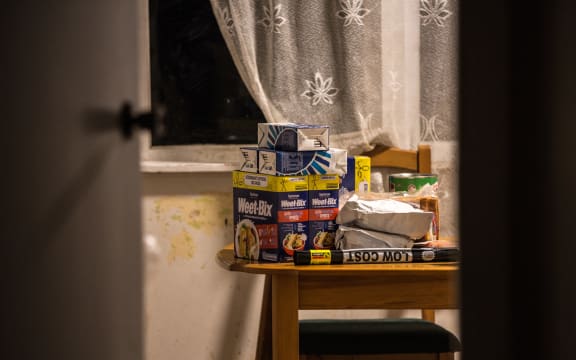
Food banks report more families, including those with a person working, are finding it hard to make ends meet to provide the basics Photo: RNZ / Cole Eastham-Farrelly
Infometrics principal economist Brad Olsen believes it’s an area ripe for the picking in the Budget.
“There has been a lot of work done on it. And it is, in a sense, an area that was already expected at some point in the government’s lifecycle to be focused on, given the review that’s gone into it.
“The challenge, I think, is looking at how that affects a number of other, or doesn’t affect, a number of other New Zealanders.”
Olsen warned there was still a risk putting more money in people’s hands could make inflation worse.
He believed any support would have to be tightly targeted – unlike last year’s cost of living payment.
“Any time that you are substituting or providing for additional money inclined, or in direct form, to households, you are effectively starting to neuter some of the effects that are happening in the wider economy to try and reduce consumption.
“That’s why effectively anything that government does risks stoking inflation further, which is why that very temporary and targeted support, rather than across the board large spending, which would be more inflationary, is likely where the government’s going to land.”
But Corinne Haines said anything that allowed people not to have to choose between their rent, or their electricity or food, would be welcome.
“What you really want to do is give people that dignity to be able to choose what they spend their money on, and to make good decisions, and to get them to be in charge of their own daily costs,” she said.
Whether the government agrees, the nation will find out at 2pm.
SOURCE RNZ



Analysis – Three years ago, Christopher Luxon headed into his first head-to-head debate with Chris Hipkins on the back of a poll that had National on 37 points and able to form a government with ACT alone.
Labour under then-Prime Minister Chris Hipkins was on a downward spiral on 27 percent in that same 1News-Verian poll and had no path to power.
Fast-forward three years and both parties headed into Tuesday night’s debate with two fresh new polls.
RNZ-Reid Research’s results had National on 26 percent and Labour on 31, while 1News-Verian had a much tighter race with just one point in it and both parties just under 30.
Those results spell early retirement and unemployment for a decent number of National Party MPs currently enjoying the government benches.
MMP has evolved so much in the past two elections that the combined Labour-National vote has gone from 81 percent at the 2017 election to just 57 in Tuesday’s RNZ-Reid Research poll.
So-called minor parties have grown in both size and influence, capturing the imagination of voters that traditionally voted blue or red.
Increasingly polling is suggesting another new party – Opportunity – has a good chance of making it into Parliament and being a potential kingmaker.
There’s now a very real possibility that the next government could be made up of four political parties.
That has happened before under Sir John Key’s National government in 2008, but because he chose to welcome the Māori Party into the fold, not because he had to.
The minor parties of 2026 have leverage and power going into any coalition talks well beyond any previous election years.
It makes a head-to-head between Christopher Luxon and Chris Hipkins far more redundant in this political age.
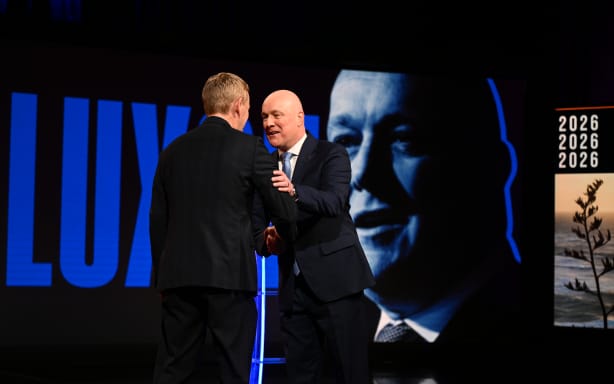
TVNZ/Harley Peters
They can’t fully commit to any of the promises they make because the slate is almost entirely wiped clean after 7 November when political parties sit down to discuss what a future government might look like.
Luxon has ruled out working with Opportunity after the election because of its land tax policy and National campaigning on no new taxes.
On Tuesday night he repeatedly refused to answer whether he would pick the phone up if he needed the party to be prime minister.
Instead, he repeated his previous comments about an untenable land tax, and then told reporters after the debate the question was a “hypothetical” that didn’t need an answer.
To be clear, that’s not a no.
At times in the debate the leaders could have been put in a time machine and transported back to three years ago, so similar were some of the issues and answers to them.
The cost of living crisis continued to be the overwhelming theme, a healthcare system under pressure and patients waiting too long in emergency departments hadn’t improved, and neither Chris had fully grasped the meaning of a yes or no question.
There was no big revelation or pledge – on the latter neither party has the headroom in their fiscal plans to do so.
It’s unlikely undecided voters watching were swayed one way or the other by the end of it.
That’s not to say the two Chrises performed badly.
They were both across their briefs, and while they had some nervous energy at the outset both settled into a comfortable rhythm and got their key messages across.
While Hipkins managed to land a few blows on Luxon over his failure to discipline New Zealand First’s Winston Peters and Shane Jones over racist remarks, Luxon in return made a strong argument on education and had Hipkins concede he had done what Labour couldn’t and got India across the line on a free trade agreement.
The biggest controversy of the night was the pair being asked to pick between the All Blacks and the Warriors with Luxon going Team ABs while Hipkins chose to “Up the Wahs”.
Both would have gone to bed happy with their performance and grateful they didn’t say or do anything they deeply regretted.
There is a week until they face-off again – another week of smiling at the cameras and hoping voters return them to the major party league.
rnz



Police say person who fired gun at officers still at large

New Zealand sides named for RLWC finals

Parliamentary Service working on extra chairs and offices for increased number of MPs


-

 Latest News2 months ago
‘Chilling’: Business groups speak out against National’s supermarket break-up plan
-

 NZ News2 months ago
Tom Phillips report: The missed opportunities to find the children
-

 Politics2 months ago
National vows to try to split Pak’nSave and New World
-

 Latest News2 months ago
Cars bearing Chinese police markings stir unease in Auckland
-

 Fiji News2 months ago
Plans to have new Constitution by Dec 24th 2026
-

 NZ News2 months ago
Cop who stole $68,000 can now be named as champion Muay Thai fighter Haimona Tamati-Te Paki
-

 Politics2 months ago
MBIE confirms botched biometric projects costs blown out to $50.7 million
-

 Latest News2 months ago
Five Karangahape Road venues lose their liquor licences after police intervention