

Latest News
Teaching the ‘basics’ is critical – but what teachers really want are clear guidelines and expectations


Analysis – Anyone watching the debate over the National Party’s recent curriculum policy announcement could be forgiven for thinking there is a deep divide in education philosophy and best practice in New Zealand. The truth isn’t quite that simple.
In fact, most (if not all) interested parties would agree that teaching and learning the basics of literacy and numeracy are vital. As one expert observer noted, the policies of the major political parties actually have much in common.
The National Party policy promises a curriculum focused on “teaching the basics brilliantly”. The government says much of this work is already under way with its current curriculum “refresh”. So where exactly is the issue?
The idea of mandated testing checkpoints clearly has some worried that the National Party’s policy is a return to a “back to basics” mentality that ignores or minimises other vital areas of teaching. As one headline had it, “KPIs are for businesses and boardrooms, not children and schools”.
While the basics are important, the argument goes, there are other things schools should focus on. That may be true, but it need not be so binary. Basic early literacy and numeracy skills are the foundation on which much other success is built.
Perhaps a better way to frame the discussion might be: a wider view of learning is important – and the basics are necessary.

Learning literacy is a complex process: handwriting skill is the best predictor of writing success. Photo: 123rf.com
Learning to read and write is hard
Foundations take time to put in place, however. With reading and writing, for example, it’s common for capable adults to assume that many of the foundational skills are easily achieved.
In fact, neuroscience shows literacy learning is a remarkably complex process. Learning to identify letters and the sounds associated with them, and learning to read and retain words, involves a kind of repurposing of the brain’s architecture.
Learning to correctly spell words is even more complex than reading them. Successful teaching of spelling requires clear and systematic guidelines. Mastery cannot be left to chance or done through rote learning lists of words.
Another often undervalued basic skill is handwriting. It can be seen as purely a presentation technique and simply about neatness. But research shows handwriting skill contributes directly to writing achievement and is the best predictor of writing success in younger students.
Reading and writing also rely on a foundation of oral language skill, including understanding sentence structure and having a strong vocabulary. Being proficient with sentences is the building block for paragraph formation, essential to more advanced writing tasks. Vocabulary knowledge is a strong predictor of academic achievement, connected to both reading and writing success.
What teachers want
None of these skills develop by chance. So the question becomes, how can a curriculum best support teachers to teach literacy from its foundations upwards, with as many students as possible succeeding?
In my work as a literacy facilitator, I find teachers want specifics. They want to know what to teach at each stage. They want to know what the children in their classes should be able to do within that year. They want to know what denotes progress, and when they should be concerned.
But the curriculum as a whole is necessarily broad and all-encompassing, to reflect the complex needs of society. The curriculum refresh groups learning in broad bands – and this presents problems for specific guidance and benchmarks.
In the English curriculum, one of the literacy goals for learners in the year 1-3 band is to “use decoding strategies with texts to make meaning”. This is far too broad to be helpful in teaching or assessment in any specific way.
More nuanced progress indicators are still being developed, but the draft examples suggest there will be more guidance in more specific age bands.
Guidelines and benchmarks
As well as through the curriculum, teaching will be supported by the Literacy & Communication and Maths Strategy and the Common Practice Model. As an educator, I hope the final versions of these documents will offer clear guidelines for both teaching and assessment.
And there are new resources recently provided to schools that contribute usefully to a systematic and successful approach to literacy teaching. These are based on current evidence of how reading is best taught. They include a progression of word learning framework, and decodable readers with lesson plans.
All of these resources should provide useful direction for schools in their literacy teaching. While we can never make the task of teaching literacy simple, specific guidelines can make the pathway for teaching more straightforward.
More focus on the basics need not be boring for learners, either. I recently observed a lesson where the children were learning to decode new words. At the end, a 6-year-old said “that was fun, can we do more?” The act of laying foundations for literacy is anything but dull.
The National Party’s call for guidelines around “teaching the basics brilliantly” speaks to a vital part of a rounded education. More detail is now needed about what “brilliance” will mean in practice, just as we need more detail on the current curriculum refresh. Making foundation skills a key component of the curriculum may not be the whole answer, but it is absolutely necessary for overall success.
* Christine Braid is a professional learning and development facilitator in literacy education at Massey University.
This story was originally published on The Conversation.
SOURCE RNZ



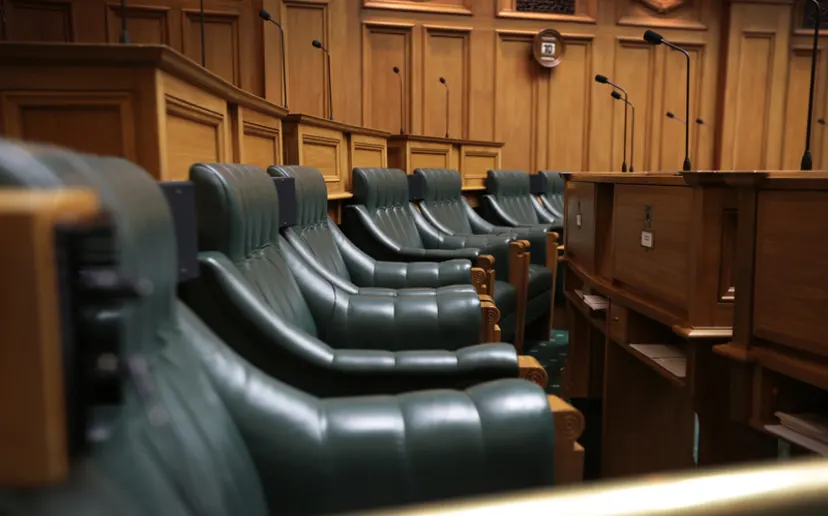
The chief executive of the Parliamentary Service is confident there will be enough room to accommodate the increased number of MPs and their staff coming into Parliament.
On current numbers, up to 131 MPs could be sitting in the Chamber following the election, brought on by a record overhang result.
Clerk of the House of Representatives Dr David Wilson told the Spinoff that currently the debating chamber had enough chairs to seat 124 MPs – including the Speaker of the House – and work was being done to accommodate more by altering the seating arrangement.
In a statement, Parliamentary Service chief executive Rafael Gonzalez-Montero said planning for a larger Parliament had been going for “some time”.
“Now that the election results have confirmed an increase to the number of members we are looking at several options.
“We are confident we will be able to accommodate all members within the Chamber.”
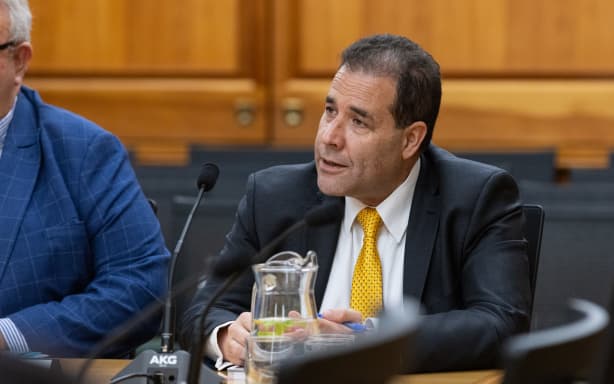
VNP / Phil Smith
Gonzalez-Montero said office accommodation for members and their staff would be “stretched” for a short time, but the new Members’ Building was only a few months away from “practical completion”.
That building – located behind Parliament – was due to be ready to occupy in April next year and had capacity to accommodate around 30 backbench MPs.
“All members should be in fit-for-purpose accommodation from that point,” Gonzalez-Montero said.
Following the 2023 election, 123 MPs sat in the Chamber – a record number at the time. That decreased to 122 following the resignation of National MP Judith Collins.
Collins held the seat of Papakura and stepped down in May and Parliament voted against holding a by-election because it was too close to the election.
The election result also meant high-ranking National Party MPs like Chris Bishop, Paul Goldsmith, Nicola Willis and Gerry Brownlee – Speaker of the House and an MP for 30 years – would likely not make it back into Parliament.
Only resigning or retiring MPs were permitted to give a valedictory speech meaning none of them would get the chance to give a valedictory statement.
Asked if their would be special allowances for valedictories, Wilson said in a statement that normally only MPs were allowed to speak in the House but the House could suspend its own rules or temporarily alter them.
“It could do so to allow former members to address the House.”
Wilson said no such arrangements could be made until the next Parliament opened and members sworn in.
rnz


Police say person who fired gun at officers still at large

New Zealand sides named for RLWC finals

Parliamentary Service working on extra chairs and offices for increased number of MPs


-

 Latest News2 months ago
‘Chilling’: Business groups speak out against National’s supermarket break-up plan
-

 NZ News2 months ago
Tom Phillips report: The missed opportunities to find the children
-

 Politics2 months ago
National vows to try to split Pak’nSave and New World
-

 Latest News2 months ago
Cars bearing Chinese police markings stir unease in Auckland
-

 Fiji News2 months ago
Plans to have new Constitution by Dec 24th 2026
-

 NZ News2 months ago
Cop who stole $68,000 can now be named as champion Muay Thai fighter Haimona Tamati-Te Paki
-

 Politics2 months ago
MBIE confirms botched biometric projects costs blown out to $50.7 million
-

 Latest News2 months ago
Five Karangahape Road venues lose their liquor licences after police intervention