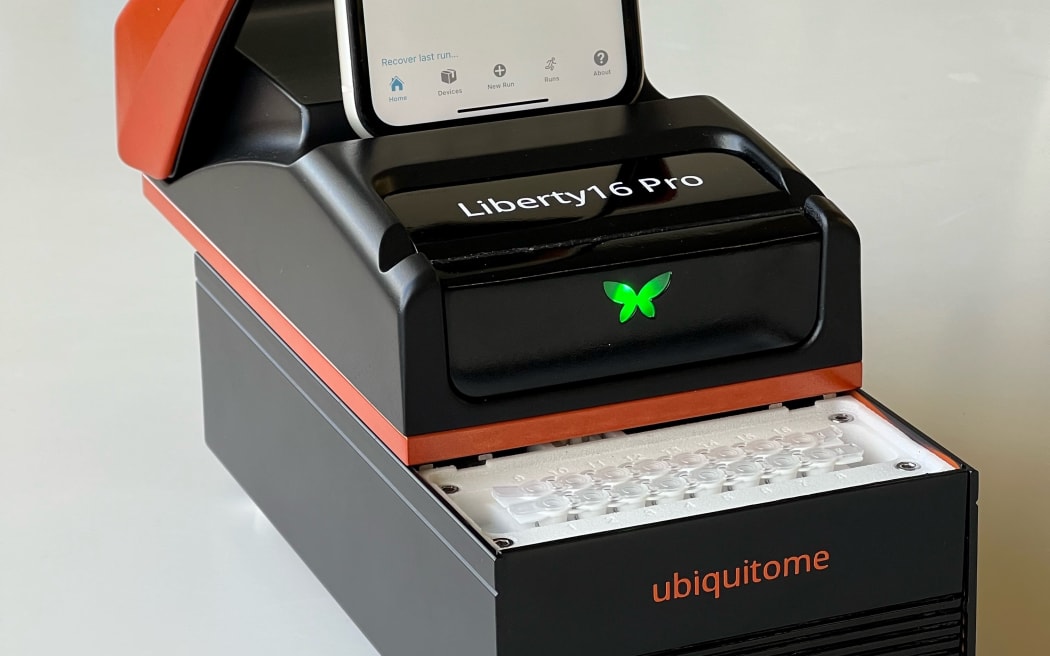
An Auckland biotech company is struggling to get a Covid-19 testing device approved for use in New Zealand, despite having twice been given the green light by the United States Food and Drug Administration (FDA).
The Liberty16 Pro by Auckland company Ubiquitome is a lab the size of a shoebox, with capacity to process 70 PCR (polymerase chain reaction) saliva tests in an hour.
Chief executive Dr Paul Pickering, who has worked in the area of PCR testing in the New Zealand and the United States over the last two decades, said regulatory approval was “the life-blood” of any health-tech company.
“And that’s why when we get an emergency use authorisation from the FDA we’re completely over the moon because it’s the biggest milestone that a company like ours can achieve.”
It is the second such endorsement for Ubiquitome from the FDA after an earlier version of the device was approved back in August 2020.
However, despite being granted half a million dollars from MBIE’s Covid-19 Innovation Accelerator Fund and more than $2 million from a federal fund in the US, achieving ISO international quality certification and a prestigious European award for its Yale-based researcher, the device is still not approved for use in this country.
At the start of the global pandemic in 2020, the government banned all Covid-19 tests except those to be used in hospital laboratories, and knocked back offers of help from Ubiquitome and other companies.
It was not until February last year that the Ministry of Health finally set up a process to consider alternative testing regimes, following a critical independent report, which found it had been too slow to adopt saliva testing and other technology.
Ubiquitome applied immediately for the so-called “exemption”, but nearly a year on, it has not yet got through all the red tape.
“We’re working to address what they perceive as challenges with the data,” Pickering said.
“I think the only comment I can make in addition to that is the data we’re presenting is the same data we’ve given to the FDA and it’s obviously got authorised by them.”
He conceded it was “frustrating” because as a New Zealand company, Ubiquitome wanted to market its products here.
“We certainly respect the need for appropriate diligence. But looking at the bigger picture, if we wish to have an economy that’s based on high-value exports like diagnostics, we need to find ways to make it easier for companies to be successful in this country.”
Meanwhile, the device – which costs about $10,000 – remains in a legal grey area in its homeland.
That has not deterred some companies and organisations from using it, including Wellington-based brewery Garage Project.
Co-founder Jos Ruffell said the device had paid for itself many times over.
“We had moments where we potentially would have had to shut down production if we’d had multiple people in the team get infected. We’ve been able to avoid that.”
Garage Project also uses the Liberty16 to test for beer spoilage organisms, which made it an even better investment, he added.
Urban Māori health and social services trust Te Whānau O Waipareira used multiple Liberty devices during big outbreaks to test vulnerable clients and keep front-line workers safe.
Chief executive John Tamihere said it was a “no brainer” to get gold-standard PCR testing so cheaply – especially when people were having to wait days for the results of nasal swabs and the Ministry of Health was refusing to allow rapid antigen testing (RATs).
That was until the director-general of health’s sudden announcement that RATs would become the main diagnostic tool, despite being less accurate.
“I find that decision bizarre in the context of what happened with blocking the rollout of a product like Ubquitome,” Tamihere said.
“It’s fast, it’s accurate, it’s cheap and we can test people regularly without tenderising their noses.”
Research scientist Dr Anne Wyllie leads the team at Yale, where she developed the protocols that turned the Liberty16 from a research tool into a diagnostic device.
This work has just seen her announced the recipient of the 2023 European Society of Clinical Microbiology and Infectious Diseases Award for Young Investigator.
Dr Wyllie, who grew up in Northcote on Auckland’s North Shore and did her undergraduate degree and masters at the University of Auckland, said it was “an incredible honour”.
“It’s definitely been a long three years and it’s nice that our efforts are being recognised in innovating how clinical diagnostics can be performed.”
She acknowledged approval processes were complicated but believed New Zealand had missed vital opportunities to benefit from the hard-won lessons in the US, where saliva testing had been used to great effect.
“It shows what more potentially could have been done [in New Zealand] to keep kids in schools healthier when Omicron did come through or to keep businesses functioning better.
“It could have been used as a model of what to do, and I think that’s a shame.”
The Yale team is now focusing on getting full approval from the FDA and widening the device’s scope to allow it to test for several diseases in one sample and get patients on the right treatment fast.
The Ministry of Health has been approached for comment.