

NZ News
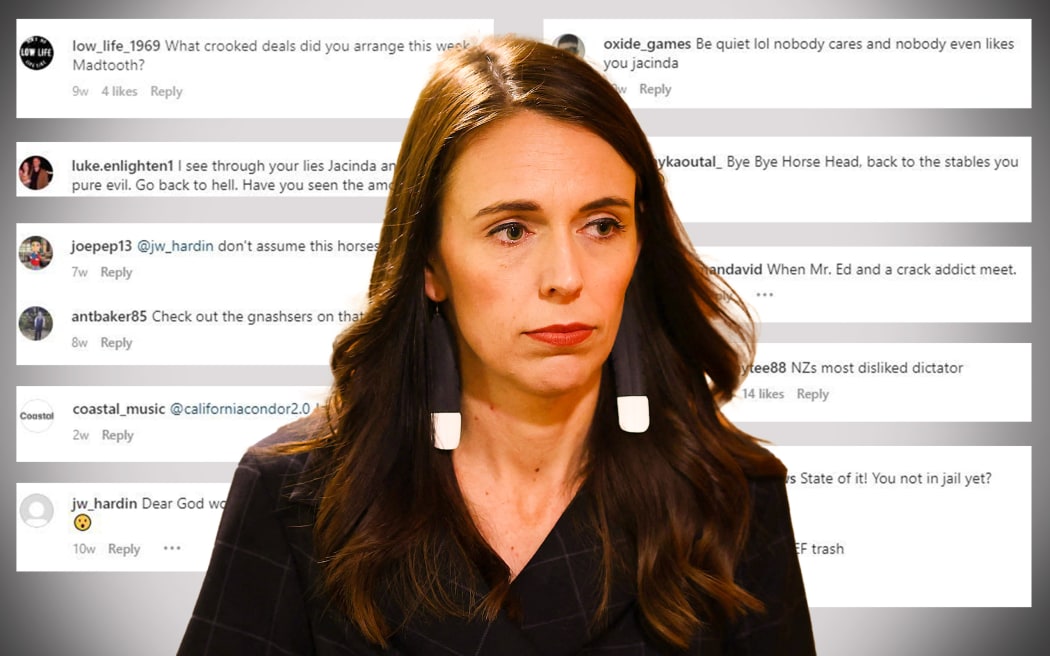
The hatred and vitriol Jacinda Ardern endured ‘would affect anybody’

Within hours of Prime Minister Jacinda Ardern’s shock resignation announcement in Napier, a small crowd gathers outside the city’s conference centre.
Unlike the steady stream of shocked Labour MPs still coming to terms with the news, these folks are celebrating.
“Ding dong the witch is gone,” a placard reads.
Online, there are similar sentiments to be found among groups bitterly opposed to Ardern. The Freedom & Rights Coalition even takes credit for Ardern’s departure in a post on Facebook: “We can now celebrate the departure of this leader of division. We did it!”
The comments on the post are unfit to repeat here.
Entering what would have been her sixth year, Ardern is the longest-serving Labour Prime Minister after Peter Fraser and Helen Clark. But in an emotional speech to her caucus in Napier she revealed she “no longer had enough in the tank” to do the job. “It’s time,” she said.
“As much as I have taken great joy in this job, I would be giving a disservice to this country and to the Labour Party if I continued, knowing that I just don’t have enough in the tank for another four years.”
While it wasn’t explicitly stated, it’s hard to imagine the increasingly violent abuse directed at her was not part of the reason.
“It is no surprise to me at all … she could not, not be affected by this,” says Disinformation Project director Kate Hannah.
Read more:
- Who are the frontrunners for Labour leadership?
- Live updates after Jacinda Ardern announces resignation
- What you need to know
- Reaction from around the world
- Reactions from New Zealanders and local politicians
Ardern probably tops the list for the amount of vitriol endured by any political leader in this country, Hannah believes.
“In the earlier parts of her first term we got sort of commentary about her looks and her lack of perceived experience. The fact that sort of she was, you know, well spoken, and really good at communicating complex issues was kind of a slur against her.”
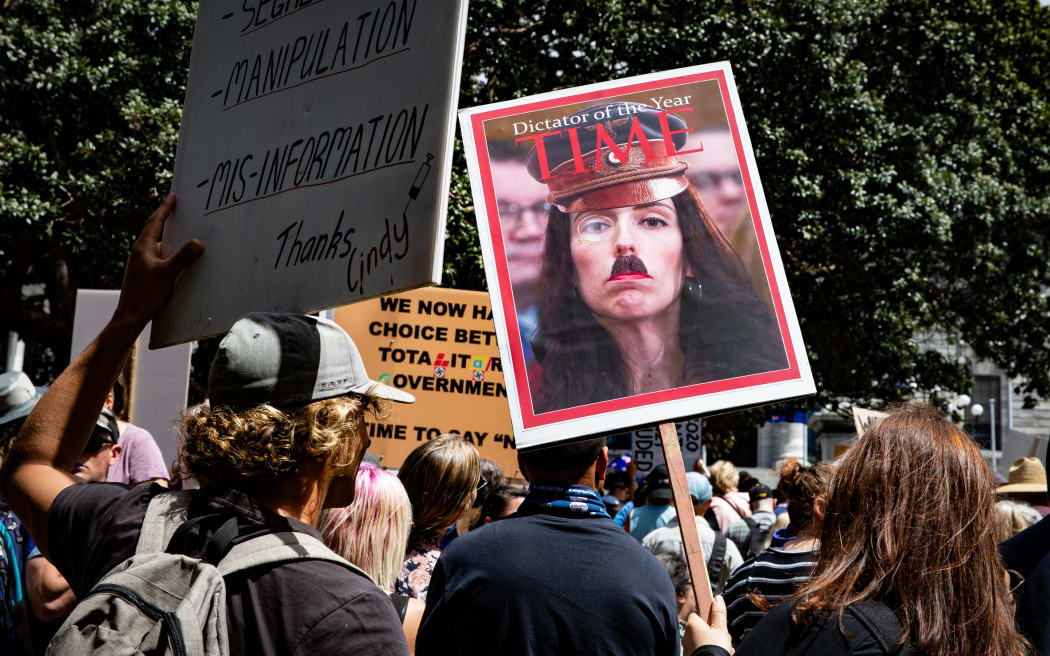
Jacinda Ardern was commonly depicted as a tyrant – even compared to the worst genocidal leaders in world history. Photo: VNP / Phil Smith
But in the last two years the misogyny and violence directed towards Ardern has not only increased in volume, but also become more dangerous, says Hannah, who studies online hate speech and disinformation.
“The language and imagery used to talk about the Prime Minister has become more violent, more vulgar, more crude and repetitive.”
According to a recent study, published just before Christmas, which charts the rise of misogynistic language towards female leaders and women in the public sphere, the most prevalent word used to describe the Prime Minister in these circles is “the C word, and the most prevalent visual image is of witchcraft.”
“And this is old data. This is data from the middle of last year. So it’s actually got worse.”
Another grim factoid from the paper shows the word “Neve” – referring to Ardern’s pre-school daughter – is also on the most prevalent list.
In June, it was revealed the number of threats towards Ardern has almost tripled in the past three years.
Hannah, who herself has been subjected to similar abuse – including death threats – says she presented the paper’s findings to Ardern and a range of MPs late last year.
How did Ardern react?
“As we all do … trying to laugh it off and saying the job is more important … and you just have to get on with the job,” says Hannah.
But this is no laughing matter, she says. This new virulent brand of misogyny is on the rise and it affects all women.
“The international disinformation, far right, pro-Putin community is incredibly misogynistic.
“It is incredibly abusive and derogatory, and what it does is attempts to reduce a person to their basic self, and in doing so signals to every other person who shares characteristics with that individual who has been targeted that they are equally worthless, equally base, equally loathed.
“So has this purpose of both targeting individually her as a woman, her role as prime minister, and then all women or all people who share some of those characteristics with her,” says Hannah.
Massey University senior lecturer Suze Wilson, who studies leadership and has examined the vitriol aimed at Ardern, says even the coining of “Jacindamania”, referring to her meteoric rise in popularity as leader served as an early warning of what was to come.
“As if somehow people were losing their heads to be excited by the prospect of a potential Prime Minister, who was young and female and articulate, through to the last couple of years where it’s become increasingly violent, the kind of abuse to which she’s been subjected.”
While the pandemic has been a factor, research also shows that generally it is becoming more challenging for women to be taken seriously, says Wilson.
“Particularly if they are younger and particularly if they don’t cleave to a masculine style, which Ardern does not.”
Worryingly, misogynistic sentiment is also on the rise globally. The latest Reykjavik Index for leadership tracks views about whether a man or woman would be more suitable to a certain position.
“The most recent data came out just before Christmas, and it is showing that in some countries for the first time that there was actually some backwards moving trends,” says Wilson.
“It was showing, alarmingly, that it’s particularly amongst younger men, and those are the ones that are being exposed to the likes of Jordan Petersons and Andrew Tates of the world who are learning from them a really just disrespectful and antagonistic view towards women.”
Wilson says she first started noticing a shift in sentiment towards Ardern during the first 2020 lockdown. But it didn’t come from the dark corners of the anti-vax movement, but on the mainstream business social networking site LinkedIn.
‘”I started seeing people, you know like business leaders, using words like tyrant and dictator to describe the prime minister, and I was kind of quite disturbed by that.
“The fact that they can make those kinds of statements and think that somehow that would be a credible statement, tells you kind of something about the shifting norms of what’s considered an OK way to talk about our prime minister.”
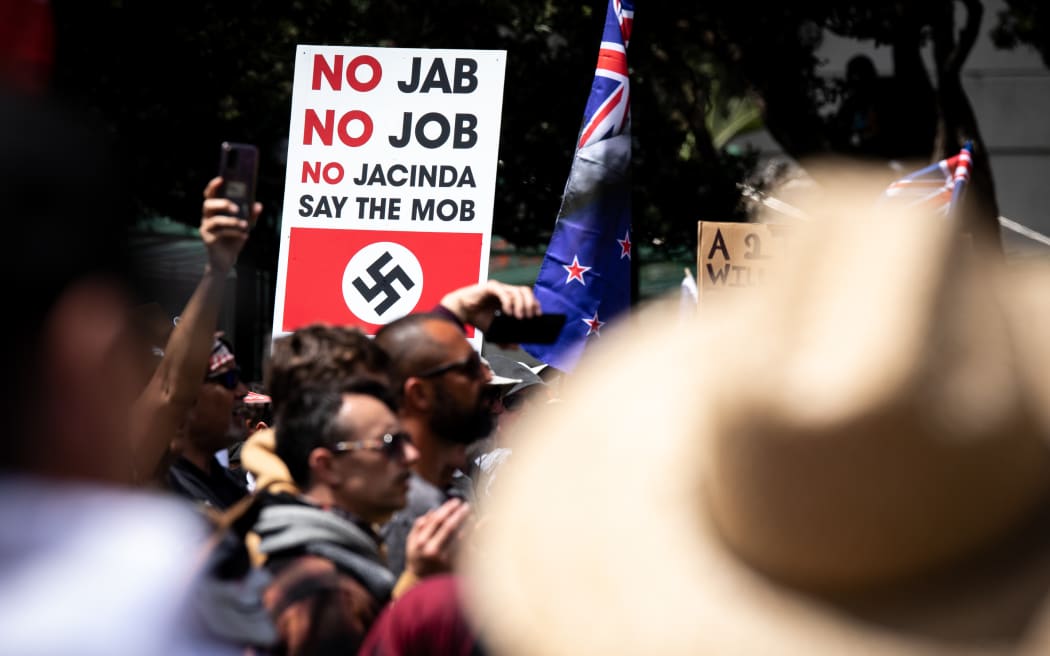
These protesters against a requirement to be vaccinated against Covid-19 compared Jacinda Ardern’s government to the Nazis. Photo: VNP / Phil Smith
Wilson believes this must have taken its toll on Ardern.
“It’s hard to believe that it wouldn’t affect you, right? I mean, it would affect anybody … Having people talk about wanting to hang her, wanting to harm her child, the persistent rumours about her partner. She’s human, of course it’s going to take quite a toll.”
Ardern herself has rarely acknowledged the abuse publicly. Wilson can understand why.
“I can understand why she doesn’t want to highlight it, because it would be, perhaps for those that are engaged in that behaviour, some kind of reinforcement that what they’re doing is having an effect.
“But really, they should just look in the mirror and be deeply ashamed of their conduct.”
Hannah says it’s also worrying the violent rhetoric towards the prime minister is now considered the “new normal”.
“This type of language and abuse is now so normalised that it’s very hard to pull back from. When people have become accustomed to using the C word, as the most commonly used word to describe the prime minister, then, you know, I just don’t know how we come back from that in any kind of quick way.”
For some, the issue was so pervasive it defined the way they viewed the announcement of her resignation. A number of public figures referred to it in posts on Twitter.
And on the streets of Auckland, miles away from the now dwindling crowd outside Napier’s conference centre, an emotional Tessa Williams from Taupō, perhaps summed up the view of those most disturbed by the vitriol Ardern received.
“She’s put up with a lot of really tough stuff. I mean, I was surprised that she has hung in kind of as long as she did,” Williams said.
“It was pretty rough how she’s been treated. Yeah, I think it’s a good decision. It was so hard for her. She did a really good job.
“It’s sad that people were so mean to her.”
Source – RNZ



Latest News
Opportunities to mitigate multi-million-dollar RNZ budget blowout likely missed – experts

Multiple opportunities to identify and mitigate a multi-million-dollar budget blowout at RNZ appear have been missed, according to the former executive director at Audit New Zealand.
The public broadcaster on Monday revealed a near $12 million shock financial loss after a litany of financial blunders, which will now lead to sweeping job cuts.
The $11.8m loss is more than 25 times the $470,000 RNZ had expected to lose over the year to June.
CEO Paul Thompson took responsibility for the result, and said internal reports gave an inaccurate picture of the finances, meaning the scale of the loss only became clear in October.
RNZ’s former chief financial officer Hilary Parker resigned unexpectedly in early October.
The board said it would commission an independent review into what went wrong.
Independent contractor Stephen Walker, who left the Audit Office earlier this year, said the size of the loss was surprising, as was the length of time it took to identify it – months after the financial year ended.

Supplied / OAG
“Probably more of a concern is that they had seemingly been unaware that they were running up a significant deficit until they were in the preparation stage of their annual report in October.”
Walker said public entities typically produced monthly financial reports.
An interim audit also took place before the end of the financial year, he said, but if the organisation hadn’t identified significant losses at that stage, the auditor could also be in the dark.
“It seems that there’s a real weakness in forecasting and budgeting that’s occurred here and that the monthly accounts, when they’re produced, either haven’t identified these significant variances against budget or the magnitude of them really hasn’t come to light until right towards the end of the financial year,” Walker said.
“And really at that point, there’s no opportunity for the chief executive, the leadership team to take, and the board to take, any corrective action because the year has effectively been completed.”
Walker said the “significant miss” was difficult to account for given it was more than 10 percent of RNZ’s total funding.
He said based on RNZ’s annual report, financial complexity didn’t appear to be a factor.
“This $11.8m loss isn’t made up of one particular item … it seems to have been contributed to by a number of separate expense lines running over budget. So I don’t think it’s necessarily to do with complexity.”
Among the errors, RNZ wrongly counted $2m from land sales as income in its budget. Staff costs also came in $3.2m over budget, including $1.4m in redundancy payments.
Professor at Auckland University’s business school Norman Wong said based on media reports the issues identified were “significant and troubling”.

Supplied / University of Auckland
“But recognising the sale of land as income in their budget is a basic error that one would have expected to have been caught and corrected well before it got to this point.”
With funding reductions at RNZ over the past two years, Walker expected greater scrutiny of financial results.
“Virtually every public entity has had their annual budget reduced. And so you would expect … the leadership team on a monthly basis and board – I’m not sure how frequently the board will consider the information – but you would expect them to be interrogating the results on a regular basis throughout the year,” he said.
Walker said initiating an independent review was the correct course of action and that he’d want to understand what information the leadership team and the board were regularly receiving.
He said he’d “love to say” surprising financial results were rare, but conceded they occured on a semi-frequent basis during his time leading the Audit Office.
“The benefit of independent scrutiny by the Audit Office – and the auditors providing that support to the Auditor General – [is] that the reporting is fairly presented at the end of the year, whether it’s good, bad or ugly.”
rnz


Police say person who fired gun at officers still at large

New Zealand sides named for RLWC finals

Parliamentary Service working on extra chairs and offices for increased number of MPs


-

 Latest News2 months ago
‘Chilling’: Business groups speak out against National’s supermarket break-up plan
-

 NZ News2 months ago
Tom Phillips report: The missed opportunities to find the children
-

 Politics2 months ago
National vows to try to split Pak’nSave and New World
-

 Latest News2 months ago
Cars bearing Chinese police markings stir unease in Auckland
-

 Fiji News2 months ago
Plans to have new Constitution by Dec 24th 2026
-

 NZ News2 months ago
Cop who stole $68,000 can now be named as champion Muay Thai fighter Haimona Tamati-Te Paki
-

 Politics2 months ago
MBIE confirms botched biometric projects costs blown out to $50.7 million
-

 Latest News2 months ago
Five Karangahape Road venues lose their liquor licences after police intervention