Connect with us

HTML Image

i

Covid-19

Covid-19 variant BA.2.75 dominates cases as holidaymakers warned to take precautions

Published

on

There is a new dominant Covid-19 variant for the first time since July, as health officials warn holidaymakers to take precautions.

In an update today, the Ministry of Health said there were 42,740 new cases of Covid-19 and 64 deaths of people with the virus over the past week.

BA.2.75, which is a strain of Omicron, now makes up 39 percent of genetically sequenced cases, and more than half of the cases in wastewater samples.

It has surpassed BA.5 which was the main variant for five-and-a-half months and drove the second wave in winter.

The ministry said BA.2.75 looked like it was more transmissible and could evade immunity from other variants but more data was needed to be certain.

There is no sign it is causes a more dangerous or severe illness.

The government is urging people to be prepared in case they catch Covid-19 while on holiday.

Labour MP Dr Ayesha Verrall

Covid-19 Response Minister Ayesha Verrall Photo: RNZ / Angus Dreaver

Healthcare professionals in holiday hotspots are bracing for an influx of Covid-19 patients, with one modeller warning Christmas week could see one-in-20 people infected.

Covid-19 Response Minister Ayesha Verrall said people who were eligible for a booster should get one.

She was also reminding people if they tested positive, they had to isolate for seven days.

It was important everyone played their part, she said.

What to do if you test positive while travelling

Te Whatu Ora interim national medical director Dr Pete Watson urged everyone to take precautions to protect themselves ahead of the holiday season.
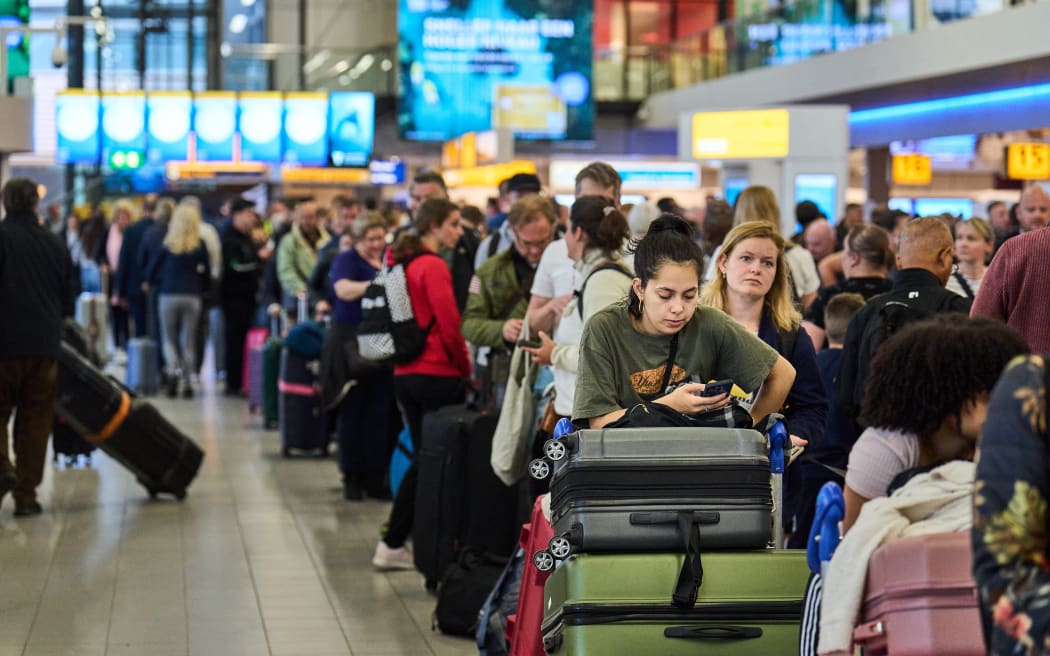
People standing in a queue at Schiphol airport in Netherland as holiday season puts a strain on airlines.

People who test positive to Covid-19 and do not have private transportation need to find somewhere to isolate, health officials say. (file picture) Photo: PHIL NIJHUIS / ANP MAG / ANP via AFP

“Over summer, large numbers of people will be travelling for trips or seasonal work. There are more social gatherings and large events, such as festivals, and many of our health care workers will be taking well-deserved leave,” Watson said.

“We need to continue our good health behaviours to ensure we can not only protect ourselves and each other, but help reduce pressure on health providers, urgent care clinics and hospital emergency departments.”

Health New Zealand, Te Whatu Ora, has provided a checklist for holidaymakers on staying safe over the summer break.

Health officials say if you test positive while you are away from home and you are well enough to drive back home, you can, but only if you can travel via a private or work vehicle with only your immediate family or household members.

“If that isn’t possible for whatever reason, you need to be able to isolate where you are or find somewhere else to isolate,” Watson said.

“If you don’t have any RATs, consider collecting some now or ordering them in advance of any Christmas and New Year’s holiday travel you have planned, so you’re well prepared.”

No caption

People who contract Covid-19 on holiday should consider antiviral medication, health officials say. (file picture) Photo: RNZ /Dom Thomas

People who contract Covid-19 on holiday should consider antiviral medication, which was free for those who were eligible, Watson said.

“Antiviral medicines can help you if you’re at risk of becoming very sick with Covid-19. They reduce the amount of virus in your body, so you don’t get as sick and you’re less likely to go to hospital.”

Many pharmacies provide antivirals without a prescription, or healthcare providers can write a prescription for a pharmacy to fill. Covid-19 antiviral medicines are free for eligible people.

Free rapid antigen tests (RATs) can be taken from a range of locations, including collection sites, some marae and some pharmacies.

Free masks and RATs can be ordered here.

Current face mask mandates for visitors in healthcare settings also remain in place.

Watson also reminded people to save the Healthline number (0800 358 5453) or the Disability health helpline (0800 11 12 13) into their phone for general health and Covid-related health advice.

Source – RNZ

Covid-19

Covid-19 update: 8544 new cases, 39 further deaths linked to virus

Published

on

There were 8544 new cases of Covid-19 reported in Aotearoa in the week to midnight on Sunday, and a further 39 deaths attributed to the virus.

The total number of deaths attributed to the virus in New Zealand is now 3077.

In addition, there were 246 cases in hospital at midnight on Sunday with six in intensive care.

The seven-day rolling average of cases was 1217.

Last week, 9883 new Covid-19 cases were reported and a further 37 deaths were attributed to the virus.

Source: RNZ

Continue Reading

Covid-19

Dr Jonathan Howard: why US doctors spread Covid disinformation

Published

on

An American doctor believes more than 800,000 Americans would be alive today, if the US had taken New Zealand’s Covid approach.

Jonathan Howard, who is the chief of neurology at Bellevue Hospital in New York, said he was angry that influential health professionals minimised the seriousness of the virus.

“We want them infected,” was the call of then presidential science adviser Paul Alexander.

It’s also the title of Howard’s new book, which tells the story of how some medical and public health professionals came to become anti-vaccine and pro herd immunity.

He told Kim Hill on Saturday Morning there was a deluge of mis-information from prominent US doctors, some of whom wanted to actually spread the virus.

“Famous doctors from our top universities went on television and told people that Covid was just going away, that it was just the flu, that young people under the age of 65 have essentially no risk,” he said.

“And not only were there not attempts to limit the virus, these were loud influential voices who wanted to spread it.

“You can read quotes from our former Covid advisor, Donald Trump’s former Covid advisor, celebrating rising cases, saying this is a good thing when cases rise, which is shocking and astonishing.”

While Howard said there were obvious differences between the two countries, many lives could have been saved if the US had taken a similar approach to New Zealand.

“If we had limited infections until we had vaccinated the vast majority of our population, we would have potentially had hundreds of thousands of people still alive today, there’s no question about that.”

However, our zero-Covid strategy wasn’t without its critics, with Stanford professor Jay Bhattacharya writing that it had “cost New Zealand dearly”.

“I think that the fact that most of your grandparents are still alive means that zero Covid did not cost you dearly,” Howard said in response.

“I don’t discount that, there were real costs of the lockdowns, I don’t know anyone who argues otherwise and I want to be very clear that I was protected from those costs, meaning I am very fortunate to be employed, I worked throughout the pandemic, I was never lonely, I don’t have my own business.”

But Howard said he didn’t think that the alternative – letting the virus spread freely – would have yielded a better outcome.

He said that when forklifts were needed to move bodies into giant refrigerated trucks in New York, it was fantasy to imagine the city could have operated as normal during the pandemic.

“You talk about deferred healthcare – every single healthcare worker was working with Covid patients, our hospitals were overflowing,” he said.

“So when I hear people lament they missed cancer screenings, who would have done those screenings? Would elderly patients have left their house to go to crowded waiting rooms to get a mammogram for example? I don’t think so.

“I think that the fantasy is that things could have just been normal if only if it hadn’t been for overly cautious politicians.”

By comparison, New Zealand did well, Howard said.

“I look at the numbers, I look at your death rate with great jealousy.” he said.

“And I think for long periods of time your economy was more open than ours was because we had to keep locking down, just because there were overwhelming outbreaks of the virus.”

Howard said the fact many older New Zealanders were still alive compared with the US statistics, showed the success of this country’s Covid strategy.

Source  RNZ

Continue Reading

Covid-19

Covid-19 case numbers: 11,739 new cases, 58 further deaths

Published

on

There were 11,739 new cases of Covid-19 reported in Aotearoa in the week to midnight on Sunday, and a further 58 deaths attributed to the virus.

The total number of deaths from the disease is now 2850.

In addition, there were 247 cases in hospital at midnight Sunday, with six in intensive care.

The seven-day rolling average of cases was 1672.

Last week 12,277 new cases were reported and a further 30 deaths attributed to the virus.


Source RNZ

Continue Reading

Trending

Copyright © 2026 The Buzz: Powered by Apna Network Limited - Concept by Digital Hub NZ