Al Qaeda leader Ayman al-Zawahiri was killed in a US strike in Afghanistan over the weekend, US President Joe Biden said, in the biggest blow to the militant group since its founder Osama bin Laden was killed in 2011.
Zawahiri, an Egyptian surgeon who had a $25 million bounty on his head, helped coordinate the September 11, 2001, attacks that killed nearly 3000 people.
US officials, speaking on the condition of anonymity, said the United States carried out a drone strike in the Afghan capital Kabul on Sunday morning at 6.18am local time.
“Now justice has been delivered, and this terrorist leader is no more,” Biden said in remarks from the White House. “We never back down.”
US intelligence determined with “high confidence” that the man killed was Zawahiri, a senior administration official told reporters. No other casualties occurred.
“Zawahiri continued to pose an active threat to US persons, interests and national security,” the official said on a conference call. “His death deals a significant blow to al Qaeda and will degrade the group’s ability to operate.”
There were rumours of Zawahiri’s death several times in recent years, and he was long reported to have been in poor health.
His death raises questions about whether Zawahiri received sanctuary from the Taliban following their takeover of Kabul in August 2021. The official said senior Taliban officials were aware of his presence in the city.
The drone attack is the first known US strike inside Afghanistan since US troops and diplomats left the country in August 2021. The move may bolster the credibility of Washington’s assurances that the United States can still address threats from Afghanistan without a military presence in the country.
In a statement, Taliban spokesman Zabihullah Mujahid confirmed that a strike took place and strongly condemned it, calling it a violation of “international principles.”
Zawahiri succeeded bin Laden as al Qaeda leader after years as its main organizer and strategist, but his lack of charisma and competition from rival militants Islamic State hobbled his ability to inspire spectacular attacks on the West.
Until the US announcement, Zawahiri had been rumoured variously to be in Pakistan’s tribal area or inside Afghanistan.
A video released in April in which he praised an Indian Muslim woman for defying a ban on wearing an Islamic head scarf dispelled rumours that he had died.
The senior US official said finding Zawahiri was the result of persistent counterterrorism work. The United States identified this year that Zawahiri’s wife, daughter and her children had relocated to a safe house in Kabul, then identified that Zawahiri was there as well, the official said.
“Once Zawahiri arrived at the location, we are not aware of him ever leaving the safe house,” the official said. He was identified multiple times on the balcony, where he was ultimately struck. He continued to produce videos from the house and some may be released after his death, the official said.
In the last few weeks, Biden convened officials to scrutinize the intelligence. He was updated throughout May and June and was briefed on 1 July on a proposed operation by intelligence leaders. On 25 July he received an updated report and authorised the strike once an opportunity was available.
A loud explosion echoed through Kabul early Sunday morning.
“A house was hit by a rocket in Sherpoor. There were no casualties as the house was empty,” Abdul Nafi Takor, spokesman of the interior ministry, said earlier.
One Taliban source, requesting anonymity, said there had been reports of at least one drone flying over Kabul that morning.
With other senior al Qaeda members, Zawahiri is believed to have plotted the 12 October 2000 attack on the USS Cole naval vessel in Yemen which killed 17 US sailors and injured more than 30 others, the Rewards for Justice website said.
He was indicted in the United States for his role in bombings of US embassies in Kenya and Tanzania on 7 August 1998 that killed 224 people and wounded more than 5000 others.
Both bin laden and Zawahiri had eluded capture when US-led forces toppled Afghanistan’s Taliban government in late 2001 following the September 11 attacks on the United States.
Bin Laden was killed in 2011 by US forces in Pakistan. (RNZ)
The Trump administration denounced CNN on Thursday (local time) for airing a portion of the new Iranian supreme leader’s public statement, the second time in three days the network has been targeted for reporting on how the regime is responding to the American attacks.
The attack illustrated the care news outlets must take in reporting during wartime, and the responsibilities of American journalists to report the perspective of countries its government views as enemies. It also exposed inconsistencies.
The message of Supreme Leader Ayatollah Mojtaba Khamenei during his first public statement since he succeeded his father, who was killed in an Israeli airstrike, was widely available elsewhere.
The White House said on social media that “fake news CNN just aired four straight minutes of uninterrupted Iranian state TV, run by the same psychotic and murderous regime that prided itself on brutally slaughtering Americans for 47 years”.
Earlier CNN interview criticised by Trump’s communications leader
Two days earlier, White House communications director Steven Cheung took issue with CNN anchor Erin Burnett’s interview with Hossein Mousavian, a former Iranian nuclear negotiator. Burnett asked Mousavian what he had been hearing about the Iranian government’s interest in having talks with the United States. There wasn’t much, he said.
“Ever notice how CNN just regurgitates quotes and unverified information from Iranian terrorists?” Cheung wrote on X.
“Total disgrace. They have become the murderous Iranian Regime’s version of Pravda,” he said, referring to the official newspaper of the former Soviet Union.
CNN did not address Cheung’s statement but did respond to the White House attack on Thursday. It noted that CNN, Sky News and Al Jazeera also showed portions of the ayatollah’s statement live.
“The world is watching with anticipation which direction this war will take,” CNN said. “Purported remarks from Iran’s new supreme leader are a critical component in helping audiences understand where this conflict is heading and were aired for their obvious news value.”
Other news outlets, including The Associated Press, sent out alerts on what Khamenei said. His vow to keep up attacks on other Arab countries in the region and plans to choke off the world’s oil supply were headlines.
Mojtaba Khamenei, the son of Iran’s Supreme Leader, Ayatollah Ali Khamenei, center, attends the annual Quds, or Jerusalem Day, rally in Tehran, Iran, May 31, 2019. (Source: Associated Press)
The New York Times led its website with a story on the speech in its immediate aftermath, later writing that the speech “was an early indication of how the new supreme leader would approach the war, as well as how he would lead the country”.
CNN has long been a favoured target of President Donald Trump, dating back to his first term. It’s a particularly vulnerable time for the network with Paramount Global’s agreement to purchase CNN’s parent company, Warner Bros Discovery, raising questions about its future editorial independence.
CNN showed a news anchor reading a portion of Khameini’s remarks in Farsi, with an English translation. It did not air them in full. After the speech, correspondent Nick Paton Walsh gave a debrief to anchor Kate Bolduan, noting how the non-appearance of the leader — reportedly injured in an air attack — was as important as what he said.
“We were waiting to see the face of the man to have proof of his health and survival,” Walsh said, “and they’ve not met that moment. Instead, a handwritten message, it seems, that mostly reiterates things we kind of already knew.”
A social media message board for Iran’s point of view
The Tech Transparency Project has reported that several Iranian leaders and institutions maintain verified accounts on X, formerly Twitter, owned by Trump ally Elon Musk. CNBC said Thursday that Khamenei has one of them, and an X account with his portrait posted the text of his remarks, available in Farsi and in an English translation.
Even though Khamenei’s father is dead, an account with his portrait was active on Thursday, mainly reposting messages from his son. “The revenge we have in mind is not just because of the martyrdom of the illustrious Leader of the Revolution,” read one message posted Thursday. “Every member of the nation martyred by the enemy is a separate case that demands we seek revenge.”
X is officially blocked in Iran, although many use a virtual private network to bypass restrictions. A message sent to the platform on Thursday was not immediately returned.
There’s a long history of journalists seeking interviews with world leaders, even when they are regarded as enemies of the United States. Most notable was 60 Minutes correspondent Mike Wallace’s interview with Iran’s Ayatollah Ruhollah Khomeini in 1979, when that country was holding Americans hostage.
Thursday’s remarks by Iran’s new supreme leader were absolutely newsworthy and legitimate for CNN to air them, said Jane Ferguson, a veteran international correspondent and founder of the journalism platform Noosphere. It’s not the job of government leaders to pick apart what CNN is reporting, she said.
“We’ve always faced this,” she said, about when reporters interview leaders or other figures hostile to American interests. “This has been a bit of low-hanging fruit for a while.”
Historian Douglas Brinkley of Rice University said that it’s unfair for CNN to be singled out in this instance. He, too, believes it is newsworthy to learn what leaders of an adversary are thinking, but it’s important to make sure that journalists are careful.
“You have to be leery of being used as a propaganda tool by the Iranian regime,” he said. “On the other hand, knowing what the enemy is saying and looking for a sign of a peace offering or a nuance is important … It’s a difficult balance.”
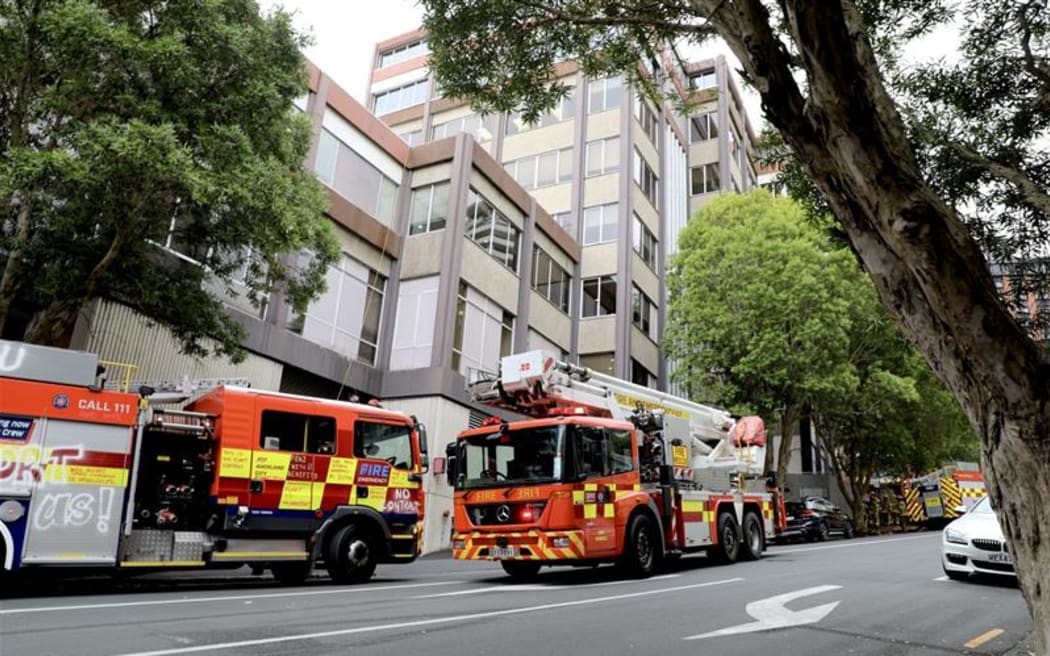
A fire at the University of Auckland law school building has now been extinguished.
A Fire and Emergency spokesperson said there had been a fire at the University and six fire trucks were at the scene on Short Street. The call to 111 came through at about 2.40pm.
FENZ said the fire was now extinguished but crews will stay near the building this afternoon.
Staff and students were seen going in floor by floor, starting with level 6, to retrieve any belongings left behind
A student who was evacuated from the fourth floor of the building said it seemed the fire started on level two.
Police were at the scene talking to students who have been evacuated.
Student Talisha Lal said when the fire alarm went off she, and other students, thought it was a drill.
Lal said once she was out of the building, she could see smoke.
An Auckland teacher has had her registration cancelled after recording explicit videos of herself urinating on the floor of a classroom and on a student’s belongings.
The New Zealand Teachers Disciplinary Tribunal found Lisa Marie Edmondson had committed serious misconduct.
The school was alerted to the content after the deputy principal of the school was approached by a member of the public who had come across a video on TikTok and recognised the setting. A search for the username led to a pornographic account.
The account contained more than 30 explicit videos which had been recorded at various locations over a period of two-and-a-half years.
In one of the videos, Edmondson appeared to urinate on the floor of a classroom with genitalia clearly visible. A second video showed the teacher urinating on a hat with a student’s name clearly visible in a lost property box.
The summary of facts stated there was an “ongoing urine smell” in some classrooms during the time of her employment which had been attributed to rats and mice. Bait stations had been set up during the school holidays but no rodent activity was noted. The tribunal said her students were “likely to have been adversely affected” due to evidence of an “unpleasant smell that required deep cleaning”.
While she was not visible in the videos, the teacher was recognised due to her voice and clothing.
Edmondson resigned in May 2023 after receiving notice of a formal investigation.
Following her resignation, Edmondson worked as a relief teacher at a second school before being invited to apply for a fixed-term position.
The tribunal found that Edmondson had failed to disclose her full employment history when applying for – and subsequently working at – a new school in 2023 and failing to inform her employer that she was the subject of a mandatory report and current investigation by the Teaching Council.
In her reflective statement, Edmondson acknowledged that she had let her students down and “was not the role model that I should have been for them”.
“I have accepted that the likelihood of returning as a teacher has ended. This has been a very difficult concept to accept because I loved teaching, loved being in the classroom and loved my students and their whānau.”
The tribunal noted Edmondson failed to address the conduct head on or express concern for her former students and colleagues.
Edmondson’s registration was cancelled and the former teacher was issued a formal censure. She was ordered to pay $3,255.87 towards the Complaints Assessment Committee’s costs and $582 to the Teaching Council.
‘I have let down so many people’
In a statement to Stuff, Edmondson said she had no choice but to accept the ruling, but regretted her actions.
“During a two-year period which covers this time I was suffering from extreme anxiety, I can’t explain why I did it other than self sabotage and treating myself badly for things that had happened. By the time it was reported, I really did not even remember and hadn’t done anything else.”
Her actions had impacted her children and her ability to provide for them.
“I can’t change what I have done, but can make sure it never happens again.”