

World
China-Nepal flood toll tops 1000 as tunnel rescue offers last hope

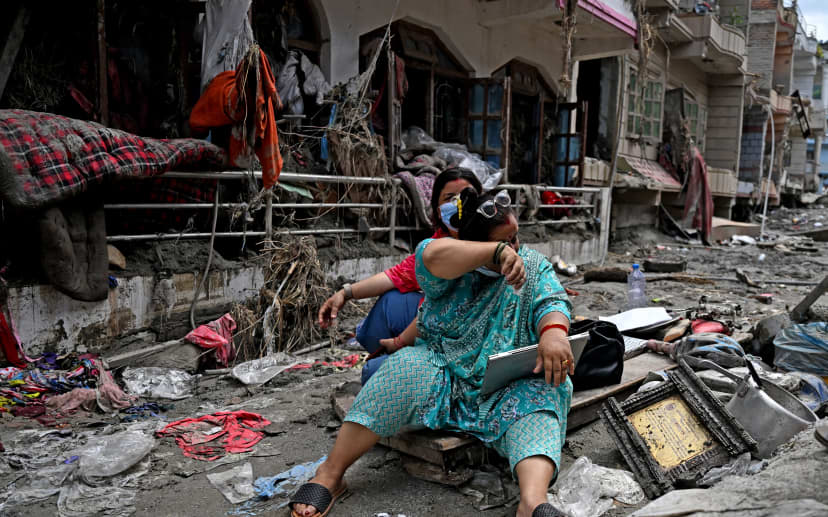
The death toll from devastating Himalayan glacial floods crossed the grim 1000 mark on Tuesday, as Chinese and Nepali teams searched for survivors including dozens feared trapped in hydropower tunnels.
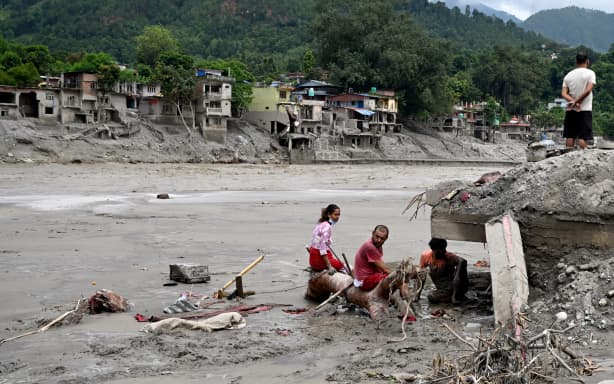
Nearly 4500 people are missing after the gigantic wave of freezing water, rocks and debris from a high-altitude glacial collapse roared downstream on Wednesday, wiping out entire settlements and gouging a path of destruction through Nepal.
Nepali rescue teams are digging, drilling and blasting through debris in a race against time in treacherous conditions to free around 100 hydropower workers believed trapped in multiple tunnels.
So far, only corpses have been pulled out of tunnels blocked with sludge.
“We are focused on search and rescue efforts at the tunnels, our work is continuing,” Raja Ram Basnet, Nepal Army spokesman, told AFP on Tuesday.
“Our soldiers are also deployed to collect bodies and prevent the spread of disease.”
With mortuaries overflowing in Nepal, the authorities have begun burying hundreds of unidentified bodies after DNA sampling. At least 17 bodies have also been pulled from rivers far downstream in India.
Nepal’s Prime Minister Balendra Shah has called the catastrophe “unimaginable and heartbreaking”.
‘Find their bodies’
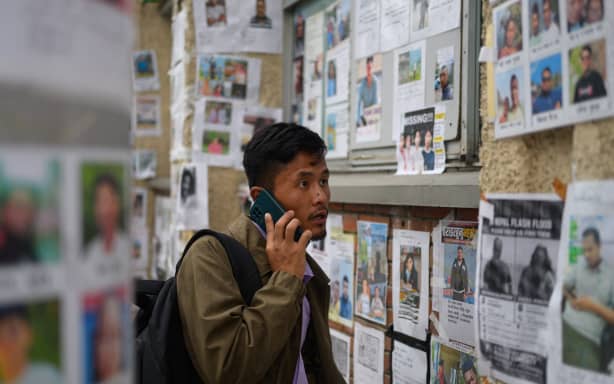
In the capital Kathmandu, crowds lined up to search for their missing relatives, posting photographs on a long wall outside a hospital, in the fading hope of finding them alive.
Debu Sapkota, a 58-year-old driver, came to post photos of his 83-year-old mother-in-law and granddaughter who went missing in the town of Trishuli Bazaar, after being swept away by last week’s surge.
A warning alert sounded, but the elderly woman was “too old to run”, he recounts.
“Her granddaughter was helping her escape but both were swept away.”
Sapkota says he no longer has “any hope that they survived”, after witnesses saw them being carried away by the torrent.
“I am here hoping to find their bodies,” he said, holding up photos of the two missing women dressed in traditional clothes.
In Chitwan district, mourning relatives cremated some of the dead.
AFP / Manan Vatsyayana
Soldiers were seen unloading bodies of victims from helicopters in Nepal’s Nuwakot and Rasuwa districts.
Aid needs are enormous. Entire communities have been swept away, leaving families homeless and using makeshift shelters as heavy rain lashes down.
Roads and dozens of bridges have been smashed, and power plants destroyed.
“There are too many challenges,” said police officer E. Hawadi in badly affected Nuwakot district.
‘Climate change’
In Nuwakot, AFP photographers on Tuesday saw people scouring through mud into the rubble of their homes for usable items, some clearing away dirt and stringing up plastic sheeting for shelter in the ruins.
Foreigners missing among the list include 583 in Nepal and 261 in China, coming from more than 30 nations.
They include tourists who had come for trekking in the apparently serene Himalayas, as well as Hindu pilgrims seeking spiritual peace at Tibet’s sacred Mount Kailash.
There is growing anger at the scale of destruction to hit Nepal, a largely rural nation of 30 million people – that has contributed little to the emissions driving global warming churned out by wealthy and industrialised nations, but is suffering its consequences.
ARUN SANKAR
“It is now time for us to strongly raise with the international community the issue of the disasters we are experiencing as a result of climate change,” Shah, Nepal’s prime minister, said in a statement late Monday.
Scientists say the Himalayas, the world’s highest mountain range, are melting faster as global temperatures rise.
Nepal’s economy is already under pressure, with limited resources to respond to a disaster of this scale, with Kathmandu warning reconstruction costs could run into the “billions of dollars”.
‘Mourn the victims’
Nepal said 987 bodies had been recovered, and listed 3916 as missing.
China’s state media reports 16 dead, and 546 people missing.
That takes the overall number of dead to 1003, and missing to 4462.
In China, Tibet is largely inaccessible to foreign journalists, and Chinese authorities are the only source of official information.
Emergency workers, officials and residents in Tibet held memorial services on Tuesday.
“Rescuers, local officials and residents stood in silence to mourn the victims,” China’s official news agency Xinhua said.
More than 2000 people are aiding rescue operations, including soldiers, Xinhua added.
It said on Tuesday that teams were “working around the clock to search for survivors, repair roads, set up communication base stations and restore power lines.”
But Tibetan advocacy groups in exile have questioned China’s account of the disaster.
Tencho Gyatso, president of the International Campaign for Tibet, called for China to disclose “complete and verifiable information about the damage and casualties”.
Beijing’s foreign ministry said Monday that the “release of information has been open, transparent and timely”, and rejected international reports that it was underreporting deaths.
Source: AFP & RNZ

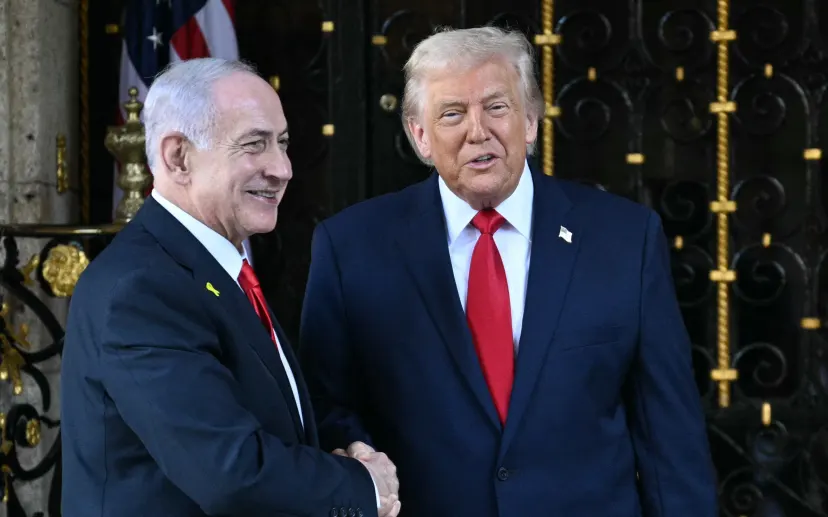
Israeli Prime Minister Benjamin Netanyahu boasted of his endorsement from Donald Trump on the eve of Israel’s election, suggesting the two leaders could restart their war against Iran if he wins, after Trump said they should “finish the job”.
“US President Donald Trump has come with a friendship that has never existed before between an Israeli prime minister and an American president. And it is doubtful we will ever have such a friendly president again,” Netanyahu said in a televised appearance late on Sunday night. “He has another two years, and he says he is calling on you to vote for me.”
In his own social media post on Sunday, Trump, who launched the Iran war jointly with Netanyahu in February, said: “Vote for Bibi Netanyahu for Prime Minister, we have to finish the job that we started!”
Netanyahu said Trump was willing to take action “that would finally, finally, remove the Iranian threat”, but only as long as Netanyahu himself remains in power.
“And I have already instructed the Mossad and the IDF (military) to bring down this regime, to bring down this regime because that is the only way to put an end to this threat,” Netanyahu said, referring to Israel’s main intelligence service and military.
Asked for comment on Netanyahu’s remarks, White House Deputy Press Secretary Anna Kelly said: “As President Trump stated, Iran is in very bad condition, both economically and militarily, and the blockade will remain in full force and effect, with oil flowing in record numbers of barrels through the Hormuz Strait.”
“The United States will not be attacking Iran at any time prior to the midterm elections,” Kelly added via email, referring to the November 3 vote in the US.
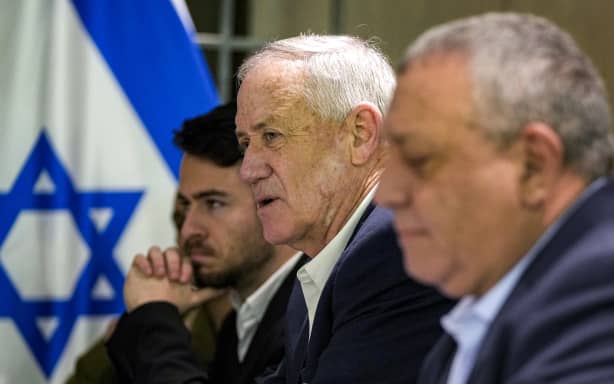
Netanyahu’s leading opponent, centrist former military Chief of Staff Gadi Eisenkot, posted his own comments on social media, praising Trump as “a true friend of Israel”.
“I value his efforts and his commitment to Israel’s security, and I am confident that he will work in full cooperation with any leader chosen by the people.”
Mark Schiefelbein / POOL / AFP
Eisenkot accuses Netanyahu of fear-mongering
Tuesday’s vote, Israel’s first since the October 7, 2023, Hamas attacks, is the first chance for voters to deliver a verdict on the worst security failure in generations and the wars on multiple fronts that followed.
With Netanyahu already at the helm of the most right-wing government in Israeli history, politics have shifted even further to the right. Nearly all Jewish-led parties, including that of the hawkish Eisenkot, now oppose the “two-state solution” that underpinned decades of peace negotiations with the Palestinians.
But many voters say the divisive politics of Israel’s longest-serving leader make the country weaker. Polls suggest Netanyahu’s Likud Party will lose seats, potentially depriving his coalition of right-wing, far-right and ultra-Orthodox parties of its narrow majority.
Eisenkot and an array of opposition parties ranging from the rump of the centre-left to the right, also have no clear path to unseat him.
Netanyahu, 77, is an unrivaled master of political survival: the only time since 2009 that opponents managed to wrest him briefly from the premiership, it took four inconclusive elections within two years to get him out. He was back 18 months later.
Neither side planned major public events for Monday. But both posted on social media, drumming on the election’s major themes: for Netanyahu, that he is the only leader with the mettle to face down Israel’s enemies; for his opponents, that his divisive politics have weakened the country.
Netanyahu shared an AI-generated video on Monday of Iran’s Supreme Leader Ayatollah Mojtaba Khamenei, whose father Ali Khamenei was killed on the first night of US-Israeli strikes on Iran in February. Lying in a hospital bed, the younger Khamenei says his own vote would be “definitely not Bibi. Another term like this and I will be meeting my father sooner than expected.”
On Sunday Netanyahu posted a computer-generated photo of a mushroom cloud over Tel Aviv, saying Israel was in existential danger from Iran.
Eisenkot responded by accusing him of “relying on a campaign of fear-mongering, lies, and threats – including images of nuclear bombs in the heart of Tel Aviv. This time, it won’t work for him.”
Trump’s endorsement of Netanyahu carries its own political risks a week before a legislative election in which his own Republicans are seeking to hold onto power.
The Iran war is deeply unpopular in the United States, blamed for a surge in prices especially for fuel. Major fighting has been suspended for months after ceasefire negotiations held without Israeli participation.
Source: Reuters & RNZ


Police say person who fired gun at officers still at large

New Zealand sides named for RLWC finals

Parliamentary Service working on extra chairs and offices for increased number of MPs


-

 Latest News2 months ago
‘Chilling’: Business groups speak out against National’s supermarket break-up plan
-

 NZ News2 months ago
Tom Phillips report: The missed opportunities to find the children
-

 Politics2 months ago
National vows to try to split Pak’nSave and New World
-

 Latest News2 months ago
Cars bearing Chinese police markings stir unease in Auckland
-

 Fiji News2 months ago
Plans to have new Constitution by Dec 24th 2026
-

 NZ News2 months ago
Cop who stole $68,000 can now be named as champion Muay Thai fighter Haimona Tamati-Te Paki
-

 Politics2 months ago
MBIE confirms botched biometric projects costs blown out to $50.7 million
-

 Latest News2 months ago
Five Karangahape Road venues lose their liquor licences after police intervention