

Sports
A majority Māori and Pacific All Blacks squad shows how far rugby’s ‘greatest rivalry’ has come


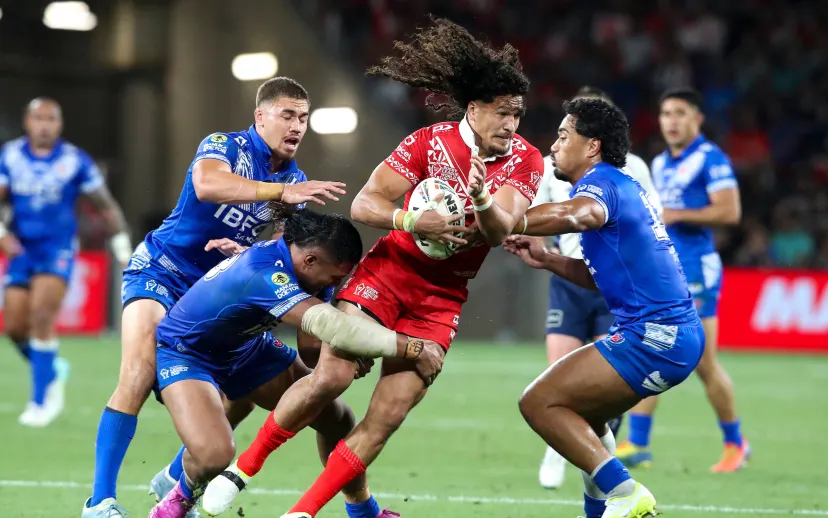
Tongan powerhouse forward Addin Fonua-Blake scored the winner as the Tonga 13 pipped Toa Samoa 20-18 in their final pool match at the Rugby League World Cup in Sydney on Sunday night.
His try saw Tonga regain their lead in the tough, physical battle after Samoa had led 18-14 seven minutes from the end.
The big forward managed to break the Samoans’ defensive line with ball in hand, and was in the clear to score what would be the winner in the game.
The Tongans managed to survive the late Samoan fight-back in the last four minutes of the game, with winger Sualauvi Fa’alogo stepping on the sideline as he dived to score a late try that was cancelled; and fullback Hamiso Tabuai-Fidow passing the ball forward after a mid-air catch close to the Tongan line.
The result meant both Pacific Island teams are into the semifinals next weekend, with Tonga topping the combined Pool B and C, set to face New Zealand, while Samoa meets Australia.
That also marks the first time both teams have made the final four at a world cup, with Samoa getting into the semis in two consecutive world meets, having made the final in 2022.
And in another history-making moment, the two men’s team will join their women counterparts Fetū Samoa and the Fiji Bulikula in the semifinals, making it four Pacific island teams playing off for the finals across the men and women’s competition.
Fonua-Blake’s fellow co-captain Jason Taumalolo thanked divine intervention and paid tribute to the fans post-match.
“First and foremost I would like to thank the man above for bringing everyone here not just as a celebration of Samoa and Tonga but the game of rugby league,” Taumalolo said.
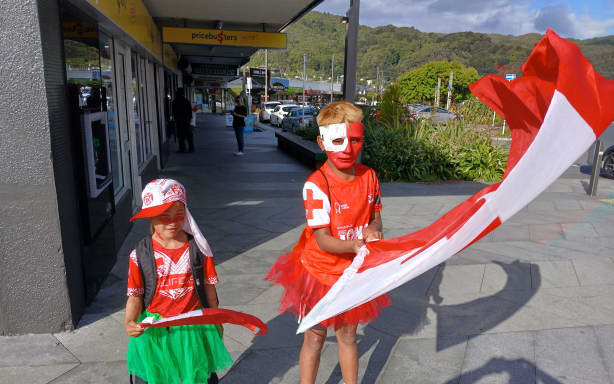
“From the Tongan point of view, to see the red flags, Samoan flags, this is probably the best game I have been a part of and truly blessed.
“We knew tonight was gonna be a physical game and it was going to be a tough one from the start.”
He said Tonga was a bit slow off the mark, and Samoa “being the electrifying team they have been in the last two games” came out and put points on the board and made it a contest to the last minute.
“Big shout to the Samoan boys for tonight and it was a very tough game. Thank you to all the MMT fans tonight and thank you so much to the Toa Samoa fans for making tonight special.”
Taumalolo said they will reset and move on to New Zealand next weekend.
“Obviously the Kiwis and Australia are the benchmark,” he said.
“Tonight was a tough one and we have a short turnaround, the boys will get some recovery; celebrate tonight with our families and all our countrymen that came out here to support us.”
Samoan co-captain Junior Paulo congratulated Tonga and thanked the fans also for their support.
“First of all I thank all of our fans on both sides. Toa Samoans am sorry we didn’t get the job done, but at the end of the day this is what it’s all about, making both nations’ people proud,” he said.
“It was one of the games where you were looking forward to [it] before the tournament started and at the end of the day big credit to the Tongan boys for turning up tonight.
“We knew it was going to be a tough one but all blessings to both nations.”
Samoa scored four tries to Tonga’s three but the difference was Tonga’s Isaiya Katoa, who kicked all conversions and a penalty to seal the deal.
Samoan kickers Harris Channel-Tavita and Ronald Volkman only managed to successfully convert one try each.
Physical battle
The first half of 40 minutes turned out as everyone expected, a torrid and physical battle, which featured big hits across the field.
Tonga laid the challenge with their Sipi Tau, before Toa Samoa responded with the Sivi Tau in front of the packed-out 29,400-plus crowd at the CommBank Stadium, Sydney.
Amongst the fans was All Black captain Ardie Savea, who is originally from Samoa.
Isaiya Katoa kicked off the battle and Tonga came close twice in the first 17 minutes.
Former New Zealand Kiwi Dallin Watene-Zelezniak stepped on the sideline as he planted the ball across the line in the right corner, before his wing partner Jojo Fifita lost the ball over the line in the left corner.
Two minutes later dummy half Salesi Foketi knocked on over the line as Tonga went on attack again.
But their consistent pressure gave them the opening try in the 27th minute when centre Robert Toia got an offload from Haumole Olakau’atu and stepped inside Hamiso Tabuai-Fidow and Sualauvi Faalogo to run around behind the posts. Katoa kicked the conversion as the men in red led 6-0.
In the 35th minute Katoa kicked a penalty from inside the 20-metre zone and pushed Tonga to an 8-0 lead.
However, Samoa got one try back in the 38th minute when veteran winger Brian To’o got the loose ball near the Tongan line and dived over, to reduce the scoreline as Tonga led 8-4 at halftime.
Both sides showed brutal power and physicality upfront, with thunderous hits and tackles, raising cheers from fans.
Tonga had co-captains Addin Fonua-Blake and Jason Taumalolo leading them upfront with Foketi, Olakau’atu, Siua Wong, Tyson Frizell, Stefano Utoikamanu, Taniela Paseka, Demitric Vaimauga and Leka Halasima supporting them.
Toa Samoa were led by Junior Paulo, with Benaiah Ioelu, Connelly Lemuelu, Jermaine McEwen, Francis Manuleleua and Spencer Leniu ably supporting the territorial gains through the middle of the field.
RNZ/ Karoline Tuckey
Close second half
Tonga started the second spell where they had left off at the end of the first, as To’ia was tackled short near the line after their first set of six.
To’ia, who turned down the offer from the Kangaroos to play for them, got to the loose ball after Watene-Zelezniak had caught the high ball from a Katoa bomb near the corner, and tapped it back into the field.
The men from the ‘Friendly Islands’ got the first points in the second 40 in the 47th minute through Jojo Fifita. That came from a scrum near the Samoan 10-metre line, with Katoa combining with veteran Tuimoala Lolohea, who sent a cut-out pass to Fifita, for the winger to run in and score. Katoa’s conversion saw them extend their lead to 14-4.
Samoa got their second try, via To’o again for his second, in the 52nd minute, following a Luai bomb which Critchon collected mid-air and passed it on to Tavita, whose overhead back pass found the unmarked To’o out wide, to stroll in and score.
That try inspired the Samoans into action again with Tabuai-Fidow scoring from a Fa’alogo pass, following another high bomb from Luai that caught the Tongan defence napping – that try reducing the scoreline to 14-12 in favour of Tonga.
But Samoa claimed the lead in the 68th minute after replacement Ronald Volkman rolled over Tongan tacklers on the line to plant the ball, with his conversion giving Samoa an 18-14 lead.
Fonua-Blake got Tonga back in the lead, with Katoa adding the extra two points, with seven minutes remaining.
Samoa attacked twice more, with Fa’alogo stepping on the sideline before scoring in the corner and Tabuai-Fidow passing the ball forward from an aerial catch, but Tonga held on to win the clash.
Mulitalo’s semifinal ban
Meanwhile, Kiwis winger Ronaldo Mulitalo will miss the semifinal clash against Tonga after being hit with a grade 2 careless high tackle charge.
Mulitalo was sent off in the 52nd minute of Saturday’s clash against Fiji after a high tackle on Ronald Philitoga.
The Fijian winger left the field and was ruled out of the rest of the match.
Should Mulitalo enter an early guilty plea he will miss New Zealand’s semi-final but if he fights the charge and is found guilty at the judiciary he will be banned for two games.
Rugby League World Cup media said a two-game ban would rule Mulitalo out of the World Cup final should the Kiwis make it through.
Fiji halfback Brandon Wakeham has also been charged, getting a grade 2 striking offence after he threw a punch at Mulitalo after the high shot on Philitoga.
Wakeham’s tournament is already over as Fiji won’t play in the semis, but he is facing a one-game ban should he plead guilty.
rnz


Police say person who fired gun at officers still at large

New Zealand sides named for RLWC finals

Parliamentary Service working on extra chairs and offices for increased number of MPs


-

 Latest News2 months ago
‘Chilling’: Business groups speak out against National’s supermarket break-up plan
-
 NZ News2 months ago
Tom Phillips report: The missed opportunities to find the children
-
 Latest News2 months ago
Cars bearing Chinese police markings stir unease in Auckland
-
 Politics2 months ago
National vows to try to split Pak’nSave and New World
-

 Fiji News2 months ago
Plans to have new Constitution by Dec 24th 2026
-
 Latest News2 months ago
NRL finals schedule: Who plays who in week 2 and how the Warriors can make the Grand Final
-
 NZ News2 months ago
Cop who stole $68,000 can now be named as champion Muay Thai fighter Haimona Tamati-Te Paki
-

 Politics2 months ago
MBIE confirms botched biometric projects costs blown out to $50.7 million