

Uncategorized
No guarantee shelter can be provided for every rough sleeper – officials

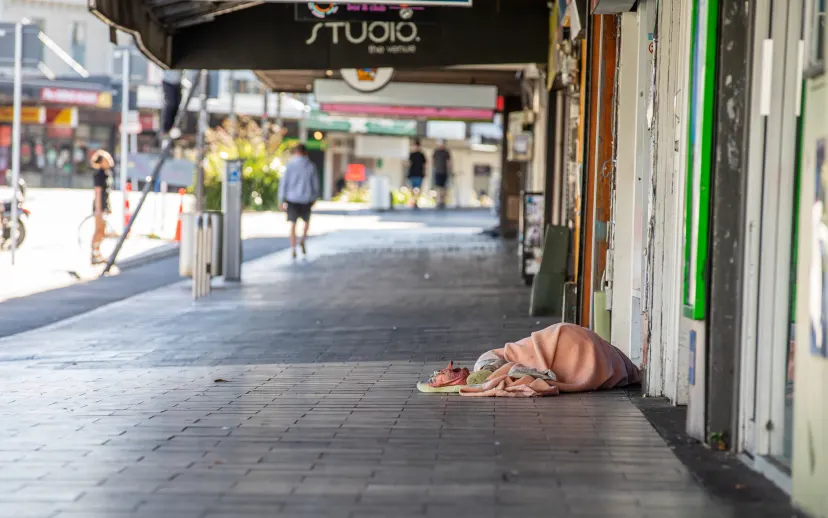
Weeks before the government is set to give police powers to move on rough sleepers, officials have admitted to RNZ they can’t guarantee immediate shelter for anyone on any given night.
Auckland City Missioner Helen Robinson says she’s grateful it’s been “formally acknowledged”, but is “deeply distressed” that’s the reality in the country.
It comes as the largest provider of the most immediate form of shelter tells RNZ it’s managing with the resources it has, but demand is “relentless”.
In June, it was reported that Ministry of Social Development (MSD) managers had performance measures related to reducing emergency housing numbers. These measures have now been refocused to achieve “sustainable housing”.
At the time, the prime minister admitted he did not know there was no night shelter in Auckland for people sleeping rough.
Since then, RNZ has attempted to understand what shelter is available for someone who is sleeping rough.
Over the past month, RNZ sought clarification from both MSD and the Ministry for Cities, Environment, Regions and Transport (MCERT) – which leads the government’s overall programme of work to address rough sleeping – to understand where exactly someone is supposed to go if they need shelter immediately.
After multiple requests, RNZ was finally told by MCERT “there is no guarantee that shelter can be provided for every person in every circumstance in every location”.
The agency said access to accommodation was dependent on a range of factors such as “an individual’s circumstances, location, service capacity, and real-time availability of accommodation and appropriate support”, all of which could change quickly it said.
Robinson told RNZ she’d never had it formally acknowledged there was no guarantee, “I am distressed and I am calling for change.”

Auckland City Mission
It comes as the government’s move on orders legislation, which has received strong opposition, are being progressed ahead of the election.
The law would give police the power to order people as young as 14 to move elsewhere or face a possible jail sentence if they were being disorderly, begging or rough sleeping.
It also comes following reports of rough sleepers dying outdoors overnight, a man found unresponsive in a Cuba Street doorway in Wellington and a woman found unresponsive on New Brighton beach in Christchurch. RNZ understands another rough sleeper died in Auckland in July.
So for those who had nowhere else to go, and may be told to move on, where exactly could they go?
Understanding the current situation
As recently as Sunday, the minister in charge of move on orders, Paul Goldsmith told TVNZ’s Q+A there were “resources available and places available for people 24/7”.
Emergency housing grants are the government’s primary mechanism for providing immediate shelter to people who have “nowhere else to go” and “can’t stay where they are”.
Housing Minister Chris Bishop said in July emergency housing still existed “because there will always be people facing genuine housing crises”.
“But now it’s being used as it was always intended: as a temporary last resort.”
Housing providers and social services have consistently said the governments tightened emergency housing criteria has resulted in an uptick in homelessness. That concern was raised by RNZ as early as March last year, with Community Housing Aotearoa chief executive Paul Gilberd saying again this week there was a direct link between the two.

RNZ / Samuel Rillstone
As recently as Thursday, Serena Moran – a nurse practitioner and clinic lead at Te Aro Health Centre in Wellington – told RNZ there’d been an increase in rough sleepers she was treating, including people being released from prison with no plans to continue accessing antipsychotic medication.
She said the reality most days was treating patients who may have been assaulted and having nowhere to send them.
“I basically have to say to them, ‘I’m sorry, I can’t find you anywhere to stay tonight. You’ll need to go back to the street. I’ll give you pain relief. I’ll try and make you feel as comfortable as I can’.”
But ministers and MSD have consistently maintained that emergency housing remains available to anyone who meets the criteria and has a “genuine need”.
Ministers and MSD have also repeatedly said that people who did not receive emergency housing could have their “needs met in another way”, including through other housing pathways.
Other options include:
- transitional housing;
- social housing; and
- immediate access transitional housing
But none of those pathways guaranteed a person sleeping rough today would have somewhere safe to sleep tonight, especially if the limited immediate access transitional housing beds were full. There were only 65 nationwide.
Kāhui Tū Kaha provided the majority of these beds and told RNZ it was managing with the resources it had, but said the demand was “relentless”. It also accepted referrals from police and hospitals overnight.
On Thursday evening, it accepted an elderly woman with physical access needs and a 17-year-old who had both been sleeping on the street. It also accepted a woman becoming homeless due to family violence, and a young woman who police wanted separated from a violent partner.
Kāhui Tū Kaha said things were tight but “we’re constantly juggling”.
RNZ



Analysis – Three years ago, Christopher Luxon headed into his first head-to-head debate with Chris Hipkins on the back of a poll that had National on 37 points and able to form a government with ACT alone.
Labour under then-Prime Minister Chris Hipkins was on a downward spiral on 27 percent in that same 1News-Verian poll and had no path to power.
Fast-forward three years and both parties headed into Tuesday night’s debate with two fresh new polls.
RNZ-Reid Research’s results had National on 26 percent and Labour on 31, while 1News-Verian had a much tighter race with just one point in it and both parties just under 30.
Those results spell early retirement and unemployment for a decent number of National Party MPs currently enjoying the government benches.
MMP has evolved so much in the past two elections that the combined Labour-National vote has gone from 81 percent at the 2017 election to just 57 in Tuesday’s RNZ-Reid Research poll.
So-called minor parties have grown in both size and influence, capturing the imagination of voters that traditionally voted blue or red.
Increasingly polling is suggesting another new party – Opportunity – has a good chance of making it into Parliament and being a potential kingmaker.
There’s now a very real possibility that the next government could be made up of four political parties.
That has happened before under Sir John Key’s National government in 2008, but because he chose to welcome the Māori Party into the fold, not because he had to.
The minor parties of 2026 have leverage and power going into any coalition talks well beyond any previous election years.
It makes a head-to-head between Christopher Luxon and Chris Hipkins far more redundant in this political age.

TVNZ/Harley Peters
They can’t fully commit to any of the promises they make because the slate is almost entirely wiped clean after 7 November when political parties sit down to discuss what a future government might look like.
Luxon has ruled out working with Opportunity after the election because of its land tax policy and National campaigning on no new taxes.
On Tuesday night he repeatedly refused to answer whether he would pick the phone up if he needed the party to be prime minister.
Instead, he repeated his previous comments about an untenable land tax, and then told reporters after the debate the question was a “hypothetical” that didn’t need an answer.
To be clear, that’s not a no.
At times in the debate the leaders could have been put in a time machine and transported back to three years ago, so similar were some of the issues and answers to them.
The cost of living crisis continued to be the overwhelming theme, a healthcare system under pressure and patients waiting too long in emergency departments hadn’t improved, and neither Chris had fully grasped the meaning of a yes or no question.
There was no big revelation or pledge – on the latter neither party has the headroom in their fiscal plans to do so.
It’s unlikely undecided voters watching were swayed one way or the other by the end of it.
That’s not to say the two Chrises performed badly.
They were both across their briefs, and while they had some nervous energy at the outset both settled into a comfortable rhythm and got their key messages across.
While Hipkins managed to land a few blows on Luxon over his failure to discipline New Zealand First’s Winston Peters and Shane Jones over racist remarks, Luxon in return made a strong argument on education and had Hipkins concede he had done what Labour couldn’t and got India across the line on a free trade agreement.
The biggest controversy of the night was the pair being asked to pick between the All Blacks and the Warriors with Luxon going Team ABs while Hipkins chose to “Up the Wahs”.
Both would have gone to bed happy with their performance and grateful they didn’t say or do anything they deeply regretted.
There is a week until they face-off again – another week of smiling at the cameras and hoping voters return them to the major party league.
rnz



Police say person who fired gun at officers still at large

New Zealand sides named for RLWC finals

Parliamentary Service working on extra chairs and offices for increased number of MPs


-

 Latest News2 months ago
‘Chilling’: Business groups speak out against National’s supermarket break-up plan
-

 NZ News2 months ago
Tom Phillips report: The missed opportunities to find the children
-

 Politics2 months ago
National vows to try to split Pak’nSave and New World
-

 Latest News2 months ago
Cars bearing Chinese police markings stir unease in Auckland
-

 Fiji News2 months ago
Plans to have new Constitution by Dec 24th 2026
-

 NZ News2 months ago
Cop who stole $68,000 can now be named as champion Muay Thai fighter Haimona Tamati-Te Paki
-

 Politics2 months ago
MBIE confirms botched biometric projects costs blown out to $50.7 million
-

 Latest News2 months ago
Five Karangahape Road venues lose their liquor licences after police intervention