

World
We’ve never seen the Sun in this much detail before

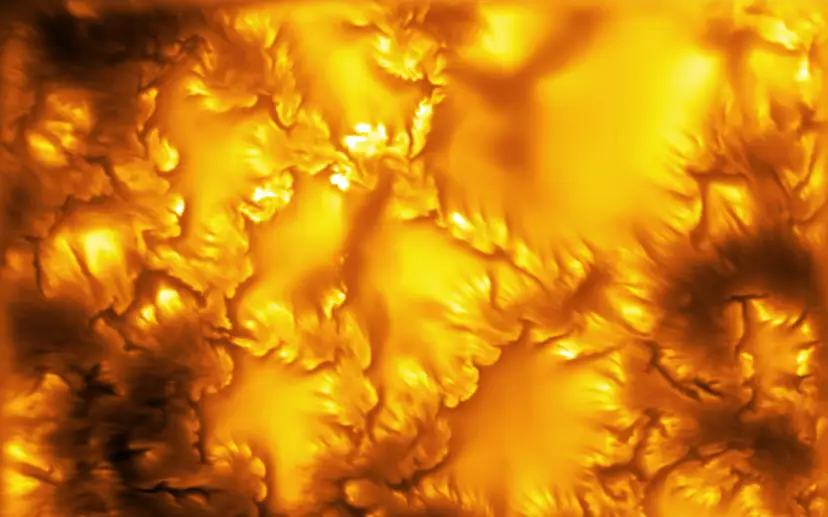
Those swirling eddies play a huge role in the Sun’s occasional violent outbursts, but they’re difficult to see because it is so bright.
Now astronomers have used the world’s largest solar telescope to capture the highest-resolution imagery ever taken of our star’s roiling surface.
It shows a section of the Sun about 5000 by 3500 kilometres in size: a zone that, on Earth, could comfortably enclose mainland Australia.
The stunning imagery also captures a never-before-seen physical process, which the researchers have described in the journal Nature.
Michael Wheatland, an astrophysicist at the University of Sydney who wasn’t involved with the research, said the imagery was “just incredible”.
“We’ve never observed the Sun at that resolution,” Professor Wheatland said.
“In this amazing detail, we see all of this really interesting fundamental physics happening.”
Whirling patterns on the Sun’s surface
The observations show the solar surface, called the photosphere, constantly swirls and flows with plasma.
According to the researchers, these ebbs and flows show the plasma undergoes a physical process called Kelvin-Hemholtz instability.
This effect happens when different types of fluids mix, causing small fluctuations at the borders between them.
“You see it in clouds, you see it in the ocean, you see it whenever you have fluids,” Wheatland said.
“But we haven’t actually seen it on the Sun in a way that’s really unambiguous. I think the evidence here is completely unambiguous.”
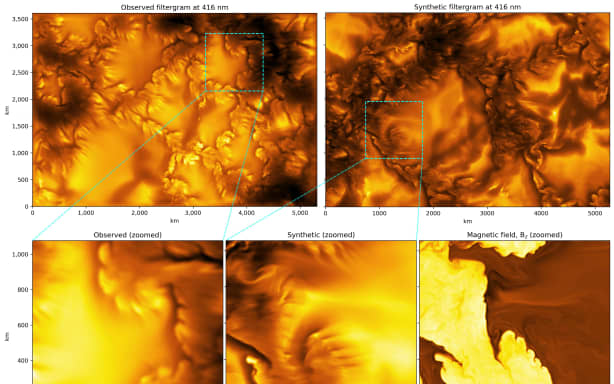
Supplied/NSF/NSO/AURA/MPS
On Earth, this instability is often driven by fluids of different temperatures or densities, or moving at different speeds. On the Sun, the differences come from changes in magnetism.
“When you mix the fluid, you move the magnetic field around as well,” Wheatland said.
This mixing can lead to an increase in energy which could be the reason the Sun’s corona – the outer part of its atmosphere – is so hot.
The Sun’s surface is roughly 5500 degrees Celsius, but the corona above it can reach 2 million degrees.
The solar telescope in Hawaii
Hannah Schunker, an astrophysicist at the University of Newcastle, said because the Sun was so close to Earth – a mere 149 million kilometres away – it was the only place astronomers could study the surface of a star in detail.
“The Sun is like an astrophysical laboratory,” Dr Schunker, who also wasn’t involved with the new research, said.
The observations were made with the Daniel K. Inouye Solar Telescope, in Hawaii, which is run by the US National Science Foundation.
Solar telescopes use the same basic technology as other large optical telescopes – large mirrors and lenses which magnify light – but since they’re designed to focus on the Sun, they need to be purpose-built.
“The Sun is just so bright and produces so much more heat and light than a distant star,” Schunker said.
“So it requires specialised filters, cooling systems and instruments that can be safely pointed at the Sun without damaging the telescope.”
Friedrich Woeger, senior scientist at the US National Solar Observatory and co-lead author on the paper, said that while preparing for and analysing the observations required months of work, the imagery they captured spans only a few minutes.
“The acquisition of the data used in the study itself actually did not take much longer than five minutes,” Dr Woeger said.
Predicting space weather
Schunker said it was important to understand the Sun’s magnetic field because it drives all space weather.
While these images only capture a small part of the Sun’s surface for a small period of time, she said data and modelling like this could eventually be used to predict things like solar flares.
“These very small-scale changes that are happening on the surface of the Sun, they are responsible for all the larger scale things happening in the atmosphere, and we’ve never been able to see them before,” Schunker said.
Flares and other solar phenomena can cause bright auroras on Earth, and in serious cases prompt power outages and damage to satellites and other technology.
“We can take the small-scale physics and put it into the larger-scale models, and this will open the door to, hopefully, better weather predictions, better predictions of flares, [and] better predictions of how heat is transported up to the corona,” Schunker said.
Woeger said it would be valuable to have observations of a larger section of the Sun’s surface to get more data on the patterns they observed.
“We are planning for future Inouye Solar Telescope measurements with instruments that provide more information about velocities and magnetic field of the plasma on the Sun,” Woeger said.
Wheatland said the imagery signified an exciting time for solar astronomy.
“Progress will be made in some of the big, outstanding questions in solar physics.”
Source: ABC & RNZ

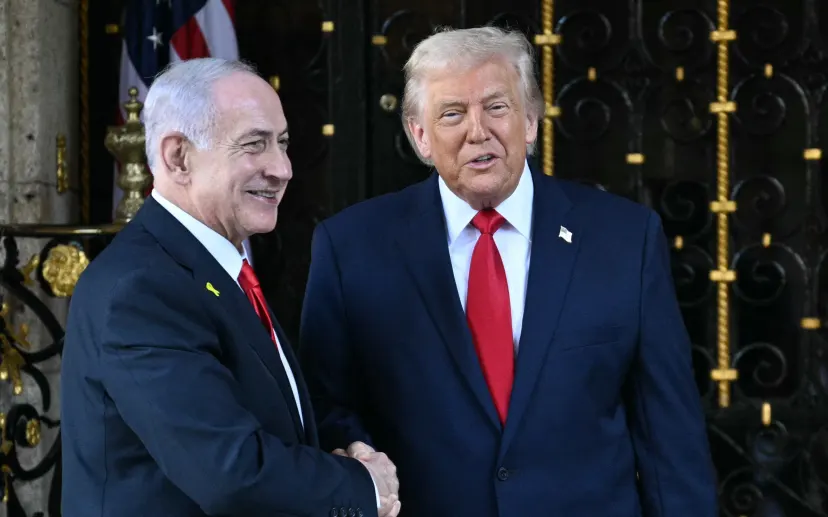
Israeli Prime Minister Benjamin Netanyahu boasted of his endorsement from Donald Trump on the eve of Israel’s election, suggesting the two leaders could restart their war against Iran if he wins, after Trump said they should “finish the job”.
“US President Donald Trump has come with a friendship that has never existed before between an Israeli prime minister and an American president. And it is doubtful we will ever have such a friendly president again,” Netanyahu said in a televised appearance late on Sunday night. “He has another two years, and he says he is calling on you to vote for me.”
In his own social media post on Sunday, Trump, who launched the Iran war jointly with Netanyahu in February, said: “Vote for Bibi Netanyahu for Prime Minister, we have to finish the job that we started!”
Netanyahu said Trump was willing to take action “that would finally, finally, remove the Iranian threat”, but only as long as Netanyahu himself remains in power.
“And I have already instructed the Mossad and the IDF (military) to bring down this regime, to bring down this regime because that is the only way to put an end to this threat,” Netanyahu said, referring to Israel’s main intelligence service and military.
Asked for comment on Netanyahu’s remarks, White House Deputy Press Secretary Anna Kelly said: “As President Trump stated, Iran is in very bad condition, both economically and militarily, and the blockade will remain in full force and effect, with oil flowing in record numbers of barrels through the Hormuz Strait.”
“The United States will not be attacking Iran at any time prior to the midterm elections,” Kelly added via email, referring to the November 3 vote in the US.
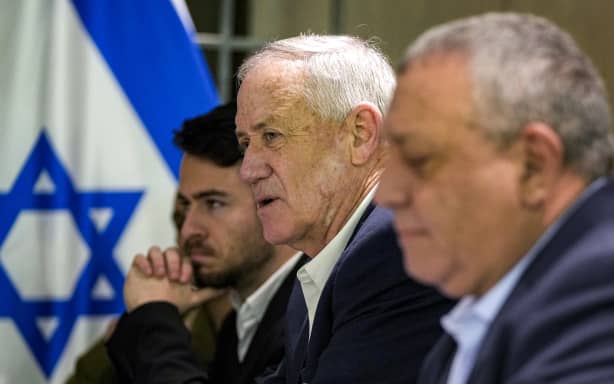
Netanyahu’s leading opponent, centrist former military Chief of Staff Gadi Eisenkot, posted his own comments on social media, praising Trump as “a true friend of Israel”.
“I value his efforts and his commitment to Israel’s security, and I am confident that he will work in full cooperation with any leader chosen by the people.”
Mark Schiefelbein / POOL / AFP
Eisenkot accuses Netanyahu of fear-mongering
Tuesday’s vote, Israel’s first since the October 7, 2023, Hamas attacks, is the first chance for voters to deliver a verdict on the worst security failure in generations and the wars on multiple fronts that followed.
With Netanyahu already at the helm of the most right-wing government in Israeli history, politics have shifted even further to the right. Nearly all Jewish-led parties, including that of the hawkish Eisenkot, now oppose the “two-state solution” that underpinned decades of peace negotiations with the Palestinians.
But many voters say the divisive politics of Israel’s longest-serving leader make the country weaker. Polls suggest Netanyahu’s Likud Party will lose seats, potentially depriving his coalition of right-wing, far-right and ultra-Orthodox parties of its narrow majority.
Eisenkot and an array of opposition parties ranging from the rump of the centre-left to the right, also have no clear path to unseat him.
Netanyahu, 77, is an unrivaled master of political survival: the only time since 2009 that opponents managed to wrest him briefly from the premiership, it took four inconclusive elections within two years to get him out. He was back 18 months later.
Neither side planned major public events for Monday. But both posted on social media, drumming on the election’s major themes: for Netanyahu, that he is the only leader with the mettle to face down Israel’s enemies; for his opponents, that his divisive politics have weakened the country.
Netanyahu shared an AI-generated video on Monday of Iran’s Supreme Leader Ayatollah Mojtaba Khamenei, whose father Ali Khamenei was killed on the first night of US-Israeli strikes on Iran in February. Lying in a hospital bed, the younger Khamenei says his own vote would be “definitely not Bibi. Another term like this and I will be meeting my father sooner than expected.”
On Sunday Netanyahu posted a computer-generated photo of a mushroom cloud over Tel Aviv, saying Israel was in existential danger from Iran.
Eisenkot responded by accusing him of “relying on a campaign of fear-mongering, lies, and threats – including images of nuclear bombs in the heart of Tel Aviv. This time, it won’t work for him.”
Trump’s endorsement of Netanyahu carries its own political risks a week before a legislative election in which his own Republicans are seeking to hold onto power.
The Iran war is deeply unpopular in the United States, blamed for a surge in prices especially for fuel. Major fighting has been suspended for months after ceasefire negotiations held without Israeli participation.
Source: Reuters & RNZ


Police say person who fired gun at officers still at large

New Zealand sides named for RLWC finals

Parliamentary Service working on extra chairs and offices for increased number of MPs


-

 Latest News2 months ago
‘Chilling’: Business groups speak out against National’s supermarket break-up plan
-

 NZ News2 months ago
Tom Phillips report: The missed opportunities to find the children
-

 Politics2 months ago
National vows to try to split Pak’nSave and New World
-

 Latest News2 months ago
Cars bearing Chinese police markings stir unease in Auckland
-

 Fiji News2 months ago
Plans to have new Constitution by Dec 24th 2026
-

 NZ News2 months ago
Cop who stole $68,000 can now be named as champion Muay Thai fighter Haimona Tamati-Te Paki
-

 Politics2 months ago
MBIE confirms botched biometric projects costs blown out to $50.7 million
-

 Latest News2 months ago
Five Karangahape Road venues lose their liquor licences after police intervention