

World
Death roll rises to 13 in Japan quake – PM Takaichi

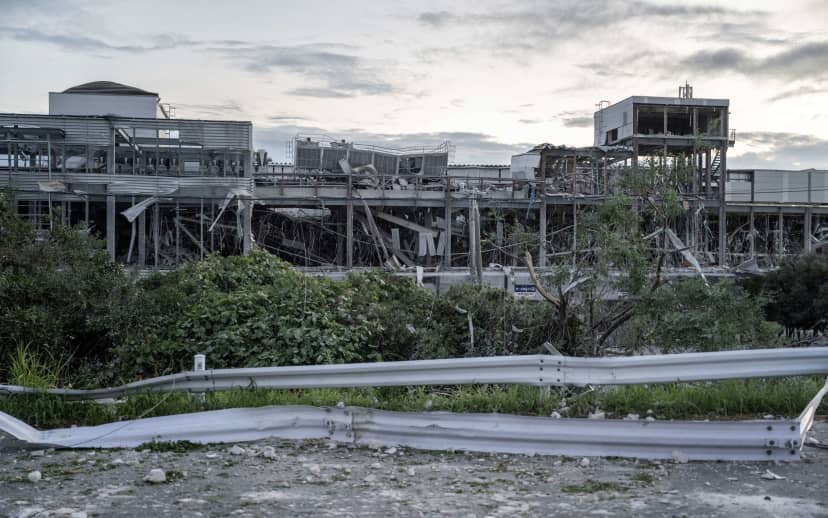
Thirteen people died following a major earthquake in Japan on Tuesday (local time), Prime Minister Sanae Takaichi says.
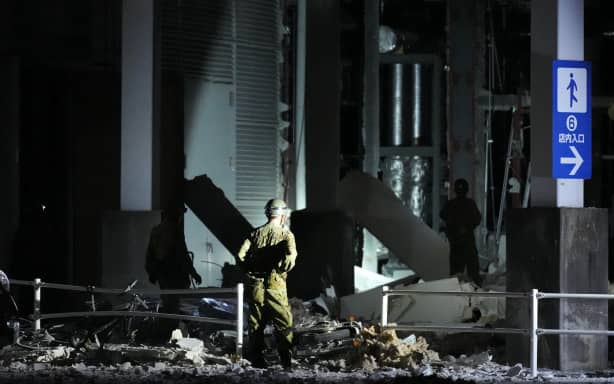
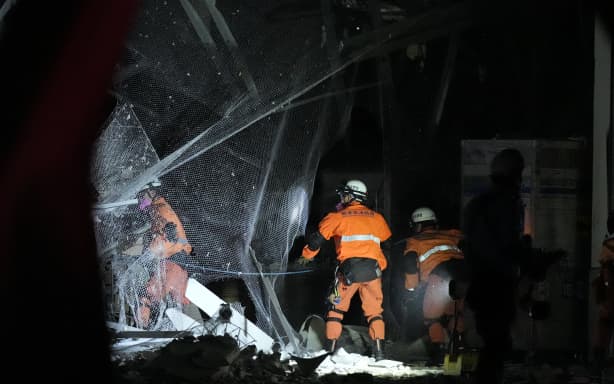
Two young women were found dead in a mall badly damaged by the powerful earthquake and subsequent explosion, local media report, as crews continue searching for missing people.
Three other people were in a state of cardiopulmonary arrest, public broadcaster NHK reported – one at the mall and two others at a factory in Yatsushiro city where a smokestack collapsed.
Nine others people were unaccounted for at the factory site, it said.
The mall blast was likely caused by a gas leak, a government source told the Kyodo news agency. Ceilings and walls collapsed, leaving the structure’s steel frame exposed.
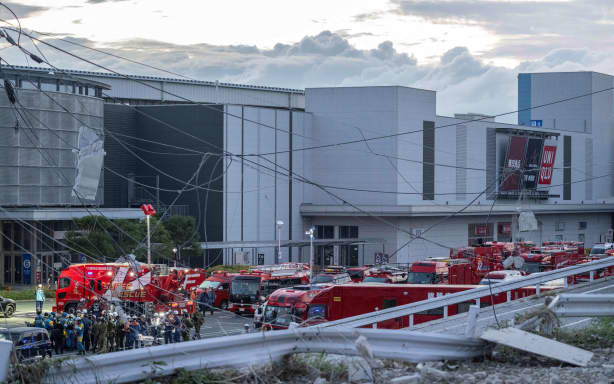
AFP / YUICHI YAMAZAKI
Many people had evacuated the facility due to the earthquake and prior to the blast, reported 30 minutes later, Kyodo said, citing a spokesperson for the mall operator.
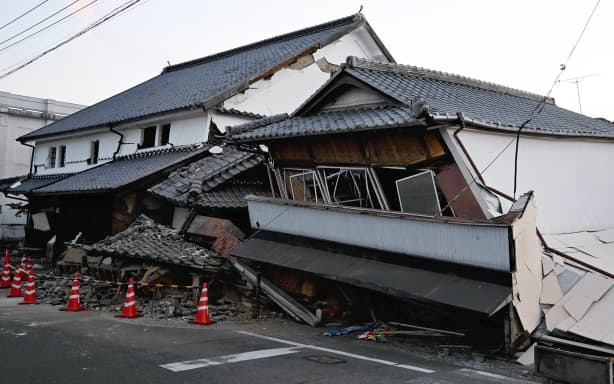
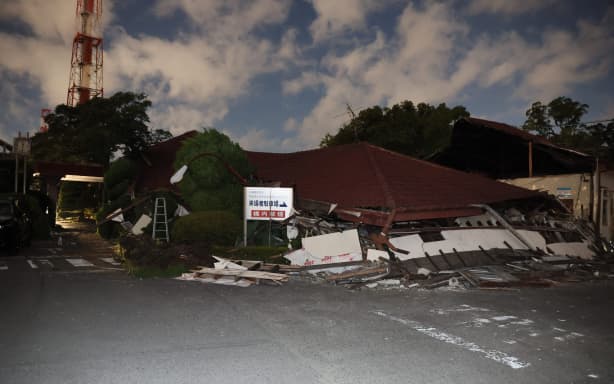
The powerful tremor at 4.27pm on Tuesday afternoon – measured at 7.1 magnitude by the Japan Meteorological Agency (JMA) – toppled buildings, sparked fires and reportedly killed one other person in a house collapse.
The US Geological Survey put the quake’s magnitude at 6.8.
A succession of aftershocks followed, including one with a magnitude of 6.1 at 5.08pm.
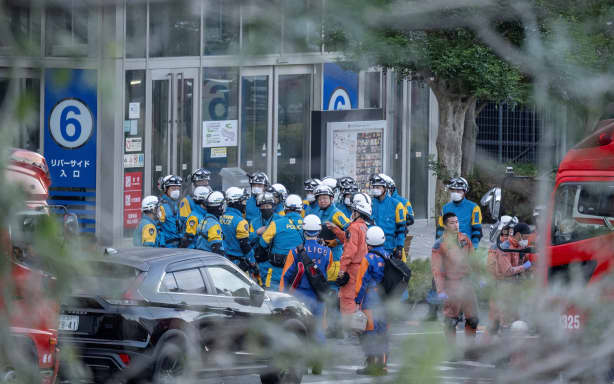
AFP / YUICHI YAMAZAKI
Emergency responders searched overnight for people feared trapped in the mall, located just outside Kumamoto city, and at the damaged factory in Yatsushiro city, both on Kyushu island in southwestern Japan.
After nightfall, regional officials said 10 people were unaccounted for at the mall, NHK reported.
It had aired footage from elsewhere in the southwestern Kumamoto region on Kyushu island showing several blazes, damaged bridges, a derailed cargo train and a number of houses threatening to topple over.
Power outages, fires
Chiharu Hara, a 35-year-old recruitment agent who was in Kumamoto, told AFP that she was “terrified” when the quake struck.
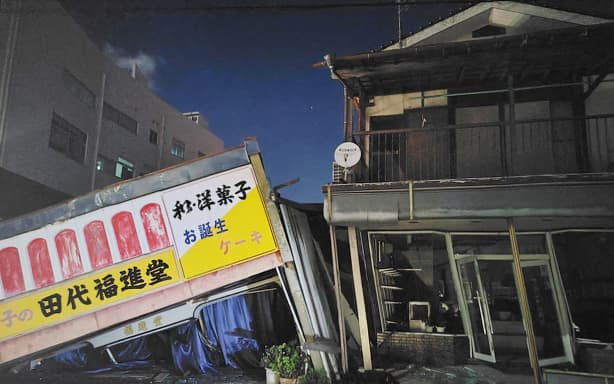
Kazuhiro Shiraishi / The Yomiuri Shimbun via AFP
“The office swayed violently side to side. I was afraid it would collapse. Everyone panicked,” Hara said.
Footage verified by AFP showed heavy vehicles, street lights and traffic lights swaying. Elsewhere, vehicles on a two-lane road in the province were seen carefully navigating sections of buckled pavement.
Many roads were closed and high-speed shinkansen train services were suspended in the region affected by Tuesday’s quake. Kumamoto airport was closed for several hours before re-opening in the evening.
Two hospitals reported taking in at least 50 injured patients each, it said.
Yuki Tsuru / The Yomiuri Shimbun via AFP
“People are coming in with burns and fractures from being trapped under objects due to the earthquake, and ambulances are constantly bringing in injured people,” NHK quoted one hospital employee as saying.
“Inside the hospital, there are water leaks and electrical system failures.”
The broadcaster also said that around 10 people were hurt at a nursing home for the elderly.
“Human casualties, building collapses, road damage, fires… have been confirmed so far,” Prime Minister Sanae Takaichi said on X, adding there were also “water and power outages”.
The Yomiuri Shimbun via AFP / Kazuki Wakasugi
The Japanese military has mobilised 3600 personnel for disaster relief operations and sent 20 aircraft to assess the damage from the air, the defence minister said.
Verified footage shared on social media showed parts of a wall at the centuries-old Kumamoto Castle collapsing.
No immediate abnormalities were recorded at nuclear power plants, the Nuclear Regulation Authority said.
About 45,000 households and facilities had no power in the Kumamoto region, according to local utility Kyushu Electric Power.
The firm said three nuclear reactors operating in the region at the time were functioning normally.
Koichi Nagano / The Yomiuri Shimbun via AFP
‘Ring of Fire’
A local NHK staffer wearing a helmet reported live on air that the shaking was continuing around half an hour after the quake, with the newsroom rocking so violently that it was difficult to remain standing.
“Including myself, there may be some people who feel their hearts racing,” the staffer said.
Kumamoto was hit by two devastating earthquakes in 2016 – one of magnitude 6.5, followed two days later by one of magnitude 7.3 – which killed 273 people and injured more than 2800.
Japan is one of the world’s most seismically active countries, sitting on top of four major tectonic plates along the western edge of the Pacific “Ring of Fire”.
The Yomiuri Shimbun via AFP / Kazuki Wakasugi
The archipelago, home to around 125 million people, typically experiences hundreds of jolts every year and accounts for about 18 percent of the world’s earthquakes.
The vast majority are mild, although the damage they cause varies according to their location and the depth below the Earth’s surface at which they strike.
Japan is haunted by the memory of a massive 9.0-magnitude undersea quake in 2011, which triggered a tsunami that killed or left missing around 18,500 people and wrecked the Fukushima nuclear plant.
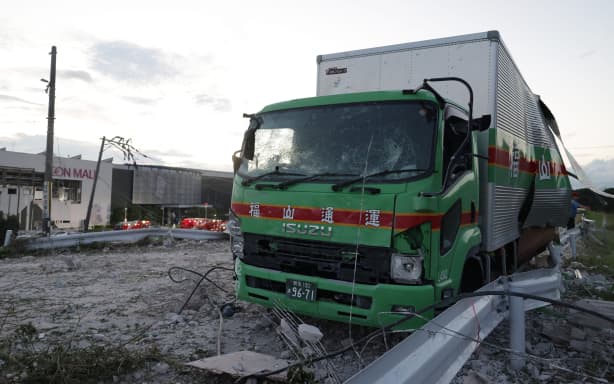
Naoya Azuma / The Yomiuri Shimbun via AFP
-AFP / Reuters/ RNZ

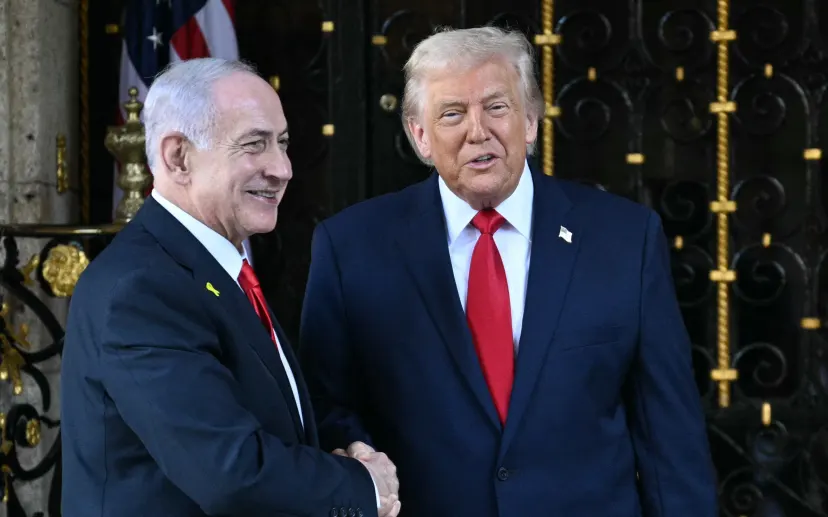
Israeli Prime Minister Benjamin Netanyahu boasted of his endorsement from Donald Trump on the eve of Israel’s election, suggesting the two leaders could restart their war against Iran if he wins, after Trump said they should “finish the job”.
“US President Donald Trump has come with a friendship that has never existed before between an Israeli prime minister and an American president. And it is doubtful we will ever have such a friendly president again,” Netanyahu said in a televised appearance late on Sunday night. “He has another two years, and he says he is calling on you to vote for me.”
In his own social media post on Sunday, Trump, who launched the Iran war jointly with Netanyahu in February, said: “Vote for Bibi Netanyahu for Prime Minister, we have to finish the job that we started!”
Netanyahu said Trump was willing to take action “that would finally, finally, remove the Iranian threat”, but only as long as Netanyahu himself remains in power.
“And I have already instructed the Mossad and the IDF (military) to bring down this regime, to bring down this regime because that is the only way to put an end to this threat,” Netanyahu said, referring to Israel’s main intelligence service and military.
Asked for comment on Netanyahu’s remarks, White House Deputy Press Secretary Anna Kelly said: “As President Trump stated, Iran is in very bad condition, both economically and militarily, and the blockade will remain in full force and effect, with oil flowing in record numbers of barrels through the Hormuz Strait.”
“The United States will not be attacking Iran at any time prior to the midterm elections,” Kelly added via email, referring to the November 3 vote in the US.
Netanyahu’s leading opponent, centrist former military Chief of Staff Gadi Eisenkot, posted his own comments on social media, praising Trump as “a true friend of Israel”.
“I value his efforts and his commitment to Israel’s security, and I am confident that he will work in full cooperation with any leader chosen by the people.”
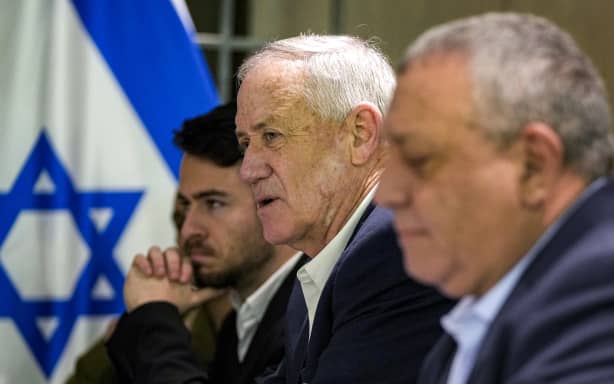
Mark Schiefelbein / POOL / AFP
Eisenkot accuses Netanyahu of fear-mongering
Tuesday’s vote, Israel’s first since the October 7, 2023, Hamas attacks, is the first chance for voters to deliver a verdict on the worst security failure in generations and the wars on multiple fronts that followed.
With Netanyahu already at the helm of the most right-wing government in Israeli history, politics have shifted even further to the right. Nearly all Jewish-led parties, including that of the hawkish Eisenkot, now oppose the “two-state solution” that underpinned decades of peace negotiations with the Palestinians.
But many voters say the divisive politics of Israel’s longest-serving leader make the country weaker. Polls suggest Netanyahu’s Likud Party will lose seats, potentially depriving his coalition of right-wing, far-right and ultra-Orthodox parties of its narrow majority.
Eisenkot and an array of opposition parties ranging from the rump of the centre-left to the right, also have no clear path to unseat him.
Netanyahu, 77, is an unrivaled master of political survival: the only time since 2009 that opponents managed to wrest him briefly from the premiership, it took four inconclusive elections within two years to get him out. He was back 18 months later.
Neither side planned major public events for Monday. But both posted on social media, drumming on the election’s major themes: for Netanyahu, that he is the only leader with the mettle to face down Israel’s enemies; for his opponents, that his divisive politics have weakened the country.
Netanyahu shared an AI-generated video on Monday of Iran’s Supreme Leader Ayatollah Mojtaba Khamenei, whose father Ali Khamenei was killed on the first night of US-Israeli strikes on Iran in February. Lying in a hospital bed, the younger Khamenei says his own vote would be “definitely not Bibi. Another term like this and I will be meeting my father sooner than expected.”
On Sunday Netanyahu posted a computer-generated photo of a mushroom cloud over Tel Aviv, saying Israel was in existential danger from Iran.
Eisenkot responded by accusing him of “relying on a campaign of fear-mongering, lies, and threats – including images of nuclear bombs in the heart of Tel Aviv. This time, it won’t work for him.”
Trump’s endorsement of Netanyahu carries its own political risks a week before a legislative election in which his own Republicans are seeking to hold onto power.
The Iran war is deeply unpopular in the United States, blamed for a surge in prices especially for fuel. Major fighting has been suspended for months after ceasefire negotiations held without Israeli participation.
Source: Reuters & RNZ


Police say person who fired gun at officers still at large

New Zealand sides named for RLWC finals

Parliamentary Service working on extra chairs and offices for increased number of MPs


-

 Latest News2 months ago
‘Chilling’: Business groups speak out against National’s supermarket break-up plan
-

 NZ News2 months ago
Tom Phillips report: The missed opportunities to find the children
-

 Politics2 months ago
National vows to try to split Pak’nSave and New World
-

 Latest News2 months ago
Cars bearing Chinese police markings stir unease in Auckland
-

 Fiji News2 months ago
Plans to have new Constitution by Dec 24th 2026
-

 NZ News2 months ago
Cop who stole $68,000 can now be named as champion Muay Thai fighter Haimona Tamati-Te Paki
-

 Politics2 months ago
MBIE confirms botched biometric projects costs blown out to $50.7 million
-

 Latest News2 months ago
Five Karangahape Road venues lose their liquor licences after police intervention