

NZ News
China’s missile test in South Pacific ‘incredibly unwelcome’, PM Luxon says


The Prime Minister says it’s unacceptable China has tested nuclear-capable weapons in the Pacific, and the government’s expressed its concerns directly.
On Monday, China test-launched a long-range ballistic missile with a dummy warhead.
RNZ understands the missile flew over the Exclusive Economic Zones of the Federated States of Micronesia, Nauru, Tuvalu and Kiribati, and landed in waters near Tuvalu and Kiribati.
Luxon said that was unacceptable, unwelcome and concerning.
“This is an intercontinental ballistic missile test, the second that we’ve seen in recent years, having not had one in the region for 40 years, from China,” he said.
“We are living in a region that is proudly nuclear free … we don’t want to see increasing militarisation in our region.”
China’s activity was legal, but inconsistent with Pacific values and the region would strongly push back against it, Luxon said.
“We have expressed our concerns [with China] very directly and very clearly,” he said.
The missile firing came shortly after a new defence treaty was signed between Australia and Fiji.
Luxon said he had spoken with both countries’ Prime Ministers about the agreement and Cabinet was discussing whether New Zealand might join it.
Cabinet was very interested in exploring participation but there was a way to go yet, given it had only just been signed, Luxon said.
Johannes Neudecker / dpa Picture-Alliance via AFP
China says it has acted legally
China insists the test missile test it carried out was a routine arrangement and consistent with international law.
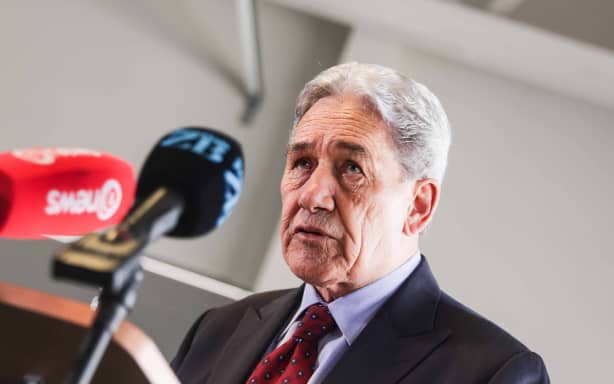
While a Chinese foreign ministry spokesperson said, “we hope relevant countries will not read too much into it”, Foreign Affairs Minister Winston Peters described the launch as being “at odds with the spirit and intent” of the Pacific.
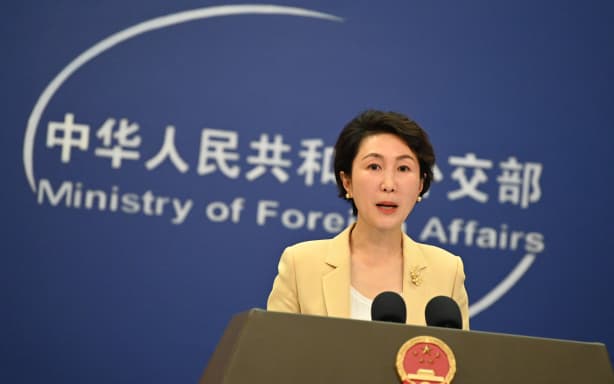
Chinese foreign ministry spokesperson Mao Ning told a press conference in Beijing the test was a “routine arrangement” in China’s annual military training programme.
“It is consistent with international law and customary international practice and is not directed at any specific country or target,” she said.
Asked by AFP whether she had any response to the criticism from countries like New Zealand, Japan, and Australia, Mao repeated her earlier comment, but added the countries concerned were informed prior to the launch.
“The whole process was safe, standard and professional. We hope relevant countries will not read too much into it.”
But on Monday, Peters said while New Zealand had been informed, China carried out the test “within hours”.
Peters said the Pacific was an Ocean of Peace, and the launch was “not consistent” with regional stability and peace in the South Pacific.
RNZ / Samuel Rillstone
“This missile was fired into the South Pacific Nuclear Free Zone established by the Treaty of Rarotonga. China’s action goes against the object and intent of that Treaty.”
RNZ understands the missile test warning from China was delivered to Ministry of Foreign Affairs and Trade officials by Chinese embassy officials in Wellington and likewise, in Beijing, New Zealand’s defence attaché was notified by Chinese counterparts.
Upon receiving the warning, New Zealand immediately relayed its concerns to both the embassy in Wellington and officials in Beijing.
However, the test went ahead a short time later.
Peters is in Singapore and flies to Japan later on Tuesday.
He will meet with Japan’s Defence Minister Shinjiro Koizumi and Foreign Affairs Minister Toshimitsu Motegi on Friday, where the China missile testing is expected to be front and centre of their talks.
Labour leader Chris Hipkins said the test was unwelcome.
“That’s a very concerning development. We want to see the Pacific stay an ocean of peace, and China’s testing of their ballistic missile capability in the Pacific is very unwelcome.”
Green Party foreign affairs spokesperson Teanau Tuiono said the party did not like any ballistic missiles being launched into New Zealand’s backyard.
“People talk about an Ocean of Peace, and I think that’s a good thing. So we should try to make the Pacific a place of peace, but that would require us to commit to demilitarisation, to actually commit to peace, and making sure that we’re very clear to particularly the big powers, the US, China, and whoever else, that that is what’s important for the Pacific.”
He called for consistency from the government, saying the United States also launched ICMBs into the Pacific.
“I do see this as part of that geo-strategic competition within the Pacific as well, and because of that I think we also need to be consistent,” he said.
“So whether China does it or whether the US does it, we always need to make sure that we draw the attention to our own nuclear-free status as well, the importance of being nuclear-free in the Pacific, important movements like the nuclear-free and independent Pacific, the Treaty of Rarotonga, and how for many Pacific island nations that nuclear testing and nuclear waste dumping is actually still a very real issue.”
US monitored test launch
The United States Department of State issued a statement saying it had kept an eye on the test launch.
It was steadfast in its defence commitments to allies and partners, said spokesperson Thomas Pigott.
“At a time when the United States is working harder than ever to prevent nuclear proliferation, China is doing the opposite,” he said.
“Beijing’s rapid and opaque nuclear weapons buildup is of great concern to the region and the world.
“We continue to urge China to engage in meaningful arms control discussions and commit to a regularized notification arrangement for all intercontinental-range ballistic missile and space launches consistent with commitments made by all other P5 members.”
P5 refers to the five permanent members of the United Nations Security Council: China, France, Russia, the United Kingdom, and the United States.
Source: RNZ



Latest News
Opportunities to mitigate multi-million-dollar RNZ budget blowout likely missed – experts

Multiple opportunities to identify and mitigate a multi-million-dollar budget blowout at RNZ appear have been missed, according to the former executive director at Audit New Zealand.
The public broadcaster on Monday revealed a near $12 million shock financial loss after a litany of financial blunders, which will now lead to sweeping job cuts.
The $11.8m loss is more than 25 times the $470,000 RNZ had expected to lose over the year to June.
CEO Paul Thompson took responsibility for the result, and said internal reports gave an inaccurate picture of the finances, meaning the scale of the loss only became clear in October.
RNZ’s former chief financial officer Hilary Parker resigned unexpectedly in early October.
The board said it would commission an independent review into what went wrong.
Independent contractor Stephen Walker, who left the Audit Office earlier this year, said the size of the loss was surprising, as was the length of time it took to identify it – months after the financial year ended.

Supplied / OAG
“Probably more of a concern is that they had seemingly been unaware that they were running up a significant deficit until they were in the preparation stage of their annual report in October.”
Walker said public entities typically produced monthly financial reports.
An interim audit also took place before the end of the financial year, he said, but if the organisation hadn’t identified significant losses at that stage, the auditor could also be in the dark.
“It seems that there’s a real weakness in forecasting and budgeting that’s occurred here and that the monthly accounts, when they’re produced, either haven’t identified these significant variances against budget or the magnitude of them really hasn’t come to light until right towards the end of the financial year,” Walker said.
“And really at that point, there’s no opportunity for the chief executive, the leadership team to take, and the board to take, any corrective action because the year has effectively been completed.”
Walker said the “significant miss” was difficult to account for given it was more than 10 percent of RNZ’s total funding.
He said based on RNZ’s annual report, financial complexity didn’t appear to be a factor.
“This $11.8m loss isn’t made up of one particular item … it seems to have been contributed to by a number of separate expense lines running over budget. So I don’t think it’s necessarily to do with complexity.”
Among the errors, RNZ wrongly counted $2m from land sales as income in its budget. Staff costs also came in $3.2m over budget, including $1.4m in redundancy payments.
Professor at Auckland University’s business school Norman Wong said based on media reports the issues identified were “significant and troubling”.

Supplied / University of Auckland
“But recognising the sale of land as income in their budget is a basic error that one would have expected to have been caught and corrected well before it got to this point.”
With funding reductions at RNZ over the past two years, Walker expected greater scrutiny of financial results.
“Virtually every public entity has had their annual budget reduced. And so you would expect … the leadership team on a monthly basis and board – I’m not sure how frequently the board will consider the information – but you would expect them to be interrogating the results on a regular basis throughout the year,” he said.
Walker said initiating an independent review was the correct course of action and that he’d want to understand what information the leadership team and the board were regularly receiving.
He said he’d “love to say” surprising financial results were rare, but conceded they occured on a semi-frequent basis during his time leading the Audit Office.
“The benefit of independent scrutiny by the Audit Office – and the auditors providing that support to the Auditor General – [is] that the reporting is fairly presented at the end of the year, whether it’s good, bad or ugly.”
rnz


Police say person who fired gun at officers still at large

New Zealand sides named for RLWC finals

Parliamentary Service working on extra chairs and offices for increased number of MPs


-

 Latest News2 months ago
‘Chilling’: Business groups speak out against National’s supermarket break-up plan
-

 NZ News2 months ago
Tom Phillips report: The missed opportunities to find the children
-

 Politics2 months ago
National vows to try to split Pak’nSave and New World
-

 Latest News2 months ago
Cars bearing Chinese police markings stir unease in Auckland
-

 Fiji News2 months ago
Plans to have new Constitution by Dec 24th 2026
-

 NZ News2 months ago
Cop who stole $68,000 can now be named as champion Muay Thai fighter Haimona Tamati-Te Paki
-

 Politics2 months ago
MBIE confirms botched biometric projects costs blown out to $50.7 million
-

 Latest News2 months ago
Five Karangahape Road venues lose their liquor licences after police intervention