

Latest News
RNZ investigation finds uranium, lead in black-market tobacco

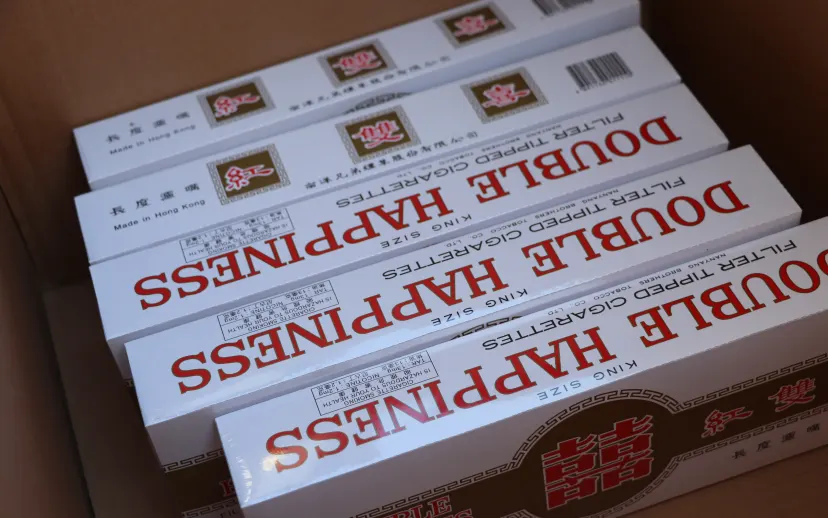
Black-market cigarettes sold in Auckland have even more harmful chemicals than regular smokes, including higher levels of uranium, RNZ has found.
RNZ has been investigating the illicit smokes, sold over the counter at prices well below retail value and without any of the health warnings or Quitline numbers required by law, for the past three months.
Without regulation, the quality of the tobacco is dubious, and lab testing has revealed the extent of the danger.
RNZ brought specialists at the University of Auckland three samples of cigarettes: a legitimate packet of Chesterfield Blue covered in the health warnings and Quitline information required by law; and two black-market smokes, a packet of Double Happiness and a packet of Hongtashan 1956 cigarettes.
By law, cigarettes have to include pictures and health warnings covering at least 75 percent of the front of the packs. But the cigarettes being sold on the black market are a throwback to the 1990s of glossy, embossed packaging and no ugly health warnings or images.
Organic and medicinal chemistry professor David Barker agreed to analyse the sample cigarettes.
“In the Double Happiness I was actually really surprised – there were lots of kind of unusual metals that you wouldn’t expect to find in plants,” he said.
“There was high levels of tin, indium, caesium and even uranium, which I was actually really surprised [by] – that wasn’t found in the other two cigarettes at all.”
“The [Hongtashan] had antimony, lead – we all know how bad lead is – and bismuth,” Barker said.
The Hongtashan had roughly 40 percent more lead than the legitimate smokes, 1013 micrograms per litre compared to 722.

Nick Monro
Hongtashan and Double Happiness both contained cadmium at levels up to 60 percent higher than the legitimate counterpart. The highly carcinogenic metal was found in virtually all smokes.
“It just shows that the soil that they were grown in wasn’t the cleanest soil,” Barker said.
Tobacco was known to absorb metals from the soil and could be used to extract metals when planted in contaminated fields, he said.
Double Happiness was also found to contain 90.8 micrograms of uranium per litre, more than double that of either of the other samples and more still than both of them combined.
That was particularly concerning for University of Canterbury emeritus professor of toxicology Ian Shaw.
“That’s the one that would give me some degree of worry,” he said.
“As you know, uranium is radioactive and it’s highly insoluble, and it forms a dust very easily.”
Shaw said if uranium was present in the cigarettes, those smoking them would be inhaling the uranium dust.
“It will sit in their lungs and it will sit there for a long time and all the time it’s sitting there it’s basically irradiating the cells,” he said.
Whether the uranium levels were significant compared with the carcinogens already in cigarette smoke was unclear.
More samples would be needed to determine just how much worse the black-market cigarettes were, Shaw said.
But he said the risks were already there when smoking cigarettes.
“Cadmium is carcinogenic, that’s well known as well, and when it gets into the lungs it will just sit there,” he said.
“It may get taken up by the lung cells and may exert its effects in the lungs but it’s not possible to know how much this increased concentration will increase the risk, except that it will increase the risk.”
At the University of Auckland’s Centre for Electron Microscopy and Material Science, researchers Catherine Hobbis and Mahyar Afshar Mohajer were able to identify the elemental make-up of the cigarettes by zooming into the tobacco leaves and analysing the material.
“We saw calcium, we saw potassium, and in the ash sample in particular we saw significant amounts of phosphorus as well,” Hobbis said.
“They’re all indicative of fertiliser and ground material.”
Supply concerns ministry
Both the black-market packs RNZ obtained were priced at a fraction of retail value, with one as cheap as $15.
Importing cigarettes without paying the excise duty is illegal, as is selling illicit smokes, and offenders can face a fine or prison time.
The Ministry of Health told RNZ it remained concerned about the supply of illicit tobacco and was working with partners across government on strengthening action to prevent the illicit tobacco trade.
Speaking to reporters on the government action group’s first sting, Health NZ’s Jo Pugh said their focus was on the community harm caused by illicit tobacco.
“Illicit tobacco is unregulated – we don’t know what materials are actually in the products that they’re selling – and it’s untaxed, and it’s sold at a much lower price,” she said.
“That really undermines those efforts that everyone is taking to reduce our smoking in this country as well.”
The action group seized $170,000 cash in addition to the black-market smokes.
It was estimated the 1.3 million cigarettes seized by the group represented more than $2 million in evaded tobacco excise.
rnz

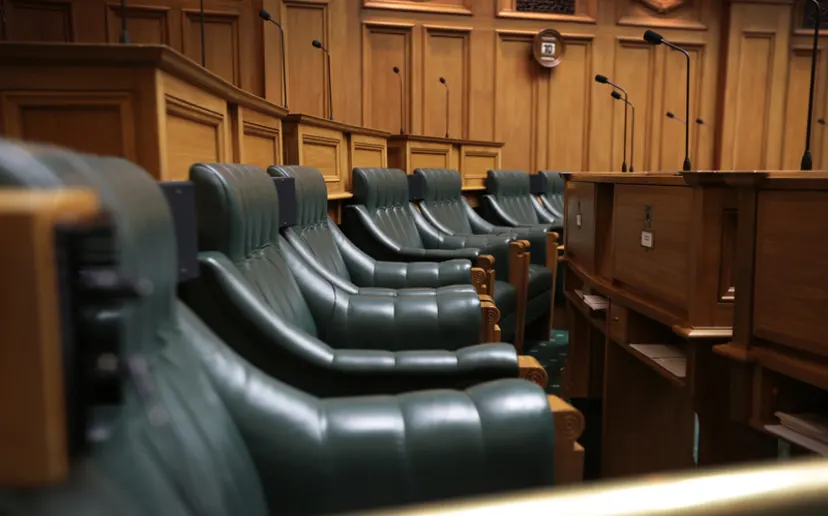
The chief executive of the Parliamentary Service is confident there will be enough room to accommodate the increased number of MPs and their staff coming into Parliament.
On current numbers, up to 131 MPs could be sitting in the Chamber following the election, brought on by a record overhang result.
Clerk of the House of Representatives Dr David Wilson told the Spinoff that currently the debating chamber had enough chairs to seat 124 MPs – including the Speaker of the House – and work was being done to accommodate more by altering the seating arrangement.
In a statement, Parliamentary Service chief executive Rafael Gonzalez-Montero said planning for a larger Parliament had been going for “some time”.
“Now that the election results have confirmed an increase to the number of members we are looking at several options.
“We are confident we will be able to accommodate all members within the Chamber.”
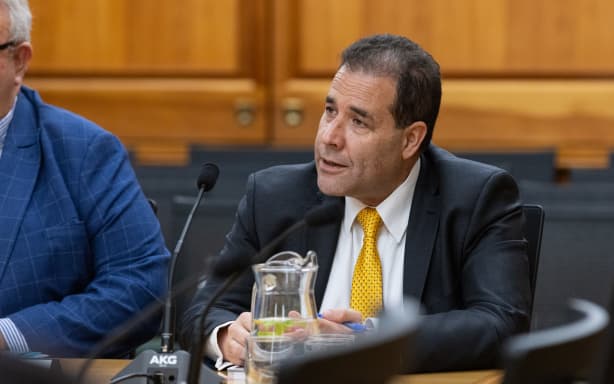
VNP / Phil Smith
Gonzalez-Montero said office accommodation for members and their staff would be “stretched” for a short time, but the new Members’ Building was only a few months away from “practical completion”.
That building – located behind Parliament – was due to be ready to occupy in April next year and had capacity to accommodate around 30 backbench MPs.
“All members should be in fit-for-purpose accommodation from that point,” Gonzalez-Montero said.
Following the 2023 election, 123 MPs sat in the Chamber – a record number at the time. That decreased to 122 following the resignation of National MP Judith Collins.
Collins held the seat of Papakura and stepped down in May and Parliament voted against holding a by-election because it was too close to the election.
The election result also meant high-ranking National Party MPs like Chris Bishop, Paul Goldsmith, Nicola Willis and Gerry Brownlee – Speaker of the House and an MP for 30 years – would likely not make it back into Parliament.
Only resigning or retiring MPs were permitted to give a valedictory speech meaning none of them would get the chance to give a valedictory statement.
Asked if their would be special allowances for valedictories, Wilson said in a statement that normally only MPs were allowed to speak in the House but the House could suspend its own rules or temporarily alter them.
“It could do so to allow former members to address the House.”
Wilson said no such arrangements could be made until the next Parliament opened and members sworn in.
rnz


Police say person who fired gun at officers still at large

New Zealand sides named for RLWC finals

Parliamentary Service working on extra chairs and offices for increased number of MPs


-

 Latest News2 months ago
‘Chilling’: Business groups speak out against National’s supermarket break-up plan
-

 NZ News2 months ago
Tom Phillips report: The missed opportunities to find the children
-

 Politics2 months ago
National vows to try to split Pak’nSave and New World
-

 Latest News2 months ago
Cars bearing Chinese police markings stir unease in Auckland
-

 Fiji News2 months ago
Plans to have new Constitution by Dec 24th 2026
-

 NZ News2 months ago
Cop who stole $68,000 can now be named as champion Muay Thai fighter Haimona Tamati-Te Paki
-

 Politics2 months ago
MBIE confirms botched biometric projects costs blown out to $50.7 million
-

 Latest News2 months ago
Five Karangahape Road venues lose their liquor licences after police intervention