Connect with us

HTML Image

i

Sports

Anzac Day Bledisloe Cup internationals confirmed for All Blacks

Published

on

New Zealand Rugby and Rugby Australia have confirmed three Anzac Day Bledisloe Cup test matches for 2027, 2029 and 2031, but none of the matches will be played in Aotearoa.

Suncorp Stadium in Brisbane will be the host for all three games, with the Queensland government providing support to get the games confirmed.

“Rugby Australia is an important partner for us, and a strong game in Australia is good for rugby in New Zealand,” New Zealand Rugby CEO Steve Lancaster said.

“Brisbane has long been seen as a home away from home with a large New Zealand population living there and we see this as a huge opportunity to work in partnership with Rugby Australia to grow the game in a key market,” he said.

Each Anzac Day test will form part of a three-test Bledisloe Cup series in 2027, 2029 and 2031, with the remaining two matches played as part of The Rugby Championship later each year, with New Zealand hosting one match, and Australia, the other.

In 2028 and 2030, the Bledisloe Cup will remain a two-match series, due to Nations Championship commitments.

The games will also add a new compement for Super Rugby Pacific, which will confirm its competition format from 2027 onward, in the coming weeks.

“The Anzac Day Bledisloe Test adds another key moment during the Super Rugby Pacific season as the early rounds will have the added element of selection intrigue ahead of this match,” Lancaster said.

“We’ve worked closely with our clubs to ensure it gives fans another compelling reason to engage with the competition across the season,” he said.

Rugby Australia CEO Phil Waugh was also looking forward to the Anzac Day games.

“The 123-year history of Australia and New Zealand rugby is renowned and revered across the globe and the first ever staging of an Anzac Day Bledisloe Cup Test will, we believe, create a new Trans-Tasman sporting tradition that will bring our nations together and reinforce our shared values,” he said.

“We are grateful to our friends at New Zealand Rugby for this partnership and, along with the Queensland government, we look forward to creating history together,” he said.

rnz

Continue Reading
Click to comment

Leave a Reply

Your email address will not be published. Required fields are marked *

Sports

A majority Māori and Pacific All Blacks squad shows how far rugby’s ‘greatest rivalry’ has come
Published

on

Analysis: This weekend’s first test between the New Zealand All Blacks and South African Springboks will be played 105 years after the two nations first began the “greatest rivalry” in rugby in 1921.

A great deal has changed in that time, including the composition of All Blacks teams and the players’ eligibility to tour the formerly apartheid republic.

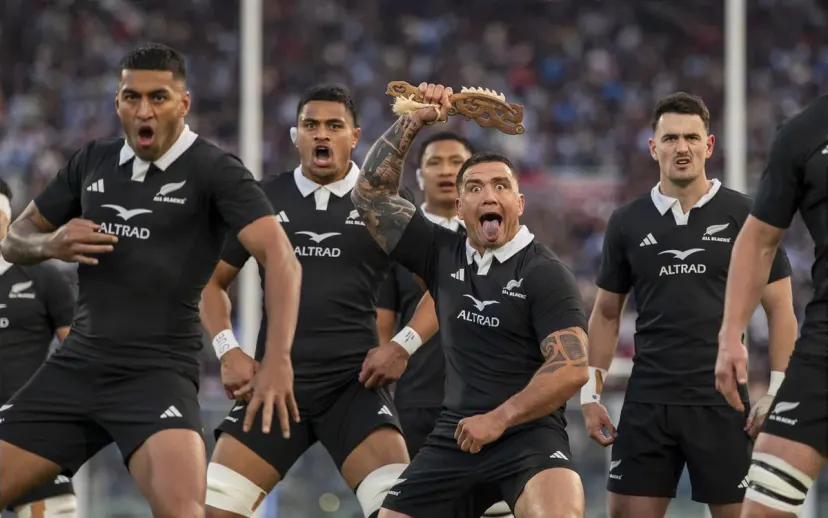
In 2026, well over half the squad of 44 have Māori or Pacific ethnic backgrounds.

That would have been impossible 66 years ago when the 1960 All Blacks team toured South Africa. In fact, only 18 of the current squad would have been able to travel back then.

Under the old republic’s “colour bar”, a majority of today’s squad – including the most recently capped All Black, Semisi Ta’eiloa (who is of Tongan descent) – would not have been eligible.

But that was precisely what happened from 1928 until 1970, a period when New Zealand rugby administrators accepted the touring conditions set down by a racist state.

‘No Māoris – No Tour’

After the historic 1921 series played in New Zealand ended in a draw, the All Blacks toured Britain, Ireland and France in 1924-25. They won every match and were dubbed “the Invincibles”.

Anticipation for the All Blacks’ first tour of South Africa in 1928 was high, not least because of a new superstar of the game, fullback George Nepia, who had become the face of the Invincibles aged just 19.

Nepia was All Black #295 – nearly 1000 All Black caps before Ta’eiloa at #1241 – and should have been part of the team to take on the Springboks. But, as his official All Blacks profile puts it:

Because he was of Māori ancestry he and another fine player, Jimmy Mill, were declared ineligible because of South Africa’s race prejudices.

This would create a significant gap in Nepia’s career record. Ultimately, as a leading anti-apartheid campaigner later wrote, it was because the then New Zealand Rugby Football Union “failed to confront South African racist political pressure”.

Despite growing unease and opposition, especially among Māori, the policy stayed in place for the All Blacks’ 1949 tour of South Africa (where they lost all four tests). By 1960, when the All Blacks were due to tour again, a genuine protest movement had emerged.

The Citizens’ All Black Tour Association raised one of the country’s largest ever petitions, collecting over 150,000 signatures under its banner of “No Māoris – No Tour”.

Regardless, and despite the Sharpeville massacre just two months earlier, the 1960 tour went ahead without any Māori players.

Progress and apology

South Africa was by now becoming a pariah state, and was banned from the Olympic Games from 1964 to 1988. The 1976 Olympics were boycotted by African countries in direct protest at the All Blacks tour of South Africa earlier that year, not long after the Soweto uprising that saw 176 protesting schoolchildren killed.

Things had shifted in New Zealand, too, albeit slowly. A proposed All Blacks tour of South Africa in 1967 had been abandoned because of the whites-only policy. A 1970 tour went ahead with brown players included – but only because they were exempted by South Africa as “honorary whites”.

Among the three non-white All Blacks was legendary winger Bryan Williams, the first player of Samoan heritage to tour South Africa. He toured again in 1976 – 50 years before Semisi Ta’eiloa followed in his bootsteps.

By 1981, however, playing rugby with apartheid South Africa had become deeply entwined in New Zealand’s domestic politics, culminating in protests and police action during the Springbok tour that tore the country apart.

Change and reconciliation was slow, but by the end of the next decade, Nelson Mandela had been released, apartheid had ended, and South Africa had hosted and won the 1995 Rugby World Cup.

In 2010, the New Zealand and South African rugby unions formally apologised for the exclusion of Māori players during the apartheid era. The New Zealand union also apologised more generally for the division rugby’s contact with South Africa had caused.

Equality and inclusion

With kickoff in the first test of the 2026 series approaching, the dominant narrative in New Zealand and South Africa has been one of anticipation and excitement after a 30-year gap since the last All Blacks tour in 1996.

At a sporting level, that’s understandable. Having lost the 1995 World Cup final to the Springboks, the All Blacks returned the next year and recorded their first ever series win on South African soil.

But there’s another narrative, too. Not only is this All Blacks squad filled with brown faces, Springboks captain Siya Kolisi is the first black player to hold that position. The story of how that happened is about more than rugby.

It’s important to remember that history, including the inconvenient truths that can all too often be glossed over with the passage of time.

And while we celebrate All Blacks past and present for their on-field endeavours, we can’t forget those who struggled off the field for equality and inclusion in sport and society – and who give rugby’s “greatest rivalry” even greater meaning.

The authors acknowledge the contribution to this article of distinguished professor Graham Hingangaroa Smith of Massey University.

*Jeremy Hapeta is an associate professor in Māori Sport, Physical Education and Oranga, School of Health Sciences at University of Canterbury, and Rochelle Stewart-Withers

a professor in Indigenous and International Development, Te Kunenga ki Pūrehuroa -at Massey University.

This story was originally published on The Conversation.

Source: RNZ

Continue Reading

Latest News

Big names back for All Blacks as team to play Springboks revealed

Published

on

The All Blacks have recalled several star players with Cam Roigard, Will Jordan and Damian McKenzie named to start in this weekend’s test against the Springboks in Johannesburg.

The trio return from injury to take their place in the side while Ardie Savea resumes the captaincy duties after being rested for the first three games of the South African tour.

Savea is at No.8 with coach Dave Rennie retaining the loose forward trio from last month’s win against Ireland, with Luke Jacobson at openside and Tupou Vaa’i at blindside.
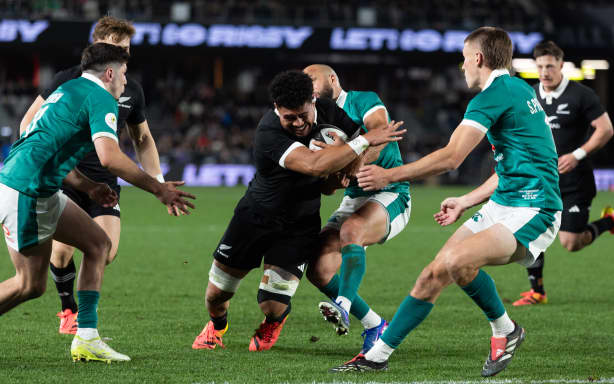
All Blacks captain Ardie Savea barges over for a try.
Ardie Savea scores a try against Ireland.

Brett Phibbs / www.photosport.nz

Codie Taylor is at hooker with Tyrel Lomax and Ethan de Groot the starting props.

There was plenty of speculation as to who would play lock and Rennie has gone with Fabian Holland and Josh Lord in the second row, with Vaa’i to provide cover.

In the backs, Roigard returns at halfback with Ruben Love at first-five and Jordie Barrett and Quinn Tupaea in the midfield.

McKenzie has overcome the ankle injury that ruled him out of the win over the Bulls last weekend and will start at fullback, with Jordan and Josh Moorby on the wings.

Rennie has gone with a 5-3 split of forwards and backs on the bench, which includes front rowers Asafo Aumua, George Bower and Fletcher Newell, loose forwards Peter Lakai and Anton Segner, midfielder Anton Lienert-Brown, halfback Kyle Preston and outside back Leroy Carter.
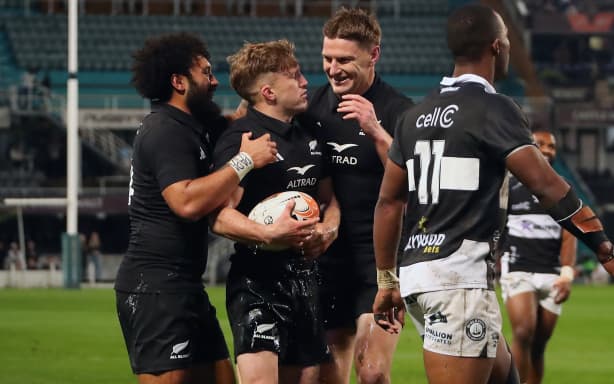
Damian McKenzie (C) scores a try which was disallowed as he celebrates with Jordie Barrett (R) and Fehi Fineanganofo (L).
Damian McKenzie celebrates a try with teammates.

Photosport

Rennie said they can’t wait to run out on Ellis Park on Sunday morning (NZT).

“After all the build up and anticipation, our whole touring squad is excited to get this first Test underway,” Rennie said.

“We have selected a balanced mix of big match, experienced players and younger players who have earned the right to play in this first Test.”

Rennie said the three games against the Stormers, Sharks and Bulls in South Africa have proved invaluable as they prepare for their biggest challenge of the year so far.

“The first three franchise games have exposed our newer players to the way South African teams play and have been fantastic in helping us build combinations and develop the game we want to play.

“We know the Test series will be a huge step up. We’re well aware of what the Springboks will bring to the contest and the pressure that will come to bear. They are number one in the world, playing at their spiritual home in front of their passionate fans, so we will have to be at our very best on Saturday.”
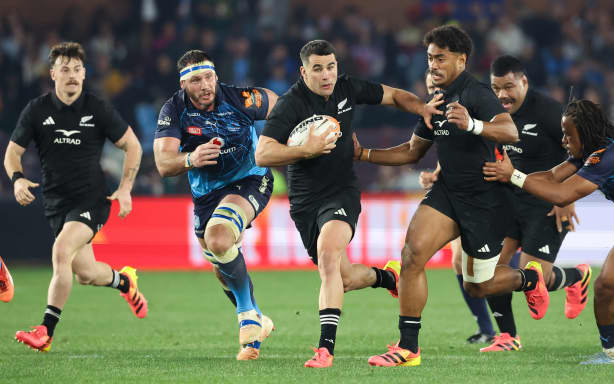
Josh Moorby makes a break against the Bulls.
Josh Moorby in action against the Bulls.

Photosport

Savea, Roigard and Jordan will make their first appearance of the tour in the match, while Savea and Taylor are playing their 110th Tests.

It will be Savea’s 18th Test against South Africa and Taylor’s 17th.

Segner and Moorby will be playing the Springboks for the first time.

Kick off is 3am NZT on Sunday morning at Ellis Park in Johannesburg.

All Blacks match-day 23 (Test caps in brackets) :

1. Ethan de Groot (43)

2. Codie Taylor (109)

3. Tyrel Lomax (51)

4. Josh Lord (15)

5. Fabian Holland (12)

6. Tupou Vaa’i (47)

7. Luke Jacobson (27)

8. Ardie Savea (109) – Captain

9. Cam Roigard (20)

10. Ruben Love (8)

11. Josh Moorby (2)

12. Jordie Barrett (81)

13. Quinn Tupaea (26)

14. Will Jordan (57)

15. Damian McKenzie (77)

16. Asafo Aumua (22)

17. George Bower (26)

18. Fletcher Newell (37)

19. Anton Segner (2)

20. Peter Lakai (10)

21. Kyle Preston (1)

22. Anton Lienert-Brown (90)

23. Leroy Carter (7)

RNZ

Continue Reading

Latest News

Codie Taylor to captain All Blacks for first time against Bulls

Published

on

Hooker Codie Taylor has been named All Blacks captain for the first time. He will lead the team in their third tour match in South Africa against the Bulls.

All Blacks head coach Dave Rennie is also handing Josh Jacomb the reins at first-five while Beauden Barrett drops to fullback.

Taylor returns from injury to captain the All Blacks in his 110th match and first of the tour.

Props Xavier Numia and Tyrel Lomax will also play their first matches of the tour.

Six players from the All Blacks team who beat the Sharks 54-0 on Tuesday are back up for the Bulls match, including lock Josh Lord, loose forward Wallace Sititi, halfbacks Kyle Preston and Cortez Ratima, midfielder Timoci Tavatavanawai and outside back Emoni Narawa.

The final hit-out before the first test against the Springboks, Rennie said this looms as an important game for the All Blacks.

“The Bulls have consistently been South Africa’s best franchise side, making the United Rugby Championship finals in four of the last five years. Loftus Versfeld is one of the most formidable rugby grounds in the world, so we are aware of the challenge in front of us and excited at what lies ahead.”

Rennie said Taylor was a natural leader of the squad and an easy pick for skipper.

“He is a top man and has done a great job leading this tour group. This is a proud moment for an All Blacks centurion who has made a massive contribution to this team.”

The All Blacks are playing at Loftus Versfeld Stadium in Pretoria. They have played there 16 times since 1928, including four games against the forerunner to the Bulls, Northern Transvaal, in 1949, 1960, 1970 and 1976.

The All Blacks won the first three games and lost the 1976 match 29-27.

Kick off is at 5am Sunday 16 August NZT.

All Blacks team to play the Bulls

1. Xavier Numia

2. Codie Taylor (Captain)

3. Tyrel Lomax

4. Fabian Holland

5. Patrick Tuipulotu

6. Simon Parker

7. Anton Segner

8. Peter Lakai

9. Cortez Ratima

10. Josh Jacomb

11. Josh Moorby

12. Anton Lienert-Brown

13. Rieko Ioane

14. Leroy Carter

15. Beauden Barrett

Bench

16.Samisoni Taukei’aho

17. George Bower

18. Siale Lauaki

19. Josh Lord

20. Wallace Sititi

21. Kyle Preston

22. Timoci Tavatavanawai

23. Emoni Narawa

rnz

Continue Reading

Trending

Copyright © 2026 The Buzz: Powered by Apna Network Limited - Concept by Digital Hub NZ