

Latest News
Budget 2026 could be a tough pill for those feeling the pinch

The increasing number of people counting every last dollar in their weekly family budget might have been hoping the coalition had some reprieve in store.
But the Finance Minister has been immovable in her belief that the best medicine for New Zealanders is getting the country back into surplus.
It’s a somewhat pointy-headed sweetener for voters in election year – an ‘eat your veges if you want dessert’ Budget that means having what’s good for you but not what you really want, and sometime in the future the good bit will arrive.
It’s a strategy that works for people who earn enough to cover the bills already, have savings, or can make ends meet if push comes to shove, but if you’re already living life on the breadline it’s a bitter pill to swallow.
For those people, it’s a strange Budget in what are for an increasing number of people the toughest of times.
There were significant spends in areas like defence (a sizeable $2.3 billion of capital and $1.2b in operating funding), the big headline was the books being back in the black a year earlier, and nearly half a billion dollars was put aside for fuel crisis-related spending – but ultimately the government decided not to allocate it.
In other words it’s a Budget that for low-income working households might not resonate, is focused on things they’re not thinking about day-to-day, and where there was money to be spent on a bit of extra cash in their backpockets or relief at the pump or on public transport, instead Willis said just hold fire.

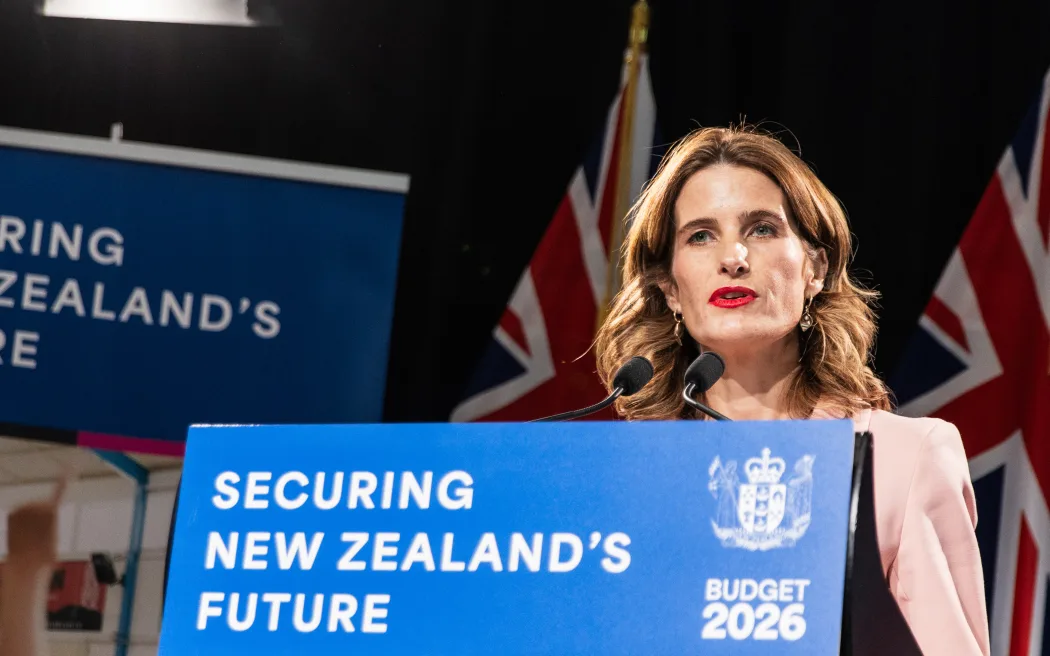
Minister of Finance Nicola Willis delivered her 2026 “Securing New Zealand’s Future” national Budget yesterday. Photo: RNZ / Samuel Rillstone
The rainy day fund may be spent before the election if the Iran conflict endures, or things get so bad politically the government – or specifically National – decide they need to spray the little ring-fenced bit of money they have to remind voters they haven’t forgotten them.
Willis has clearly weighed all this up and decided to back her fiscally responsible beliefs that this year, an election year, is the time to keep it simple and focus on the bigger picture down the track.
Her messaging was succinct and well-rehearsed in the Budget lock-up, the House, and her post-Budget interviews – that it was her “responsibility to be careful and prudent now to protect New Zealand’s future”.
Outside of the surplus forecast being due to arrive a year earlier, the big sell to New Zealanders was investment in core frontline services.
Health was the big winner on that front with a $5.8b boost, along with $682 million of capital investment.
Infrastructure also got its fair share, with the people of Waikato getting $1.8b for the Cambridge to Piarere expressway, and rail getting a decent lift to upgrade the network.
In an election year it may not be a Budget that will help National turn around the polls, but it creates problems for Labour too.
The security blanket of ‘let’s see what the Budget says’ is gone now for the Opposition, and the spotlight will shortly turn on Labour leader Chris Hipkins to reveal what his alternative government would do differently.
There are hard decisions to be made in a geopolitical climate as fraught and volatile as it is right now, and the pressure will now go on Labour to paint a picture of what it would do differently.
Criticising the government is easy; offering a fully-costed and feasible alternative won’t be.
rnz



The chief executive of the Parliamentary Service is confident there will be enough room to accommodate the increased number of MPs and their staff coming into Parliament.
On current numbers, up to 131 MPs could be sitting in the Chamber following the election, brought on by a record overhang result.
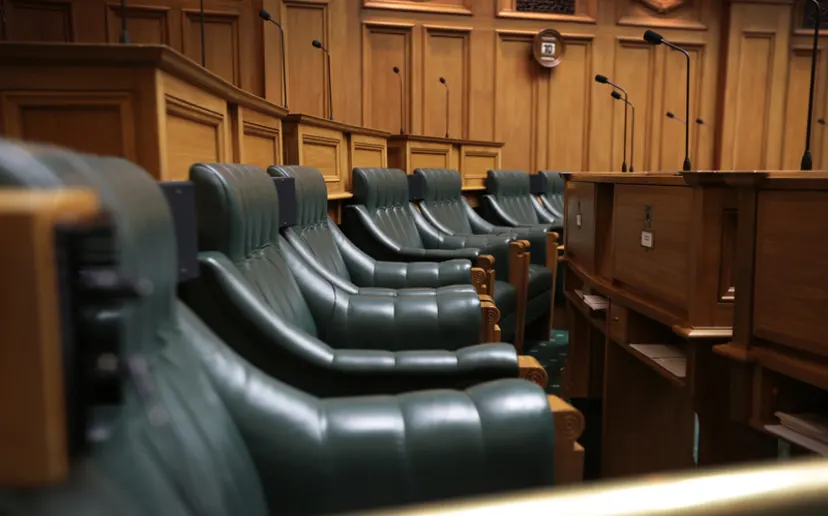
Clerk of the House of Representatives Dr David Wilson told the Spinoff that currently the debating chamber had enough chairs to seat 124 MPs – including the Speaker of the House – and work was being done to accommodate more by altering the seating arrangement.
In a statement, Parliamentary Service chief executive Rafael Gonzalez-Montero said planning for a larger Parliament had been going for “some time”.
“Now that the election results have confirmed an increase to the number of members we are looking at several options.
“We are confident we will be able to accommodate all members within the Chamber.”
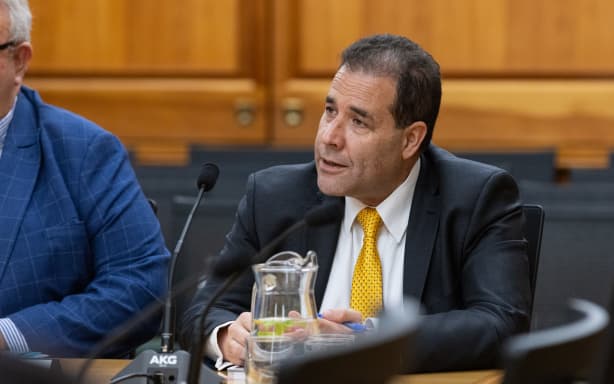
VNP / Phil Smith
Gonzalez-Montero said office accommodation for members and their staff would be “stretched” for a short time, but the new Members’ Building was only a few months away from “practical completion”.
That building – located behind Parliament – was due to be ready to occupy in April next year and had capacity to accommodate around 30 backbench MPs.
“All members should be in fit-for-purpose accommodation from that point,” Gonzalez-Montero said.
Following the 2023 election, 123 MPs sat in the Chamber – a record number at the time. That decreased to 122 following the resignation of National MP Judith Collins.
Collins held the seat of Papakura and stepped down in May and Parliament voted against holding a by-election because it was too close to the election.
The election result also meant high-ranking National Party MPs like Chris Bishop, Paul Goldsmith, Nicola Willis and Gerry Brownlee – Speaker of the House and an MP for 30 years – would likely not make it back into Parliament.
Only resigning or retiring MPs were permitted to give a valedictory speech meaning none of them would get the chance to give a valedictory statement.
Asked if their would be special allowances for valedictories, Wilson said in a statement that normally only MPs were allowed to speak in the House but the House could suspend its own rules or temporarily alter them.
“It could do so to allow former members to address the House.”
Wilson said no such arrangements could be made until the next Parliament opened and members sworn in.
rnz


Police say person who fired gun at officers still at large

New Zealand sides named for RLWC finals

Parliamentary Service working on extra chairs and offices for increased number of MPs


-

 Latest News2 months ago
‘Chilling’: Business groups speak out against National’s supermarket break-up plan
-

 NZ News2 months ago
Tom Phillips report: The missed opportunities to find the children
-

 Politics2 months ago
National vows to try to split Pak’nSave and New World
-

 Latest News2 months ago
Cars bearing Chinese police markings stir unease in Auckland
-

 Fiji News2 months ago
Plans to have new Constitution by Dec 24th 2026
-

 NZ News2 months ago
Cop who stole $68,000 can now be named as champion Muay Thai fighter Haimona Tamati-Te Paki
-

 Politics2 months ago
MBIE confirms botched biometric projects costs blown out to $50.7 million
-

 Latest News2 months ago
Five Karangahape Road venues lose their liquor licences after police intervention