

NZ News
Budget 2026 at a glance: The big changes, winners and losers – what you need to know

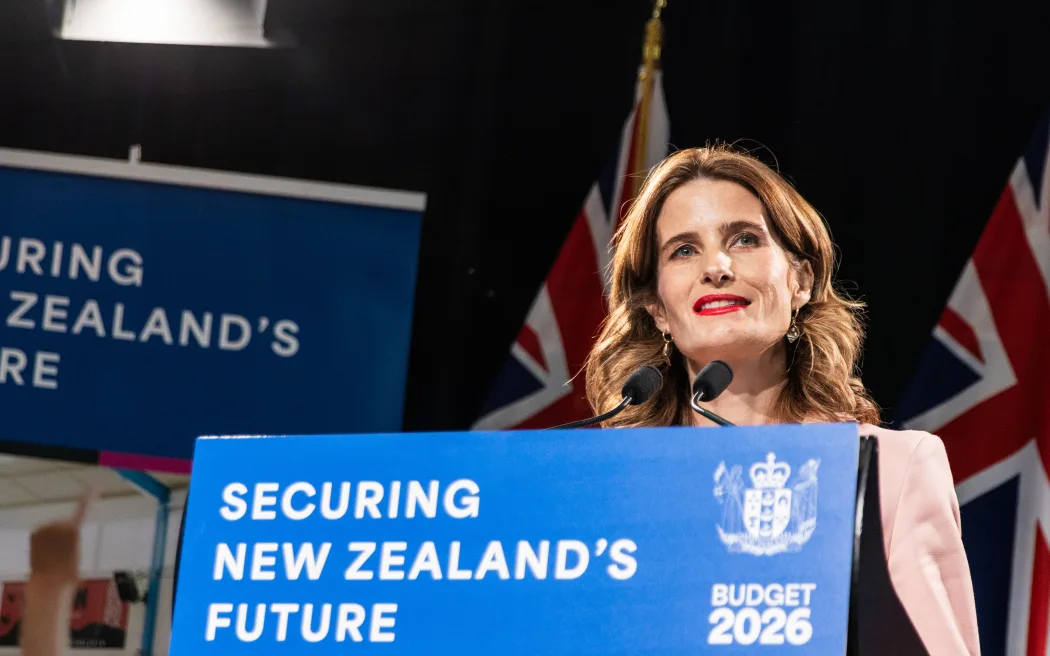
As promised, the Finance Minister has delivered a bread-and-butter Budget 2026, with few big surprises and no sign of a lolly scramble.
But there’s a health spend-up, a new highway, a levy on banks, cuts to government departments and hope of a surplus on the horizon.
Here’s what you need to know about this year’s Budget:
Not really an ‘election year budget’
Willis has used her last Budget of the term to preach discipline as she eyes a surplus on the horizon.
Thursday’s was a back-to-basics Budget, with very little in terms of headline-grabbing, vote winning plans.
Willis pushed back against the idea of election-year “band-aids and sugar hits” in favour of getting the books in order, adding it would have been easier for her to just try to bribe voters.

Nicola Willis. Photo: RNZ / Samuel Rillstone
The books
Treasury expects the government’s operating balance to get back into surplus in 2028-29, a year earlier than in December. If it happens, that would be first government surplus in a decade.
Treasury put this down to an increase in tax revenue, and a smaller budget than forecast. Willis says it’s disciplined economic management, with $3.8 billion of new spending offset by $1.7 billion in savings.
But with the Iran war looming large, there’s plenty of unknowns of the next year.
“Numbers can always change,” Willis warned in her speech.
Health gets a boost
Health is the big winner of the day, with $5.8 billion of new spending. That includes a $5.5 billion increase to frontline services over four years. In addition to the already-announced $15.5 million for paediatric palliative care, there is also $34 million for three-day postnatal stays, and $33 million to extend the eligibility for bowel screening to 56 years of age, from 58.
There’s no major increase in funding for primary care, which the sector has been calling for.
There’s another $680 million in capital spending for health infrastructure, including a new 158-bed ward at Whangarei Hospital, work at Tauranga, Hawke’s Bay, and Palmerston North, and the buying land for the new Drury hospital.
Another $930 million will go towards new clinical equipment, tech upgrades, and facility improvements nationwide.

Chris Bishop Photo: RNZ / Mark Papalii
Waikato Expressway extension and trains
Transport Minister Chris Bishop has announced $1.77 billion will spent on extending the four-lane Waikato Expressway (SH1) 16 kilometres from Cambridge to Piarere Road.
“This project has been talked about for years. Now we’re getting on with it,” Bishop said.
The government is also putting $1.075 billion into KiwiRail’s network from 2027-2030 and $107m into rail upgrades in cities.
Ministry cuts confirmed, sort of
As earlier signalled, most government ministries and departments will have to trim their budgets by 2 per cent in 2026, followed by two rounds of 5 per cent cuts in the following years, for a total reduction in funding of about 12% from where they are now. While the Budget lays out exactly how much money that is for each agencies and confirms which are included, it’ll be up to agencies themselves to find where to cut.
“Most agencies have delivered baseline savings of 2 per cent from 2026-27 through reducing back-office staff and contractors and consultants, and scaling of lower-value programmes,” the documents say.
Oranga Tamariki, law and order, health, education and defence and intelligence agencies are exempt. Foreign Affairs has dodged this year’s cut, but is still officially on the list for two bigger cuts to come – a point of contention between the Finance Minister and Foreign Affairs Minister Winston Peters.
A tight year for education
The Budget increases school operations grants and early childhood funding, but freezes most tertiary subsidies.
Operation grants will increase 2 percent next year while early childhood subsidies rise 1.5 percent from July, six months earlier than normal.
In tertiary education the Budget provides a two percent increase to subsidies only for tertiary foundation courses but also has $284-million to subsidise more student places this year and next.

Photo: RNZ/Liam K. Swiggs
The government is introducing new school curriculums and a new secondary school qualification and the Budget allocates about $240-million for that work, including teacher training and resources. It also provides $69-million over four years to double the number of secondary school students attending Trades Academies to 20,000 by 2030.
The Budget shows that axing the fees-free scheme would save $1-billion over four years.
Defence gets a boost
This year’s Budget includes an extra $2.3b in capital spending and $1.2b operating funding for the Defence Force spread across staffing, frigates, facilities, aircraft and other resilience measures in the Pacific.
A council building incentive
An ‘Incentives for Growth Fund’ of $400 million over four years has been announced for councils that build more homes.
Put broadly, councils that consent more homes will be given money out of the fund to pay for infrastructures such as roads and pipes for new suburbs.

Photo: RNZ / Samuel Rillstone
A levy on banks
The government expects to collect just over $200m over four years from banks, insurers and other finance industry companies from a new levy intended to cover the costs of services provided by the Reserve Bank.
An emergency account
$450 million has been set aside as a ‘rainy day fund’ for fuel-related issues that might crop up. That’s in addition to the already-announced temporary increase to mileage rates for care and support workers and $150 million for strategic reserves. FENZ, Corrections, Police, Customs, and Education get additional funding to keep frontline operations going in the face of sustained fuel price increases.
SuperGold card being upgraded
The SuperGold card will soon be able to be used as an official form of ID. The government has thrown $43m into allowing pensioners upgrade their cards to a new version, which be able to be used instead of drivers’ licences or passport.
Source: RNZ



Latest News
Opportunities to mitigate multi-million-dollar RNZ budget blowout likely missed – experts

Multiple opportunities to identify and mitigate a multi-million-dollar budget blowout at RNZ appear have been missed, according to the former executive director at Audit New Zealand.
The public broadcaster on Monday revealed a near $12 million shock financial loss after a litany of financial blunders, which will now lead to sweeping job cuts.
The $11.8m loss is more than 25 times the $470,000 RNZ had expected to lose over the year to June.
CEO Paul Thompson took responsibility for the result, and said internal reports gave an inaccurate picture of the finances, meaning the scale of the loss only became clear in October.
RNZ’s former chief financial officer Hilary Parker resigned unexpectedly in early October.
The board said it would commission an independent review into what went wrong.
Independent contractor Stephen Walker, who left the Audit Office earlier this year, said the size of the loss was surprising, as was the length of time it took to identify it – months after the financial year ended.

Supplied / OAG
“Probably more of a concern is that they had seemingly been unaware that they were running up a significant deficit until they were in the preparation stage of their annual report in October.”
Walker said public entities typically produced monthly financial reports.
An interim audit also took place before the end of the financial year, he said, but if the organisation hadn’t identified significant losses at that stage, the auditor could also be in the dark.
“It seems that there’s a real weakness in forecasting and budgeting that’s occurred here and that the monthly accounts, when they’re produced, either haven’t identified these significant variances against budget or the magnitude of them really hasn’t come to light until right towards the end of the financial year,” Walker said.
“And really at that point, there’s no opportunity for the chief executive, the leadership team to take, and the board to take, any corrective action because the year has effectively been completed.”
Walker said the “significant miss” was difficult to account for given it was more than 10 percent of RNZ’s total funding.
He said based on RNZ’s annual report, financial complexity didn’t appear to be a factor.
“This $11.8m loss isn’t made up of one particular item … it seems to have been contributed to by a number of separate expense lines running over budget. So I don’t think it’s necessarily to do with complexity.”
Among the errors, RNZ wrongly counted $2m from land sales as income in its budget. Staff costs also came in $3.2m over budget, including $1.4m in redundancy payments.
Professor at Auckland University’s business school Norman Wong said based on media reports the issues identified were “significant and troubling”.

Supplied / University of Auckland
“But recognising the sale of land as income in their budget is a basic error that one would have expected to have been caught and corrected well before it got to this point.”
With funding reductions at RNZ over the past two years, Walker expected greater scrutiny of financial results.
“Virtually every public entity has had their annual budget reduced. And so you would expect … the leadership team on a monthly basis and board – I’m not sure how frequently the board will consider the information – but you would expect them to be interrogating the results on a regular basis throughout the year,” he said.
Walker said initiating an independent review was the correct course of action and that he’d want to understand what information the leadership team and the board were regularly receiving.
He said he’d “love to say” surprising financial results were rare, but conceded they occured on a semi-frequent basis during his time leading the Audit Office.
“The benefit of independent scrutiny by the Audit Office – and the auditors providing that support to the Auditor General – [is] that the reporting is fairly presented at the end of the year, whether it’s good, bad or ugly.”
rnz


Police say person who fired gun at officers still at large

New Zealand sides named for RLWC finals

Parliamentary Service working on extra chairs and offices for increased number of MPs


-

 Latest News2 months ago
‘Chilling’: Business groups speak out against National’s supermarket break-up plan
-

 NZ News2 months ago
Tom Phillips report: The missed opportunities to find the children
-

 Politics2 months ago
National vows to try to split Pak’nSave and New World
-

 Latest News2 months ago
Cars bearing Chinese police markings stir unease in Auckland
-

 Fiji News2 months ago
Plans to have new Constitution by Dec 24th 2026
-

 NZ News2 months ago
Cop who stole $68,000 can now be named as champion Muay Thai fighter Haimona Tamati-Te Paki
-

 Politics2 months ago
MBIE confirms botched biometric projects costs blown out to $50.7 million
-

 Latest News2 months ago
Five Karangahape Road venues lose their liquor licences after police intervention