

Latest News
Retailers, truckers back government’s simplified fuel rationing, Labour unconvinced

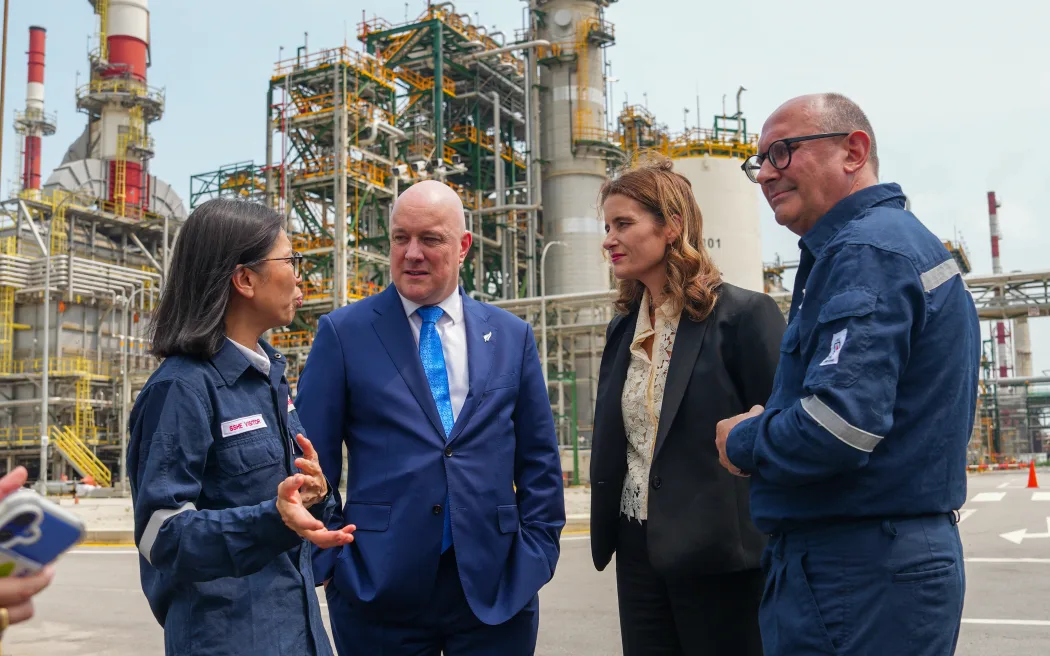
Retailers and truckers back the government’s more simplified, high-trust fuel rationing system, but Labour says it is simply not credible.
Prime Minister Christopher Luxon, Finance Minister Nicola Willis and Fuel Security Minister Shane Jones unveiled what happens at the higher-level Phases Three and Four of the national fuel plan on Monday.
Where the earlier approach had rationing at both levels, the updated plan would have Phase Three focus on voluntary limiting of supply, with additional diesel reserves able to be released.
Rationing would be limited Phase Four – the highest level – with sectors qualifying for different levels of usage depending on sector.
Critical users would face no limitations, while the next level down – food and freight – would need to come up with plans on how to reduce usage.
Road Carriers Association chief executive Justin Tighe-Umbers told RNZ that would carry some complexity – with fuel use being quite seasonal in some industries – but overall would be “fairly straightforward”.

Road Carriers Association chief executive Justin Tighe-Umbers. Photo: Supplied / Road Carriers Association
“A fuel plan for a freight operator, if we did enter Phase Four, would be to look at their fuel consumption over the last 12 months, and the government would give a tasking on that fuel consumption.
“So depending on what the situation was, they might say right there’s a 10 percent reduction on your fuel use, you now need to move to a model where you’re using 10 percent less fuel.
“Yes, there’s work involved, but it should be fairly straightforward.”
It was an improvement over the government’s earlier plan.
“It was overly complicated,” he said. “If you’ve got a food manufacturer who on a processing plant needs a part delivered, is that part considered essential freight? Is it part of an operator who’s allowed to deliver essential freight? How does that actually work?”
He noted if New Zealand reached Phase 4, diesel prices would be expected to be very high – which would curb demand.
Under the third category, which includes retail, companies and community groups would also develop plans but with bigger reductions.
Retail NZ chief executive Carolyn Young had previously called for food to be at the highest priority, but was not disappointed with the changes.

Retail NZ chief executive Carolyn Young Photo: Supplied
She said freight and food being in the higher priority would help those relying on their supply chains – and agreed the new system was an improvement.
“I think it would be fair to say that hospitals, ambulances, fire service, police – they are in a different category.
“Freight and food … we know that everyone needs to buy groceries … and to eat to be able to survive. So it’s not that you’re not going to get groceries delivered across the country, but there might be, you know, maybe there’s one less variety on the shelves or something.
“We don’t want to bring the whole country to a halt and for families that have got children that are growing and they’ve got needs – new clothes or you’ve got to get a heater for the house or whatever it might be – you want to know that you can go and get those products.
“If those businesses [are] not allowed to have freight going to their sites, it will mean that, you know, the public will start to panic.”
Labour leader Chris Hipkins said the plan was “simply not credible”.
“Their fuel plan amounts to: do nothing; do nothing; do not very much; panic,” he said.
“I think the bones of it are there, but the idea that it’ll just run on goodwill without really clear detail about how it’s supposed to operate is just very naive.
“Families are having to make some really tough choices between going to the supermarket or going to the petrol station, and this government’s message is very clear to those families: you’re on your own.”

Labour leader Chris Hipkins. Photo: RNZ / Mark Papalii
He refused to say what Labour would do differently, saying the plan was “what this government is supposed to have been working through, and they don’t seem to have answers”.
Tighe-Umbers, however, had high hopes a self-managed approach could work.
“If we’ve got to Phase Four, Kiwis have shown that we’re good at pulling together and doing the right thing in those times – you only have to look at our response in the Christchurch earthquake and responses to cyclones.”
He contrasted that with the Covid-19 response, which he said tried to control things to a high degree.
“Fuel station workers or transport operators to actually be involved in policing, that’s never a good move … we learned it’s actually very difficult and just introduces a whole lot of complexity.
“If there was a lot of people or operators not doing the right thing, then government would have to get more aggressive … but I think this is the right approach to start with.”
Young was not so sure.
“I’m not sure how cohesive we are as a community at the moment, and whether we consider each other or we’re just considering ourselves,” she said.
“That would be the caution I would have around whether we would really legitimately pull together as a community and say ‘yep, for the better, this is what I’ll do, and I’m going to comply to all of these things’, knowing that it’s not necessarily going to be enforced.
“I guess as long as everyone’s playing by the rules, then we’re all good with it, and it will just be a matter of making sure that there is really clear direction given to businesses and households.”
Regardless, Hipkins said agreed Phase Four was unlikely to be needed.

Finance Minister Nicola Willis said the probability of moving to Phase Four was low. Photo: RNZ / Mark Papalii
Willis on Monday pointed to the government’s modelling showing the probability of moving to Phase Four was in the single digits.
She indicated the measures imposed by Phase Three – which could include releasing some of the 90 million litres of reserve diesel set to be held at Marsden Point by the end of June – would ideally preclude the need to move to Phase Four.
“In just about all of the scenarios that they mapped out, they said actually with your additional reserve and your minimum stockholding obligation and a bit of fuel restraint you should be covered.”
Willis said the government was open to releasing the modelling publicly.
Luxon said with the Southeast Asian refineries that supplied New Zealand having secured supplies of crude through July and August, further reductions were not expected.
“We should know many weeks in advance of any increased likelihood of New Zealand bound orders or shipments being disrupted.”
RNZ



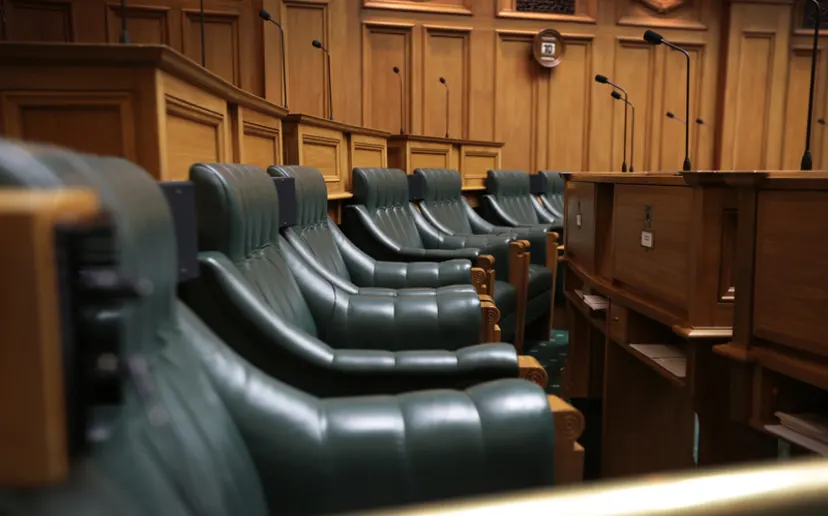
The chief executive of the Parliamentary Service is confident there will be enough room to accommodate the increased number of MPs and their staff coming into Parliament.
On current numbers, up to 131 MPs could be sitting in the Chamber following the election, brought on by a record overhang result.
Clerk of the House of Representatives Dr David Wilson told the Spinoff that currently the debating chamber had enough chairs to seat 124 MPs – including the Speaker of the House – and work was being done to accommodate more by altering the seating arrangement.
In a statement, Parliamentary Service chief executive Rafael Gonzalez-Montero said planning for a larger Parliament had been going for “some time”.
“Now that the election results have confirmed an increase to the number of members we are looking at several options.
“We are confident we will be able to accommodate all members within the Chamber.”
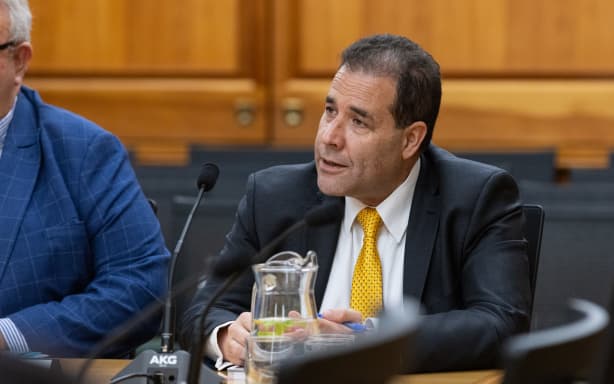
VNP / Phil Smith
Gonzalez-Montero said office accommodation for members and their staff would be “stretched” for a short time, but the new Members’ Building was only a few months away from “practical completion”.
That building – located behind Parliament – was due to be ready to occupy in April next year and had capacity to accommodate around 30 backbench MPs.
“All members should be in fit-for-purpose accommodation from that point,” Gonzalez-Montero said.
Following the 2023 election, 123 MPs sat in the Chamber – a record number at the time. That decreased to 122 following the resignation of National MP Judith Collins.
Collins held the seat of Papakura and stepped down in May and Parliament voted against holding a by-election because it was too close to the election.
The election result also meant high-ranking National Party MPs like Chris Bishop, Paul Goldsmith, Nicola Willis and Gerry Brownlee – Speaker of the House and an MP for 30 years – would likely not make it back into Parliament.
Only resigning or retiring MPs were permitted to give a valedictory speech meaning none of them would get the chance to give a valedictory statement.
Asked if their would be special allowances for valedictories, Wilson said in a statement that normally only MPs were allowed to speak in the House but the House could suspend its own rules or temporarily alter them.
“It could do so to allow former members to address the House.”
Wilson said no such arrangements could be made until the next Parliament opened and members sworn in.
rnz


Police say person who fired gun at officers still at large

New Zealand sides named for RLWC finals

Parliamentary Service working on extra chairs and offices for increased number of MPs


-

 Latest News2 months ago
‘Chilling’: Business groups speak out against National’s supermarket break-up plan
-

 NZ News2 months ago
Tom Phillips report: The missed opportunities to find the children
-

 Latest News2 months ago
Cars bearing Chinese police markings stir unease in Auckland
-

 Politics2 months ago
National vows to try to split Pak’nSave and New World
-

 Fiji News2 months ago
Plans to have new Constitution by Dec 24th 2026
-

 Politics2 months ago
MBIE confirms botched biometric projects costs blown out to $50.7 million
-

 NZ News2 months ago
Cop who stole $68,000 can now be named as champion Muay Thai fighter Haimona Tamati-Te Paki
-

 Latest News2 months ago
Five Karangahape Road venues lose their liquor licences after police intervention