

Latest News
The NZ Census guided vital economic and social planning. What happens now it’s gone?


The old New Zealand Census – first conducted in 1851 – is to be no more.
In its place will be a new and largely untried system that could potentially undermine the statistical basis of crucial social and economic policy making and planning.
In our view, these major changes are being made prematurely, without the level of expert independent scrutiny such sweeping reform demands.
The Data and Statistics (Census) Amendment Bill and the Electoral (District Boundaries) Amendment Bill are currently before Parliament, with select committee submissions having just closed.
The bills propose to replace New Zealand’s internationally accepted, five-yearly, field-based census of all households with incomplete administrative data collected for other purposes by government departments and agencies.

A person fills out the 2023 Census. Photo: Stats NZ
This administrative data will be augmented by a new Census Attributes Survey. Over a period of several years, the survey will sample 3-5 percent of the population. The information from those surveyed will be added to existing administrative data.
The replacement system will not be a census in the true sense. Nor will it meet the accepted international definition of “official statistics“.
Before these bills become law, we argue there should be an independent review through the relevant Parliamentary committee. This should involve a panel of international and local experts reassessing the proposal and the suitability of its statistical methodology.
An unprecedented change
StatsNZ appointed a percent22 percent22 Future Census Independent Evaluation Panel in 2024. But this meant the panel was not independent of StatsNZ itself, and it was only permitted to consider five options specified by StatsNZ.
All five options required the traditional field-based census be replaced in whole or part, possibly with a supplementary sample survey, so that administrative data is the primary data source.
In its report to StatsNZ, the panel nevertheless made useful suggestions and 83 recommendations. It did not consider in any detail the statistical methodology needed to move to an administrative and sample-survey database system.
Before being implemented, methodological developments in official statistics are typically researched, then externally peer-reviewed, published and debated internationally.
Although StatsNZ has produced a series of reports on replacing the field-based census, methodological and implementation information remain incomplete.
Ideally, StatsNZ would release details of the relevant methodological research for public scrutiny and international expert assessment, and clarify how it plans to meet its tight implementation timelines.

A field-based census can provide accurate information for the variables collected for any sized group, no matter how small. Photo: 2023 Census, Stats NZ
Missing data and modelling
A field-based census can provide accurate information for the variables collected for any sized group, no matter how small (with data release subject to confidentiality of personal information).
The composite administrative database being proposed would contain substantially less real information. Using such a database instead of a census is unprecedented internationally.
Combining databases into a composite is not a simple task either. It would rely heavily on the accuracy, reliability, completeness and availability of the data used, and the ability to link individuals’ records across the different databases.
A composite database may also be inaccurate and unreliable. Different components will be updated at different times, so even total counts of people – for example, within electorates – may not be sufficiently accurate.
This has the potential to raise human rights issues because accurate headcounts are needed to set fair electoral boundaries.
Where data is missing, it will almost certainly require an extension of existing statistical modelling methods. Missing data will be replaced by “synthetic” values generated by statistical models. These are not real data.
There will be limits to the minimum number of people from which accurate information can be gained. Relying only on the Census Attributes Survey for sound statistics on subgroups, such as age or ethnic groups within electorates or local authority territories, is not feasible.
The data necessary for calculating the New Zealand index of socioeconomic deprivation – core information for planning since 1991 – will also not be available from the administrative database.
Costs and risks
Not all governments use a field-based census. In Scandinavian countries, for example, there is a full population register available to ensure accuracy of population statistics.
But there is no such register in New Zealand. Abandoning a field-based census will inevitably mean losing detailed local and community information.
It may be claimed that StatsNZ’s Integrated Data Infrastructure (IDI) – “a large research database containing de-identified microdata on people and households” – is similar to a population register.
But this is a circular argument: the current backbone of the IDI is the conventional field-based census.
The traditional census may be considered expensive, which was a reason the government gave for ending the field-based approach. And there have clearly been problems with data quality and proper process that led to the resignations of two government statisticians in 2019 and 2025.
But the cost of a field-based census needs to be balanced against the risks and costs of making major long-term economic, social and health decisions using insufficiently detailed data.
Any future system will need to be led by a government statistician with considerable international experience, supported by the local expertise contained within StatsNZ’s technical and field staff.
Losing sound economic, social and health planning information can have considerable and unexpected implications. But that is the risk if the Data and Statistics (Census) Amendment Bill and the Electoral (District Boundaries) Amendment Bill become law.
rnz



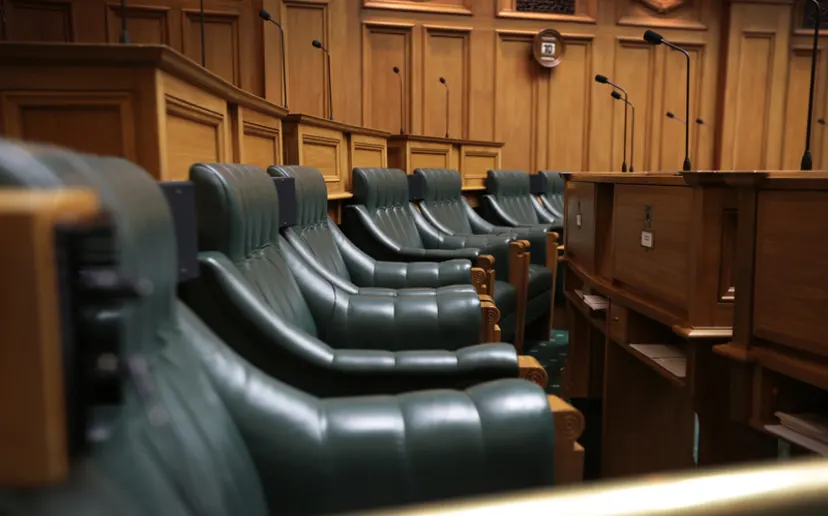
The chief executive of the Parliamentary Service is confident there will be enough room to accommodate the increased number of MPs and their staff coming into Parliament.
On current numbers, up to 131 MPs could be sitting in the Chamber following the election, brought on by a record overhang result.
Clerk of the House of Representatives Dr David Wilson told the Spinoff that currently the debating chamber had enough chairs to seat 124 MPs – including the Speaker of the House – and work was being done to accommodate more by altering the seating arrangement.
In a statement, Parliamentary Service chief executive Rafael Gonzalez-Montero said planning for a larger Parliament had been going for “some time”.
“Now that the election results have confirmed an increase to the number of members we are looking at several options.
“We are confident we will be able to accommodate all members within the Chamber.”
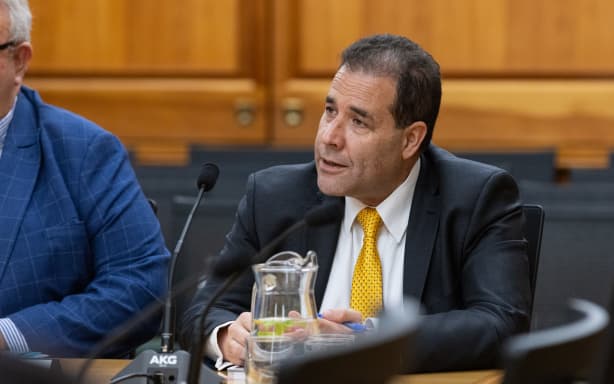
VNP / Phil Smith
Gonzalez-Montero said office accommodation for members and their staff would be “stretched” for a short time, but the new Members’ Building was only a few months away from “practical completion”.
That building – located behind Parliament – was due to be ready to occupy in April next year and had capacity to accommodate around 30 backbench MPs.
“All members should be in fit-for-purpose accommodation from that point,” Gonzalez-Montero said.
Following the 2023 election, 123 MPs sat in the Chamber – a record number at the time. That decreased to 122 following the resignation of National MP Judith Collins.
Collins held the seat of Papakura and stepped down in May and Parliament voted against holding a by-election because it was too close to the election.
The election result also meant high-ranking National Party MPs like Chris Bishop, Paul Goldsmith, Nicola Willis and Gerry Brownlee – Speaker of the House and an MP for 30 years – would likely not make it back into Parliament.
Only resigning or retiring MPs were permitted to give a valedictory speech meaning none of them would get the chance to give a valedictory statement.
Asked if their would be special allowances for valedictories, Wilson said in a statement that normally only MPs were allowed to speak in the House but the House could suspend its own rules or temporarily alter them.
“It could do so to allow former members to address the House.”
Wilson said no such arrangements could be made until the next Parliament opened and members sworn in.
rnz


Police say person who fired gun at officers still at large

New Zealand sides named for RLWC finals

Parliamentary Service working on extra chairs and offices for increased number of MPs


-

 Latest News2 months ago
‘Chilling’: Business groups speak out against National’s supermarket break-up plan
-

 NZ News2 months ago
Tom Phillips report: The missed opportunities to find the children
-

 Politics2 months ago
National vows to try to split Pak’nSave and New World
-

 Latest News2 months ago
Cars bearing Chinese police markings stir unease in Auckland
-

 Fiji News2 months ago
Plans to have new Constitution by Dec 24th 2026
-

 NZ News2 months ago
Cop who stole $68,000 can now be named as champion Muay Thai fighter Haimona Tamati-Te Paki
-

 Politics2 months ago
MBIE confirms botched biometric projects costs blown out to $50.7 million
-

 Latest News2 months ago
Five Karangahape Road venues lose their liquor licences after police intervention