

World
Trump orders US Navy to block Hormuz Strait after Iran talks fail

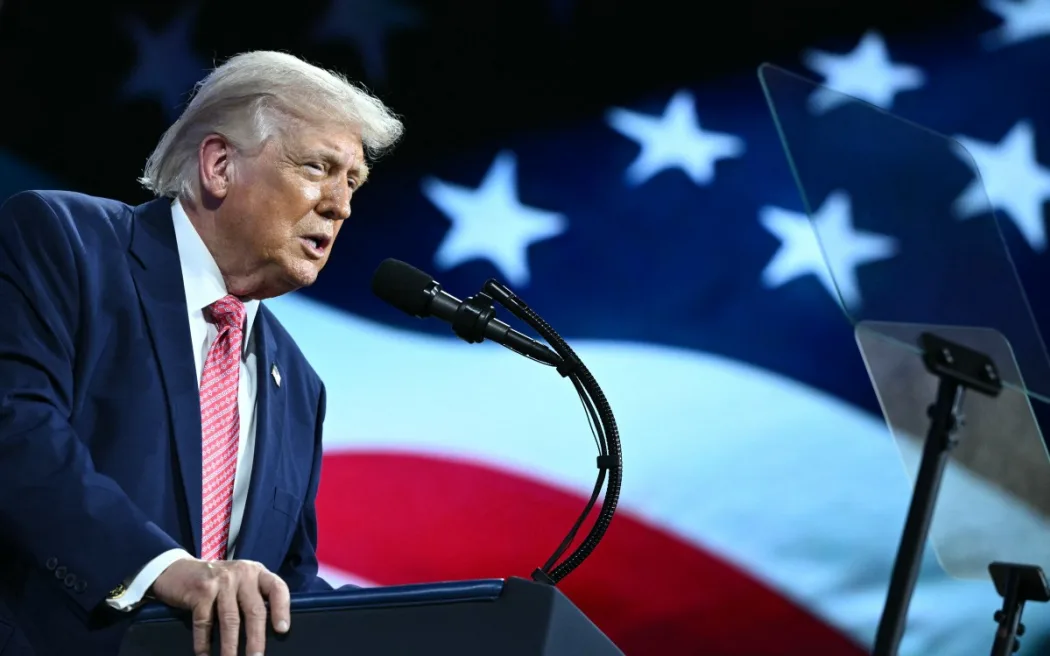
President Donald Trump has ordered the US Navy to block the crucial Strait of Hormuz shipping lane, furious with Iran’s refusal to surrender its nuclear ambitions after peace talks in Pakistan broke down without an agreement.
In response to Trump’s announcement, Iran’s Revolutionary Guards warned they had traffic in the strategic waterway under their full control and would trap any enemy who tried to challenge it “in a deadly vortex”.
In a lengthy declaration on his social media platform on Sunday (local time), Trump said his eventual goal was to clear the strait of mines and reopen it to all shipping, but that in the meantime Iran must not be allowed to profit from its control of the waterway.
“Effective immediately, the United States Navy, the Finest in the World, will begin the process of BLOCKADING any and all Ships trying to enter, or leave, the Strait of Hormuz,” Trump said. “Any Iranian who fires at us, or at peaceful vessels, will be BLOWN TO HELL!”
Iran has itself been restricting traffic through the strait – a key route for global shipments of oil, gas and fertiliser – while allowing vessels deemed to be working for friendly countries, such as China, to pass. There have been unconfirmed reports that Tehran plans to charge tolls.
“THIS IS WORLD EXTORTION,” Trump said. “I have also instructed our Navy to seek and interdict every vessel in International Waters that has paid a toll to Iran. No one who pays an illegal toll will have safe passage on the high seas. We will also begin destroying the mines the Iranians laid in the Straits.”
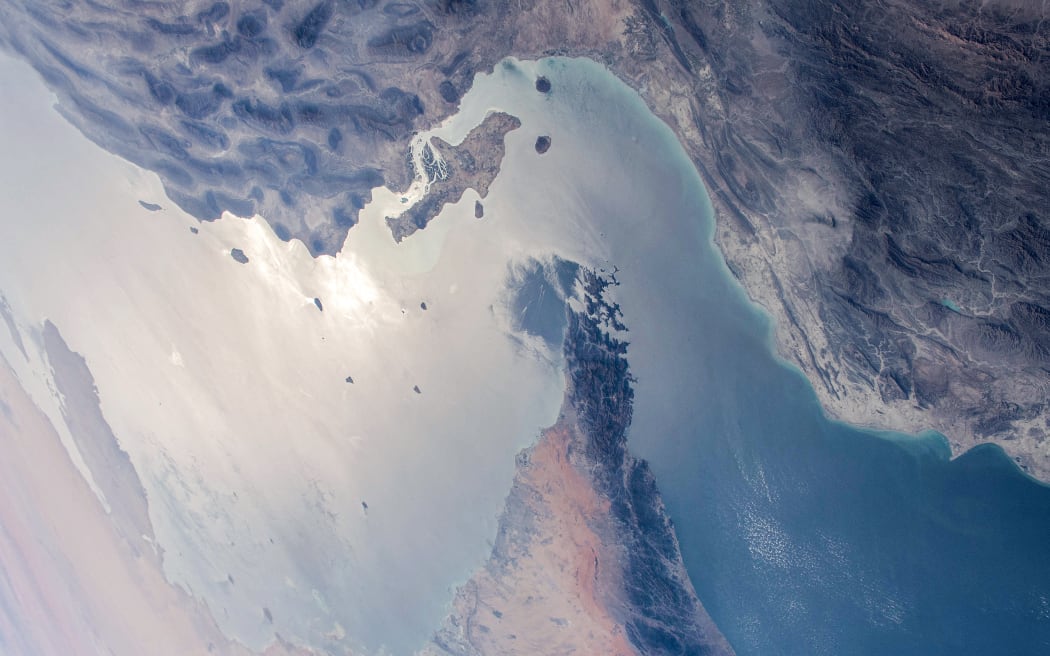
The crucial Strait of Hormuz shipping lane. Photo: AFP PHOTO /NASA/HANDOUT
The US military had said Saturday that two Navy warships transited through the strait to begin clearing it of mines and ensure it was a “safe pathway” for tankers, a claim denied by Tehran.
Iran’s Fars news agency reported on Sunday that two Pakistani-flagged oil tankers heading for the strait had turned around.
Fears of renewed fighting rattled an already tense region after the US-Iran talks collapsed.
“I am worried about the continuation of the situation and the return of attacks again,” said Imam, an Egyptian housewife living in UAE capital Abu Dhabi.
“I was making a great effort not to pass my tension on to the children.”
‘Act of extortion’
Trump later in a Fox News interview again threatened Iran’s energy infrastructure, before warning he would impose a 50 percent tariff on Chinese imports if Beijing tried to help the Iranian military.
“I could take out Iran in one day. I could have their entire energy everything, every one of their plants, their electric generating plants, which is a big deal,” he said.
The president’s latest ultimatum appeared to have been triggered by the failure of talks to secure a deal to end the six-week-old war, which began when the US and Israel launched strikes on Tehran and killed Iran’s supreme leader, Ali Khamenei.
Iran’s refusal to give up its right to a nuclear programme frustrated the US delegation, led by Vice President JD Vance, White House envoy Steve Witkoff and Trump’s son-in-law Jared Kushner.
“I have always said, right from the beginning, and many years ago, IRAN WILL NEVER HAVE A NUCLEAR WEAPON!” Trump said.
“The Blockade will begin shortly. Other Countries will be involved with this Blockade,” he added, without specifying.
Experts said blocking the crucial waterway in the middle of a two-week ceasefire, after the Islamabad negotiations, would further erode America’s global credibility.
“Imposing a blockade on the Strait of Hormuz right now — even if it’s implementable, which remains an open question — is bewildering and seems self-defeating,” said Shibley Telhami, a professor of peace and development at the University of Maryland.

Pakistan’s Prime Minister Shehbaz Sharif (right) with US Vice President JD Vance during peace talks in Pakistan, which ended without an agreement. Photo: AFP/ Jacquelyn Martin J
Vance left Pakistan after the talks – the highest-level meeting between the two sides since the 1979 Islamic revolution – and warned that Washington had made Tehran its “final and best offer” for a deal, adding: “We’ll see if the Iranians accept it.”
Iran’s parliamentary speaker Mohammad Bagher Ghalibaf, the head of his country’s negotiating team, said he had “put forward constructive initiatives” but the US team did not win Iran’s trust.
Ceasefire efforts
The failure of the talks will raise concerns that a return to fighting could drive world energy prices higher and further damage shipping and oil and gas facilities.
Pakistan, which hosted the talks, urged both countries to continue respecting the temporary truce.
UK Prime Minister Keir Starmer called the Sultan of Oman, Haitham bin Tariq, and both leaders agreed it “was vital there was a continuation of the ceasefire, and that all parties avoided any further escalation”.
An EU spokesman said diplomacy would be “essential” to securing peace and hailed Pakistan’s mediation efforts, while Russia’s President Vladimir Putin called Iranian President Masoud Pezeshkian to offer his services to the diplomatic effort.
“Vladimir Putin emphasised his readiness to further facilitate the search for a political and diplomatic settlement to the conflict, and to mediate efforts to achieve a just and lasting peace in the Middle East,” the Kremlin said, in its readout of the call.
Source: RNZ & AFP


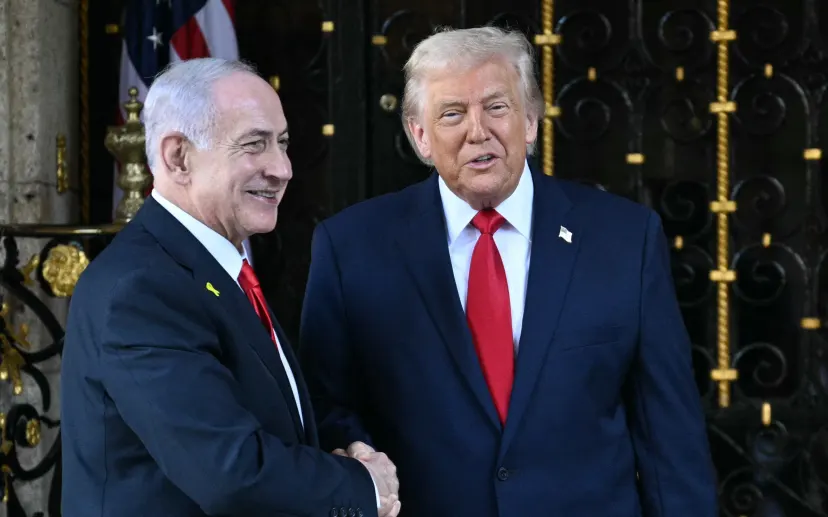
Israeli Prime Minister Benjamin Netanyahu boasted of his endorsement from Donald Trump on the eve of Israel’s election, suggesting the two leaders could restart their war against Iran if he wins, after Trump said they should “finish the job”.
“US President Donald Trump has come with a friendship that has never existed before between an Israeli prime minister and an American president. And it is doubtful we will ever have such a friendly president again,” Netanyahu said in a televised appearance late on Sunday night. “He has another two years, and he says he is calling on you to vote for me.”
In his own social media post on Sunday, Trump, who launched the Iran war jointly with Netanyahu in February, said: “Vote for Bibi Netanyahu for Prime Minister, we have to finish the job that we started!”
Netanyahu said Trump was willing to take action “that would finally, finally, remove the Iranian threat”, but only as long as Netanyahu himself remains in power.
“And I have already instructed the Mossad and the IDF (military) to bring down this regime, to bring down this regime because that is the only way to put an end to this threat,” Netanyahu said, referring to Israel’s main intelligence service and military.
Asked for comment on Netanyahu’s remarks, White House Deputy Press Secretary Anna Kelly said: “As President Trump stated, Iran is in very bad condition, both economically and militarily, and the blockade will remain in full force and effect, with oil flowing in record numbers of barrels through the Hormuz Strait.”
“The United States will not be attacking Iran at any time prior to the midterm elections,” Kelly added via email, referring to the November 3 vote in the US.
Netanyahu’s leading opponent, centrist former military Chief of Staff Gadi Eisenkot, posted his own comments on social media, praising Trump as “a true friend of Israel”.
“I value his efforts and his commitment to Israel’s security, and I am confident that he will work in full cooperation with any leader chosen by the people.”
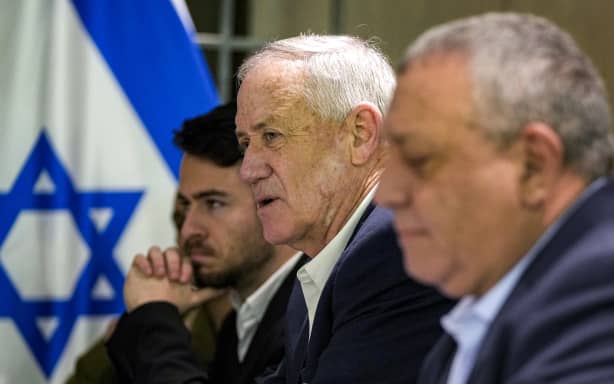
Mark Schiefelbein / POOL / AFP
Eisenkot accuses Netanyahu of fear-mongering
Tuesday’s vote, Israel’s first since the October 7, 2023, Hamas attacks, is the first chance for voters to deliver a verdict on the worst security failure in generations and the wars on multiple fronts that followed.
With Netanyahu already at the helm of the most right-wing government in Israeli history, politics have shifted even further to the right. Nearly all Jewish-led parties, including that of the hawkish Eisenkot, now oppose the “two-state solution” that underpinned decades of peace negotiations with the Palestinians.
But many voters say the divisive politics of Israel’s longest-serving leader make the country weaker. Polls suggest Netanyahu’s Likud Party will lose seats, potentially depriving his coalition of right-wing, far-right and ultra-Orthodox parties of its narrow majority.
Eisenkot and an array of opposition parties ranging from the rump of the centre-left to the right, also have no clear path to unseat him.
Netanyahu, 77, is an unrivaled master of political survival: the only time since 2009 that opponents managed to wrest him briefly from the premiership, it took four inconclusive elections within two years to get him out. He was back 18 months later.
Neither side planned major public events for Monday. But both posted on social media, drumming on the election’s major themes: for Netanyahu, that he is the only leader with the mettle to face down Israel’s enemies; for his opponents, that his divisive politics have weakened the country.
Netanyahu shared an AI-generated video on Monday of Iran’s Supreme Leader Ayatollah Mojtaba Khamenei, whose father Ali Khamenei was killed on the first night of US-Israeli strikes on Iran in February. Lying in a hospital bed, the younger Khamenei says his own vote would be “definitely not Bibi. Another term like this and I will be meeting my father sooner than expected.”
On Sunday Netanyahu posted a computer-generated photo of a mushroom cloud over Tel Aviv, saying Israel was in existential danger from Iran.
Eisenkot responded by accusing him of “relying on a campaign of fear-mongering, lies, and threats – including images of nuclear bombs in the heart of Tel Aviv. This time, it won’t work for him.”
Trump’s endorsement of Netanyahu carries its own political risks a week before a legislative election in which his own Republicans are seeking to hold onto power.
The Iran war is deeply unpopular in the United States, blamed for a surge in prices especially for fuel. Major fighting has been suspended for months after ceasefire negotiations held without Israeli participation.
Source: Reuters & RNZ


Police say person who fired gun at officers still at large

New Zealand sides named for RLWC finals

Parliamentary Service working on extra chairs and offices for increased number of MPs


-

 Latest News2 months ago
‘Chilling’: Business groups speak out against National’s supermarket break-up plan
-

 NZ News2 months ago
Tom Phillips report: The missed opportunities to find the children
-

 Politics2 months ago
National vows to try to split Pak’nSave and New World
-

 Latest News2 months ago
Cars bearing Chinese police markings stir unease in Auckland
-

 Fiji News2 months ago
Plans to have new Constitution by Dec 24th 2026
-

 NZ News2 months ago
Cop who stole $68,000 can now be named as champion Muay Thai fighter Haimona Tamati-Te Paki
-

 Politics2 months ago
MBIE confirms botched biometric projects costs blown out to $50.7 million
-

 Latest News2 months ago
Five Karangahape Road venues lose their liquor licences after police intervention