

Latest News
KiwiRail urged to implement automatic stops for trains that run red lights after near-miss

An investigation into a near miss after a train driver ran through multiple stop signals while using his mobile phone has exposed a nationwide issue, accident investigators say.
A report released Thursday into the 2024 incident at Kereone, near Morrinsville, on the East Coast Main Trunk line found the freight train avoided collliding with another vehicle by three and a half minutes.
The Transport Accident Investigation Commission (TAIC) has called on KiwiRail to implement engineering controls that would stop trains automatically if they run red stop signals.
It said controls were already in place in some parts of the country, but had not been adopted nationwide.
The rate of Signal Passed At Danger (SPAD) incidents – where stop signals were not obeyed – across KiwiRail’s network had risen to 3.2 SPADs per million kilometres in 2025, compared to KiwiRail’s own benchmark of 1 SPAD per million kilometres, TAIC’s report said.
Records showed the rate had nearly tripled from 1.2 per million in 2020.
The commission called for stronger action from KiwiRail, the New Zealand Transport Agency (NZTA) and the Ministry of Transport to address the high rate of SPADs.
TAIC’s chief investigator of accidents Louise Cooke said while there was evidence to suggest the driver was distracted by their mobile phone, the report was about a lot more than just distraction.
“It’s about distraction meeting a system when there’s just no safety backstop.”
Rules and procedures alone were not enough to prevent accidents, she said.
“People will make mistakes – that’s human nature – so the system must stop those mistakes before they turn into an accident.”
The near miss happened after the freight train, hauling 39 wagons, left Ruakura in Hamilton shortly after 11am, on its way to Tauranga.
Around 15 mins later, a hi-rail vehicle – a vehicle fitted wth retractable wheels that can travel on both road and rail – applying grease to railway lines, entered the tracks, travelling from Waharoa to Kereone.
At about 11.40am, the hi-rail arrived at Kereone station, entered the crossing loop – a section of double track allowing trains travelling in opposite directions to pass each other – as arranged with train control.
The approaching freight train drove past a stop signal, entering Kereone station’s main line, narrowly avoided a collision with the hi-rail truck, then passed a second stop signal, entering the next section of track without authorisation from train control, who eventually raised the locomotive engineer on the radio and had him stop the train, more than two kilometres past the initial stop signal.
After stopping, the driver said he had seen “normal clear signals”, but testing found the signals were working correctly, there was nothing blocking the view, no mechanical issues, equipment faults, power outages or issues with the VHF radio system.
The commission concluded it was “virtually certain” the system was working correctly and the signals were red when the train passed, but the engineer had incorrectly interpreted them to be at ‘proceed’ instead of ‘caution to stop’ and ‘stop’.
The locomotive engineer had been employed by KiwiRail since August 2022. They completed their certification in May 2024, and passed a routine safety test in July 2024, a month before the incident.
The investigation found the engineer had sent and recieved text messages – breaking KiwiRail rules – moments after two radio conversations between the hi-rail driver and train control, and was tooting his horn at a passerby while adjusting his speed during a third radio conversation as he passed another signal.
TAIC said administrative controls were inherently vulnerable to human error or rule breaking.
Complex systems like rail transport needed engineering controls – controls built into the design of the system, like technologies that could automatically slow or stop trains that went through stop signals – the report stated.
KiwiRail’s risk controls were largely administrative, and those areas that did have engineering controls were still reliant on human performance, TAIC said.
Engineering safety systems, such as the European Train Control System (ETCS), Train Stop Protections and geofenced track limits, which monitored speeds, relayed information and automatically stopped or slowed trains operated in some parts of the country, but were not in place across KiwiRail’s network.
Nor were there engineering controls installed on KiwiRail’s hi-rail or track maintenance vehicles.
The commission recommended KiwiRail install engineering safety controls across its network.

Kiwirail chief operations officer Duncan Roy. Photo: RNZ / Marika Khabazi
Kiwirail chief operations officer Duncan Roy said it was considering TAIC’s recommendation.
“We are always looking at ways to increase safety in our operations and we have a well-established programme of work underway to mitigate SPAD incidents.”
The commission also recommended NZTA increased its monitoring of KiwiRail’s high SPAD ratio.
NZTA told the commission it was already undertaking routine monitoring and that Kiwirail’s SPAD performance was “under ongoing review at NZTA’s highest levels”, which meant the recommendation was not necessary.
But Cooke said the Ministry of Transport accepted the recommendation to ensure NZTA was fulfilling its safety oversight role.
“The Ministry of Transport, in their response, say they do have safety concerns around NZTA’s performance to ensure the safety of the system,” Cooke said.
The ministry told TAIC the Minister of Transport had sought the NZTA board’s assurance in writing that it had adequate transparency and oversight of the agency’s rail safety regulatory functions.
It said the ministry would conduct a rail safety a reviewlooking at whether the regulatory system had kept pace with changing contexts, whether it was achieving intended outcomes and whether those outcomes were still fit for purpose, along with recommendations for change.
The ministry said the review had been been prompted by “several safety concerns” and performance matters raised by the Minister of Transport, TAIC, the rail safety regulator and the industry, including the frequency of SPAD incidents, and “unanswered questions about whether the current system and delivery of functions represent value for money”.
TAIC had no powers to enforce recommendations, Cooke said.
KiwiRail told the commission a SPAD mitigation programme focused on Auckland metro rail was underway and would be rolled out to its wider network, as well as a project to look at engineering solutions for hi-rail vehicles.
TAIC was concened the roll out was not happening fast enough, Cooke said.
“There are many engineering controls that could be put in place now to prevent a situation where a driver makes a mistake and it turns into an accident.”
It was frustrating to have to repeat the same recommendations found in earlier incidents, especially when the consequences were so great, she said.
In 2023, KiwiRail’s Hamilton to Auckland passenger train service Te Huia was banned from entering Auckland after drivers ran through red signal lights on two occasions.
At the time, the subsequent TAIC report called for a common engineering solution to be put in place across KiwiRail services, Auckland One Rail and track contractors.
Auckland One Rail – which was contracted to operate Auckland’s commuter train services on behalf of Auckland Transport – had European Train Control System technology fitted on its trains and infrastructure, and had a far lower SPAD ratio, the commission found.
In February 2025, Auckland Transport chair Richard Leggat wrote to KiwiRail expressing serious concerns about SPAD incidents on the metro rail retwork, warning of the potential for “catastrophic incidents” and multiple fatalities.
The frequency of SPAD incidents involving Kiwirail’s trains required “urgent intervention”, and Leggat called on KiwiRail to accelerate its project to implement ETCS.
AT understood Kiwirail’s SPAD frequency rate on the Auckland network topped 10 per million kilometres between February 2024 and February 2025, compared to international levels of less than one to two events per million kilometres, the letter said.
rnz



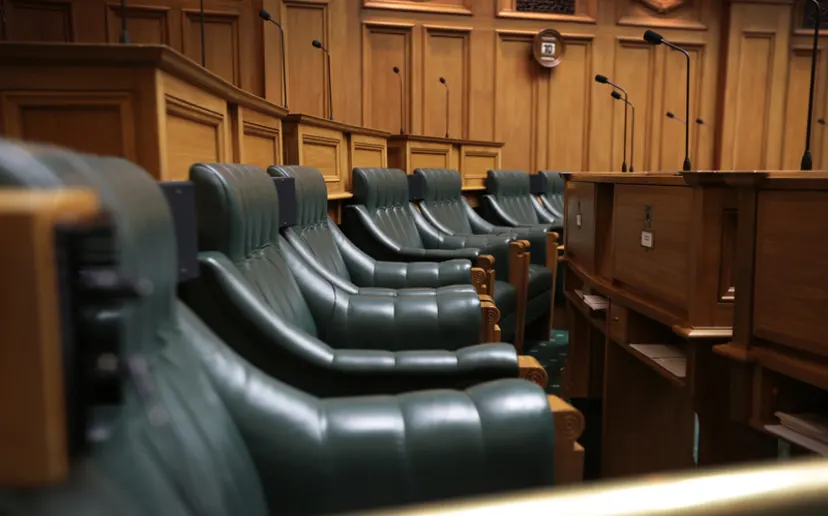
The chief executive of the Parliamentary Service is confident there will be enough room to accommodate the increased number of MPs and their staff coming into Parliament.
On current numbers, up to 131 MPs could be sitting in the Chamber following the election, brought on by a record overhang result.
Clerk of the House of Representatives Dr David Wilson told the Spinoff that currently the debating chamber had enough chairs to seat 124 MPs – including the Speaker of the House – and work was being done to accommodate more by altering the seating arrangement.
In a statement, Parliamentary Service chief executive Rafael Gonzalez-Montero said planning for a larger Parliament had been going for “some time”.
“Now that the election results have confirmed an increase to the number of members we are looking at several options.
“We are confident we will be able to accommodate all members within the Chamber.”
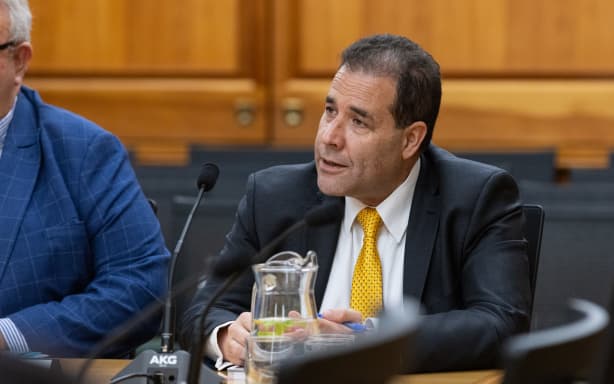
VNP / Phil Smith
Gonzalez-Montero said office accommodation for members and their staff would be “stretched” for a short time, but the new Members’ Building was only a few months away from “practical completion”.
That building – located behind Parliament – was due to be ready to occupy in April next year and had capacity to accommodate around 30 backbench MPs.
“All members should be in fit-for-purpose accommodation from that point,” Gonzalez-Montero said.
Following the 2023 election, 123 MPs sat in the Chamber – a record number at the time. That decreased to 122 following the resignation of National MP Judith Collins.
Collins held the seat of Papakura and stepped down in May and Parliament voted against holding a by-election because it was too close to the election.
The election result also meant high-ranking National Party MPs like Chris Bishop, Paul Goldsmith, Nicola Willis and Gerry Brownlee – Speaker of the House and an MP for 30 years – would likely not make it back into Parliament.
Only resigning or retiring MPs were permitted to give a valedictory speech meaning none of them would get the chance to give a valedictory statement.
Asked if their would be special allowances for valedictories, Wilson said in a statement that normally only MPs were allowed to speak in the House but the House could suspend its own rules or temporarily alter them.
“It could do so to allow former members to address the House.”
Wilson said no such arrangements could be made until the next Parliament opened and members sworn in.
rnz


Police say person who fired gun at officers still at large

New Zealand sides named for RLWC finals

Parliamentary Service working on extra chairs and offices for increased number of MPs


-

 Latest News2 months ago
‘Chilling’: Business groups speak out against National’s supermarket break-up plan
-

 NZ News2 months ago
Tom Phillips report: The missed opportunities to find the children
-

 Politics2 months ago
National vows to try to split Pak’nSave and New World
-

 Latest News2 months ago
Cars bearing Chinese police markings stir unease in Auckland
-

 Fiji News2 months ago
Plans to have new Constitution by Dec 24th 2026
-

 NZ News2 months ago
Cop who stole $68,000 can now be named as champion Muay Thai fighter Haimona Tamati-Te Paki
-

 Politics2 months ago
MBIE confirms botched biometric projects costs blown out to $50.7 million
-

 Latest News2 months ago
Five Karangahape Road venues lose their liquor licences after police intervention