

Latest News
Where does New Zealand’s fuel come from and how does it get here?

Until a few weeks ago you might have been forgiven for never thinking about where fuel comes from, other than the petrol station.
But given international uncertainty, a greater focus was going into what happens before you put the hose into your car at your local.
A global fuel crisis, limited supply and a sharp realisation Aotearoa sits at the bottom of the world, was being caused by the US and Israel’s ongoing war on Iran.
It’s hugely disrupted key supply chains and pushed Brent crude over $115 a barrel pushing the price at the pump up.
In New Zealand it’s created panic buying, huge queues and possibly even sabotage of an Auckland fuel line.

Firefighters work to contain a diesel leak in Auckland on Monday. Photo: Kim
But fuel had a long road to travel before it made it to New Zealand petrol stations.
Enroute to the shores of New Zealand, refined fuels sit in tankers, the biggest of them arriving at former refinery, Marsden Point.
The AA’s Terry Collins said as it’s a deep-water port, it could take the largest ships – up to 120 million litres.
There were nine other import terminals and two inland terminals in New Zealand – Wiri in Auckland and Woolston in Christchurch.
Mount Maunganui, Wellington and Lyttelton could receive medium-sized ships that carried 40 to 50 million litres of liquid fuels
Napier, New Plymouth, Nelson, Timaru, Dunedin and Bluff were the smaller regional terminals.
Collins said the tankers deliver the refined product from the ships to what is called ‘tank farms’ or storage tanks.
“You’ll see them perhaps Seaview in Wellington and Marston Point, obviously.
“They have big tanks, steel tanks, and generally what they do is they have what’s known as a sinking lid on them. That’s to contain the vapor as they go down.”
From here, fuel was sent around the country by road.
“They have a trucking system where the drivers turn up, pick up the fuel, and then deliver them to the service stations to be used in our vehicles.
“Depending on who they’re delivering to, a schedule of service stations where they drive around and discharge compartments of fuel, different fuel into each of the underground tanks and service stations.”
Or in the case of Marsden Point, fuel was sent through a special pipeline from Ruakaka to Auckland – ending up in the Wiri Terminal and Auckland Airport for further distribution.

Marsden Point. (File photo) Photo: RNZ / Peter de Graaf
“They’ll send down various products through the pipeline, but maybe diesel at one stage, maybe petrol at another.
“And that’s used to basically maintain the storage around the Auckland area, being the largest city in New Zealand.”
Collins said the storage tanks were like a dam with water flowing in and water flowing out.
“The level will go up and down, depending on how often the ships arrive and the shipping schedules.
“But the demand is usually fairly consistent, which is that flow out from it.”
Some fuel starts to go off after about three months, but Collins said that doesn’t happen because nothing sits for that long.
He reiterated it was not a good idea to store fuel for that very reason.
On top of the main and regional fuel terminals there were also smaller tankers that go rurally to farms and mining sites.
Refineries optimised for certain oil
Before the fuel even makes it to our shores, it must be refined.
Since the closure of the Marsden Point Oil Refinery in 2022, New Zealand imported all its refined fuel.
Before it’s refined, it starts off as crude oil, sourced mainly from the Middle East, particularly Saudi Arabia and the UAE.

An oil field in Saudi Arabia. (File photo) Photo: Reuters/CNN Newscource
Refineries in South Korea, Singapore and Malaysia need to get their hands on it before it can turn it into essential fuels (gasoline, diesel, jet fuel, heating oil), petrochemicals, and materials like plastics, rubber, asphalt.
New Zealand gets 80 percent of its fuel supply from just South Korea and Singapore.
However Collins said it’s not so simple, since the trouble in the Middle East takes away key supplies.
“Refineries aren’t all equal and oil isn’t all equal.
“We know it’s been a bit of a concern because they had been sourcing a lot from that market and because the refineries are optimized to use that type of fuel.”
He said it’s their decision where they get the crude oil from, but it may not be the kind that makes it the best for their refinery.
“Their decision is like asking the Kellogg’s company where they get their corn for their corn flakes.
“They need corn for their flakes, but some corn makes better cereal than others.”
rnz



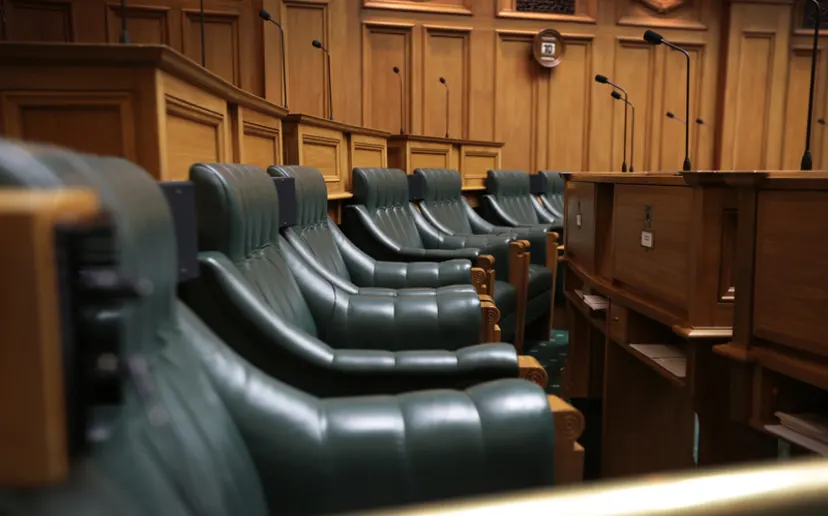
The chief executive of the Parliamentary Service is confident there will be enough room to accommodate the increased number of MPs and their staff coming into Parliament.
On current numbers, up to 131 MPs could be sitting in the Chamber following the election, brought on by a record overhang result.
Clerk of the House of Representatives Dr David Wilson told the Spinoff that currently the debating chamber had enough chairs to seat 124 MPs – including the Speaker of the House – and work was being done to accommodate more by altering the seating arrangement.
In a statement, Parliamentary Service chief executive Rafael Gonzalez-Montero said planning for a larger Parliament had been going for “some time”.
“Now that the election results have confirmed an increase to the number of members we are looking at several options.
“We are confident we will be able to accommodate all members within the Chamber.”
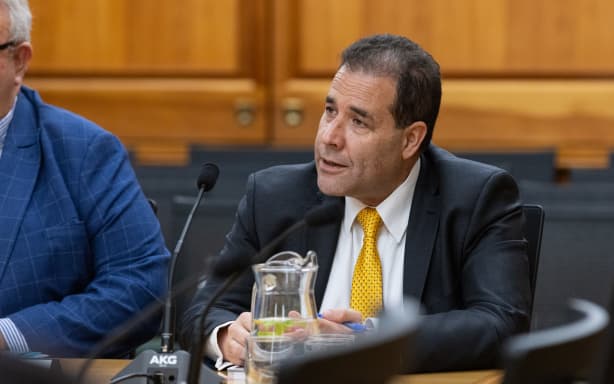
VNP / Phil Smith
Gonzalez-Montero said office accommodation for members and their staff would be “stretched” for a short time, but the new Members’ Building was only a few months away from “practical completion”.
That building – located behind Parliament – was due to be ready to occupy in April next year and had capacity to accommodate around 30 backbench MPs.
“All members should be in fit-for-purpose accommodation from that point,” Gonzalez-Montero said.
Following the 2023 election, 123 MPs sat in the Chamber – a record number at the time. That decreased to 122 following the resignation of National MP Judith Collins.
Collins held the seat of Papakura and stepped down in May and Parliament voted against holding a by-election because it was too close to the election.
The election result also meant high-ranking National Party MPs like Chris Bishop, Paul Goldsmith, Nicola Willis and Gerry Brownlee – Speaker of the House and an MP for 30 years – would likely not make it back into Parliament.
Only resigning or retiring MPs were permitted to give a valedictory speech meaning none of them would get the chance to give a valedictory statement.
Asked if their would be special allowances for valedictories, Wilson said in a statement that normally only MPs were allowed to speak in the House but the House could suspend its own rules or temporarily alter them.
“It could do so to allow former members to address the House.”
Wilson said no such arrangements could be made until the next Parliament opened and members sworn in.
rnz


Police say person who fired gun at officers still at large

New Zealand sides named for RLWC finals

Parliamentary Service working on extra chairs and offices for increased number of MPs


-

 Latest News2 months ago
‘Chilling’: Business groups speak out against National’s supermarket break-up plan
-

 NZ News2 months ago
Tom Phillips report: The missed opportunities to find the children
-

 Latest News2 months ago
Cars bearing Chinese police markings stir unease in Auckland
-

 Politics2 months ago
National vows to try to split Pak’nSave and New World
-

 Fiji News2 months ago
Plans to have new Constitution by Dec 24th 2026
-

 Politics2 months ago
MBIE confirms botched biometric projects costs blown out to $50.7 million
-

 NZ News2 months ago
Cop who stole $68,000 can now be named as champion Muay Thai fighter Haimona Tamati-Te Paki
-

 Latest News2 months ago
Five Karangahape Road venues lose their liquor licences after police intervention