

World
Donald Trump’s backtrack illuminates Iran’s leverage in an asymmetrical war

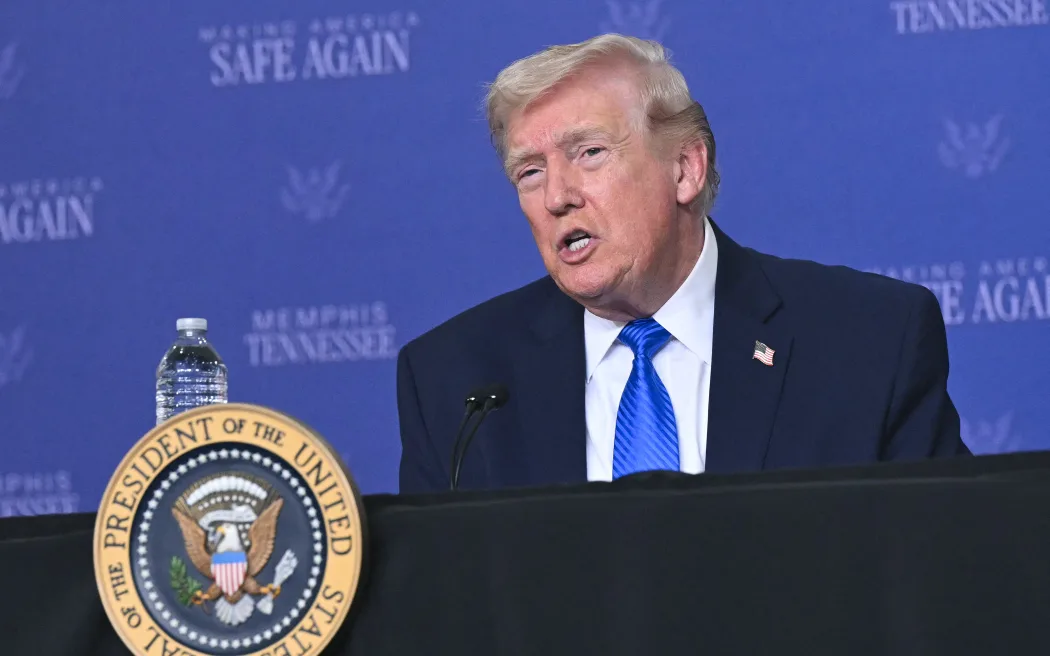
Analysis – The world has moved back from the brink of an escalated war in the Middle East – for five days, at least – but one new reality has emerged: Iran appears to have realised it has a power that can be wielded against the president of the United States.
In the battle between the US and Iran, US President Donald Trump has blinked: He has given Iran an additional five days to agree to reopen the Strait of Hormuz or else the US will begin bombing Iran’s power plants and energy infrastructure.
Trump is changing his rhetoric, appearing to acknowledge that he expects the theocracy to remain in control of Iran.
After he announced he was postponing any attack on power plants, he was asked who would control the strait in future.
“Maybe me!” he replied, adding: “Me and the ayatollah, whoever the ayatollah is.”
Iran has always known it has some leverage with the Strait of Hormuz. But until this war, it had not tested just how strong that leverage was.
Likewise, the US hadn’t realised the vulnerability of this thin strip of water – a passage just more than 30 kilometres across at its narrowest point, through which about 20 percent of the world’s oil flows.

A MarineTraffic map showing ship movements in the Strait of Hormuz . Photo: AFP / JONATHAN RAA
Securing the strait
In 2012, the US military permitted me to spend two days on the aircraft carrier USS John C Stennis as it patrolled in and around the Strait of Hormuz.
Its mission was clear: to make sure Iran could not close the strait.
It was obvious from talking to the captain at the time that no Iranian ship or boat had any chance of impeding oil tankers from travelling through the route.
But what was also apparent was that even the might of this huge aircraft carrier – with a capacity of 6500 officers and crew – could not prevent the Iranian military from installing various anti-ship missile systems along the Iranian coast near the strait.
No US carrier could police the strait 24 hours a day to ensure no mines were planted.
While Trump argues he is preparing a coalition of various countries to assist in ensuring free passage for ships through the strait, what he cannot guarantee is that insurance companies in Zurich, New York and London will give the approval for ships to travel through it in a time of conflict.
Even if Trump declares the strait safe, it is these insurance companies that will ultimately decide which oil tankers pass.
Iran knows, therefore, that if it creates enough doubt about safety, these insurance companies will avoid the risk and opt on the side of non-insurance, making any travel for most ships a non-starter.
The International Energy Agency’s website explains the significance of the Strait of Hormuz, saying it is “the primary export route for oil produced by Saudi Arabia, the UAE, Kuwait, Qatar, Iraq, Bahrain and Iran”.
“Apart from physically disrupting oil shipments from these countries, any prolonged disruption in the Strait of Hormuz could also render unavailable the vast majority of the world’s spare production capacity – most of which is held by Saudi Arabia,” it says.
“The bulk of the oil leaving the strait heads to Asian countries, with China, India and Japan being the main importers.”
In conventional military terms, Iran has taken a pounding from the US and Israel, and had it not been for the fact it has effectively closed the strait, it would have virtually no leverage.
In the early days of the conflict, when Trump was asked what a bad result would be, he said, for him, that would be the US carrying out a war and then Iran ending up with a leader more hardline than the former and now dead Ayatollah Ali Khamenei.
Well, Khamenei’s son, Mojtaba, is indeed seen as a more hardline leader. His father had approved negotiations with the US, including the nuclear deal done under then-president Barack Obama. This is something that his son is unlikely to ever have done.
Mojtaba Khamenei is much more a creature of the Islamic Revolutionary Guard Corps (IRGC), the hardline security machine that runs the country and is opposed to any deal with the US.

Mojtaba Khamenei, son of Iran’s former supreme leader Ayatollah Ali Khamenei, replaced his father on March 9, 2026. Photo: HAMED JAFARNEJAD / ISNA / AFP
An asymmetrical war
In terms of the military battle, this is an asymmetrical war. Iran is fighting this war indirectly. First, by attacking US allies in the Gulf, Iran is hoping these countries, whose economies are taking a major hit, will put pressure on Trump to stop the war.
And second, by effectively closing the strait, they are pushing up the price of oil, and therefore petrol, around the world.
This leverage is the reason Trump is feeling pressure. The rising petrol price in the US is causing a backlash against Republicans around the country.
One-time loyal Trump supporters such as Marjorie Taylor Greene, Steve Bannon, Tucker Carlson and Megyn Kelly are arguing Trump has abandoned his America First commitments to avoid foreign wars and assist working-class Americans with lower costs.
A subtext of this MAGA backlash – said explicitly by some – is that being America First means withdrawing unconditional support for Israel.
People such as Greene argue the US should not be providing billions of dollars in support each year to a country where the average Israeli has better health care than the average American.
Trump would be a mean poker player, and if he thinks he has an edge on his opponent, he wants to do more than win. He wants to crush.
And so when he issued his 48-hour ultimatum to Iran to open the Strait of Hormuz, he thought he had a much stronger hand.
But he underestimated Iran and it stared him down.
As long as Trump is in the White House the world is in for a wild ride, and his unpredictability is being highlighted by this war.
His language alone is loose and not at all presidential. He said, for example, that if a deal to open the Strait of Hormuz is not made in the next five days, the US will “keep bombing our little hearts out”.
Even for a president who has thrown out the rule book, this sort of language demeans the severity of the actions of the US and Israel, which, while it clearly is hitting many military targets, is also killing an unknown number of civilians.
“My life is a deal,” he said. “That’s all I do is deals.”
Later, he said: “My whole life has been a negotiation.”
“I would say at the end of this period, it could end up being a very good deal for everybody.”
Trump has said that the postponement of his threat was due to discussions with Iran. Asked who the US had been speaking to, he at one point said “a representative” and at another point “a top person”.
Iran’s official state news agency Fars denies any contact.
In many conflicts there will be back channels. Trump makes a valid point when he says that any Iranian leader talking to the US at the moment may not want anyone to know.
His life could be in danger from both hardliners inside Iran, who don’t want any end to a war they see themselves as winning, or from the US and Israel, who may later list this person as someone worth “eliminating”.
Trump now says the US and Iran have “major points of agreement”.
Certainly, in the short term, these words are more reassuring than his other rhetoric, such as “bombing our little hearts out”.
The US and Israel would argue that even if the war stopped now, it has seriously degraded Iran’s military apparatus and capability. Without question, more than three weeks of bombing military and paramilitary sites has weakened the regime.
The issue of how much enriched uranium Iran may have hidden remains a live one. If the US or Israel are able to locate where this material may be, they are likely to engage in special forces operations to try to seize it.
That could happen well after this war finishes. In fact, the Iranians will probably be less alert to such an operation than they are now.
So while Iran’s military capability has been seriously weakened in the short to medium term, in the longer term, the world now faces a new problem.
Iran now knows that it has a potent new weapon on the global stage: the ability to shut the Strait of Hormuz and hold the world’s oil supplies hostage.
– ABC

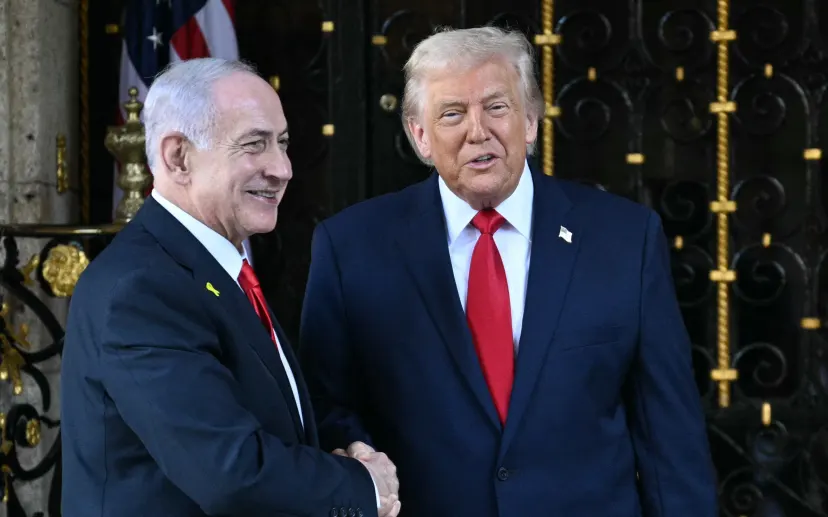
Israeli Prime Minister Benjamin Netanyahu boasted of his endorsement from Donald Trump on the eve of Israel’s election, suggesting the two leaders could restart their war against Iran if he wins, after Trump said they should “finish the job”.
“US President Donald Trump has come with a friendship that has never existed before between an Israeli prime minister and an American president. And it is doubtful we will ever have such a friendly president again,” Netanyahu said in a televised appearance late on Sunday night. “He has another two years, and he says he is calling on you to vote for me.”
In his own social media post on Sunday, Trump, who launched the Iran war jointly with Netanyahu in February, said: “Vote for Bibi Netanyahu for Prime Minister, we have to finish the job that we started!”
Netanyahu said Trump was willing to take action “that would finally, finally, remove the Iranian threat”, but only as long as Netanyahu himself remains in power.
“And I have already instructed the Mossad and the IDF (military) to bring down this regime, to bring down this regime because that is the only way to put an end to this threat,” Netanyahu said, referring to Israel’s main intelligence service and military.
Asked for comment on Netanyahu’s remarks, White House Deputy Press Secretary Anna Kelly said: “As President Trump stated, Iran is in very bad condition, both economically and militarily, and the blockade will remain in full force and effect, with oil flowing in record numbers of barrels through the Hormuz Strait.”
“The United States will not be attacking Iran at any time prior to the midterm elections,” Kelly added via email, referring to the November 3 vote in the US.
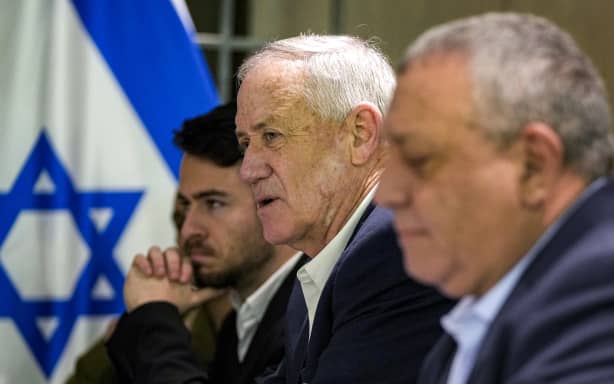
Netanyahu’s leading opponent, centrist former military Chief of Staff Gadi Eisenkot, posted his own comments on social media, praising Trump as “a true friend of Israel”.
“I value his efforts and his commitment to Israel’s security, and I am confident that he will work in full cooperation with any leader chosen by the people.”
Mark Schiefelbein / POOL / AFP
Eisenkot accuses Netanyahu of fear-mongering
Tuesday’s vote, Israel’s first since the October 7, 2023, Hamas attacks, is the first chance for voters to deliver a verdict on the worst security failure in generations and the wars on multiple fronts that followed.
With Netanyahu already at the helm of the most right-wing government in Israeli history, politics have shifted even further to the right. Nearly all Jewish-led parties, including that of the hawkish Eisenkot, now oppose the “two-state solution” that underpinned decades of peace negotiations with the Palestinians.
But many voters say the divisive politics of Israel’s longest-serving leader make the country weaker. Polls suggest Netanyahu’s Likud Party will lose seats, potentially depriving his coalition of right-wing, far-right and ultra-Orthodox parties of its narrow majority.
Eisenkot and an array of opposition parties ranging from the rump of the centre-left to the right, also have no clear path to unseat him.
Netanyahu, 77, is an unrivaled master of political survival: the only time since 2009 that opponents managed to wrest him briefly from the premiership, it took four inconclusive elections within two years to get him out. He was back 18 months later.
Neither side planned major public events for Monday. But both posted on social media, drumming on the election’s major themes: for Netanyahu, that he is the only leader with the mettle to face down Israel’s enemies; for his opponents, that his divisive politics have weakened the country.
Netanyahu shared an AI-generated video on Monday of Iran’s Supreme Leader Ayatollah Mojtaba Khamenei, whose father Ali Khamenei was killed on the first night of US-Israeli strikes on Iran in February. Lying in a hospital bed, the younger Khamenei says his own vote would be “definitely not Bibi. Another term like this and I will be meeting my father sooner than expected.”
On Sunday Netanyahu posted a computer-generated photo of a mushroom cloud over Tel Aviv, saying Israel was in existential danger from Iran.
Eisenkot responded by accusing him of “relying on a campaign of fear-mongering, lies, and threats – including images of nuclear bombs in the heart of Tel Aviv. This time, it won’t work for him.”
Trump’s endorsement of Netanyahu carries its own political risks a week before a legislative election in which his own Republicans are seeking to hold onto power.
The Iran war is deeply unpopular in the United States, blamed for a surge in prices especially for fuel. Major fighting has been suspended for months after ceasefire negotiations held without Israeli participation.
Source: Reuters & RNZ


Police say person who fired gun at officers still at large

New Zealand sides named for RLWC finals

Parliamentary Service working on extra chairs and offices for increased number of MPs


-

 Latest News2 months ago
‘Chilling’: Business groups speak out against National’s supermarket break-up plan
-

 NZ News2 months ago
Tom Phillips report: The missed opportunities to find the children
-

 Politics2 months ago
National vows to try to split Pak’nSave and New World
-

 Latest News2 months ago
Cars bearing Chinese police markings stir unease in Auckland
-

 Fiji News2 months ago
Plans to have new Constitution by Dec 24th 2026
-

 NZ News2 months ago
Cop who stole $68,000 can now be named as champion Muay Thai fighter Haimona Tamati-Te Paki
-

 Politics2 months ago
MBIE confirms botched biometric projects costs blown out to $50.7 million
-

 Latest News2 months ago
Five Karangahape Road venues lose their liquor licences after police intervention