

NZ News
‘No need to panic’, fuel supplier says as average petrol price surges past $3

Drivers are being urged not to panic-buy fuel amid going concerns about rising prices.
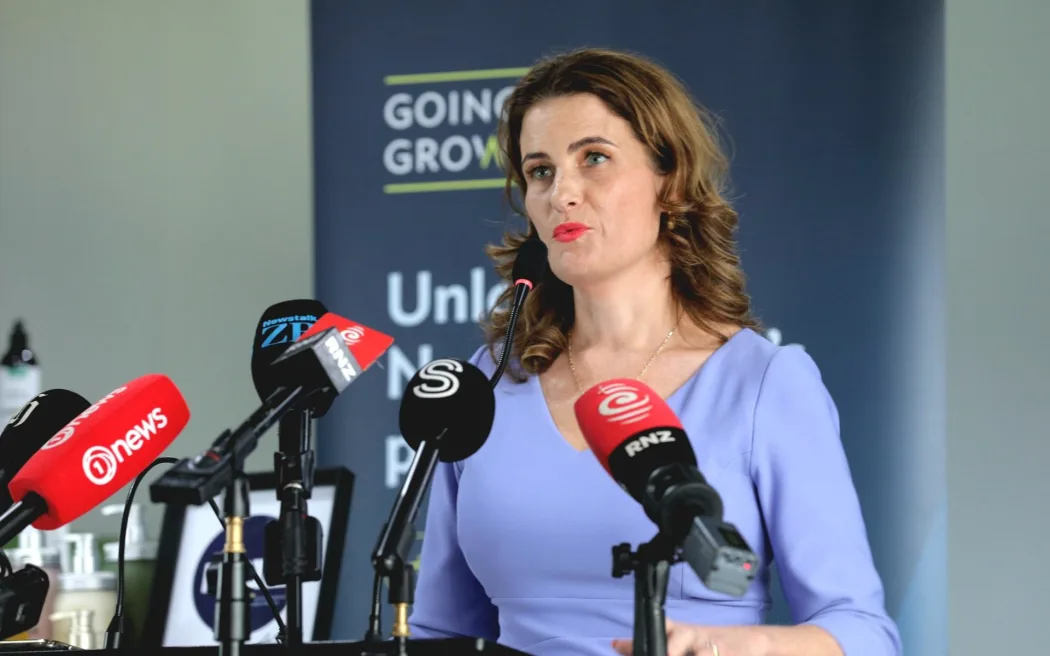
Meanwhile, Finance Minister Nicola Willis stands by her government’s decision to stop the electric car rebate scheme, as she looks at how the government could respond to rising prices.
Petrol stations across the country are seeing a surge of drivers filling up as petrol prices rise.
Petrol price monitoring app Gaspy says the average price of 91 petrol is now above $3 and has risen 20 percent since the start of the month.
Spokesperson Mike Newton said the average national price at the start of March was about $2.50 per litre.
He said it had been rising quickly.

Petrol has tipped over the $3 a litre mark in some areas. Photo: RNZ / Dan Cook
The rise in prices was largely due to the conflict in the Middle East.
US President Donald Trump is calling for countries to send ships to secure the Strait of Hormuz, which is effectively closed as Iran launches attacks to halt maritime traffic.
The area is critical because around 20 percent of the world’s oil consumption or 20 million barrels a day, usually passes through it.
It’s resulted in several petrol stations running dry over the weekend.
Newton said most of the petrol stations running low on gas seemed to be Gull.
“It’s not a supply problem, they have plenty of fuel in the tanks. It’s just they have to get it into the tankers and get it to the stations. Hopefully we’ll start to see that be alleviated in the next couple of days.”
He said the average price was now just 6c away from the level it reached when the Government cut the fuel excise tax, after the Russian invasion of Ukraine.
“We’re starting to get into that territory and this government has said they’re less interested in doing that… so it’ll be interesting to see when the pressure starts to build.”
Finance Minister Nicola Willis told Morning Report the government was carefully monitoring fuel stock levels.
New Zealand has around 32 days’ worth of fuel in the country and 25 days in ships on the way to the country.
“There is no current issue with the availability of fuel,” Willis said. “Were that to be the case, we would get very good forewarning because we would be aware of fuel companies reporting to us that orders had been disrupted or cancelled. They have not made any reports of that sort to us at this stage.
If we got that warning, Willis said we would have several weeks to plan for it.
“This is why we have these minimum stock holdings in the country, so we don’t get ourselves into a panic situation.”
She said the government hasn’t needed to review its sanctions on Russian-origin oil.
“This is, obviously, an event that is unfolding; if there are changes in that position, we will review them when they occur.”

Demand at Waitomo petrol stations has increased by 15 percent. Photo: RNZ/Nikki Mandow
Waitomo CEO Simon Parham said demand at the company’s petrol station has increased by about 15 percent.
“We’ve had the odd run out from here and there, but it’s really been for a maximum of 30 minutes,” he told Morning Report.
“What we are seeing is that increase in demand, coupled with a very stressed driver system, anything from a delay at the terminal to a truck breaking down, it’s just caused that slight delay in he system, so you have a slight run out.
“There’s nothing to worry about.”
He expects to see the demand soften.
“We’re still in good shape… There’s no need to panic. Yes, we are suffering from high prices, which is tough on everyone, but there is no need to panic at the moment.”
He said if the cargo orders can’t be placed, that’s when New Zealand may need to look at managing stock.
“If we are staying around that 50-day mark, that’s a rolling 50 days, then we’re fine. If we start to see that drop back, then that’s when we have to manage stock,” Parham said.
Westpac chief economist Kelly Eckhold said next month will be very difficult if things don’t improve.
“The refiners in Asia are going to run out of feed stocks to be able to continue to produce at the levels we are used to,” he said.
“I think if we are sitting here in mid-April and things haven’t improved, I think we will be looking at the possibility that everybody is just going to have to rein things in a bit.”
Brent crude has been sitting around US$100 a barrel, but if it reaches US$150 a barrel, Eckhold said that’s when the real damaging impacts on businesses and consumers would be seen.
She said she was closely looking at the cost of living impacts the rise in fuel prices has on lower-income working New Zealanders.

Finance Minister Nicola Willis said the government was carefully monitoring fuel stock levels. Photo: RNZ / Samuel Rillstone
“When the petrol prices go up this much, that has an effect on the cost of living, particularly for working New Zealanders who use their cars to get to work. We are very conscious of that and are considering whether a government response is warranted,” Willis said.
Willis stands by her government’s decision to remove the electric vehicle rebate.
She said the rebate was very untargeted.
“I simply don’t accept the idea that giving subsidies to millionaires in Remuera would help those afflicted by high petrol prices,” Willis said.
She said if the government were to give support, it would be targeted, temporary and timely.
Willis said she has not taken advice to Cabinet yet on these matters.
The owner of a bus company said more people could opt for public transport over private vehicles.
Kiwi Coaches owner Dayton Howie told Morning Report petrol price rises were cutting into margins.
He said the costs were currently being absorbed, but it was unclear how long that could last.
Howie said students could miss out on school trips if fuel prices keep going up.
Source: RNZ



Latest News
Opportunities to mitigate multi-million-dollar RNZ budget blowout likely missed – experts

Multiple opportunities to identify and mitigate a multi-million-dollar budget blowout at RNZ appear have been missed, according to the former executive director at Audit New Zealand.
The public broadcaster on Monday revealed a near $12 million shock financial loss after a litany of financial blunders, which will now lead to sweeping job cuts.
The $11.8m loss is more than 25 times the $470,000 RNZ had expected to lose over the year to June.
CEO Paul Thompson took responsibility for the result, and said internal reports gave an inaccurate picture of the finances, meaning the scale of the loss only became clear in October.
RNZ’s former chief financial officer Hilary Parker resigned unexpectedly in early October.
The board said it would commission an independent review into what went wrong.
Independent contractor Stephen Walker, who left the Audit Office earlier this year, said the size of the loss was surprising, as was the length of time it took to identify it – months after the financial year ended.

Supplied / OAG
“Probably more of a concern is that they had seemingly been unaware that they were running up a significant deficit until they were in the preparation stage of their annual report in October.”
Walker said public entities typically produced monthly financial reports.
An interim audit also took place before the end of the financial year, he said, but if the organisation hadn’t identified significant losses at that stage, the auditor could also be in the dark.
“It seems that there’s a real weakness in forecasting and budgeting that’s occurred here and that the monthly accounts, when they’re produced, either haven’t identified these significant variances against budget or the magnitude of them really hasn’t come to light until right towards the end of the financial year,” Walker said.
“And really at that point, there’s no opportunity for the chief executive, the leadership team to take, and the board to take, any corrective action because the year has effectively been completed.”
Walker said the “significant miss” was difficult to account for given it was more than 10 percent of RNZ’s total funding.
He said based on RNZ’s annual report, financial complexity didn’t appear to be a factor.
“This $11.8m loss isn’t made up of one particular item … it seems to have been contributed to by a number of separate expense lines running over budget. So I don’t think it’s necessarily to do with complexity.”
Among the errors, RNZ wrongly counted $2m from land sales as income in its budget. Staff costs also came in $3.2m over budget, including $1.4m in redundancy payments.
Professor at Auckland University’s business school Norman Wong said based on media reports the issues identified were “significant and troubling”.

Supplied / University of Auckland
“But recognising the sale of land as income in their budget is a basic error that one would have expected to have been caught and corrected well before it got to this point.”
With funding reductions at RNZ over the past two years, Walker expected greater scrutiny of financial results.
“Virtually every public entity has had their annual budget reduced. And so you would expect … the leadership team on a monthly basis and board – I’m not sure how frequently the board will consider the information – but you would expect them to be interrogating the results on a regular basis throughout the year,” he said.
Walker said initiating an independent review was the correct course of action and that he’d want to understand what information the leadership team and the board were regularly receiving.
He said he’d “love to say” surprising financial results were rare, but conceded they occured on a semi-frequent basis during his time leading the Audit Office.
“The benefit of independent scrutiny by the Audit Office – and the auditors providing that support to the Auditor General – [is] that the reporting is fairly presented at the end of the year, whether it’s good, bad or ugly.”
rnz


Police say person who fired gun at officers still at large

New Zealand sides named for RLWC finals

Parliamentary Service working on extra chairs and offices for increased number of MPs


-

 Latest News2 months ago
‘Chilling’: Business groups speak out against National’s supermarket break-up plan
-

 NZ News2 months ago
Tom Phillips report: The missed opportunities to find the children
-

 Latest News2 months ago
Cars bearing Chinese police markings stir unease in Auckland
-

 Politics2 months ago
National vows to try to split Pak’nSave and New World
-

 Fiji News2 months ago
Plans to have new Constitution by Dec 24th 2026
-

 Politics2 months ago
MBIE confirms botched biometric projects costs blown out to $50.7 million
-

 NZ News2 months ago
Cop who stole $68,000 can now be named as champion Muay Thai fighter Haimona Tamati-Te Paki
-

 Latest News2 months ago
Five Karangahape Road venues lose their liquor licences after police intervention